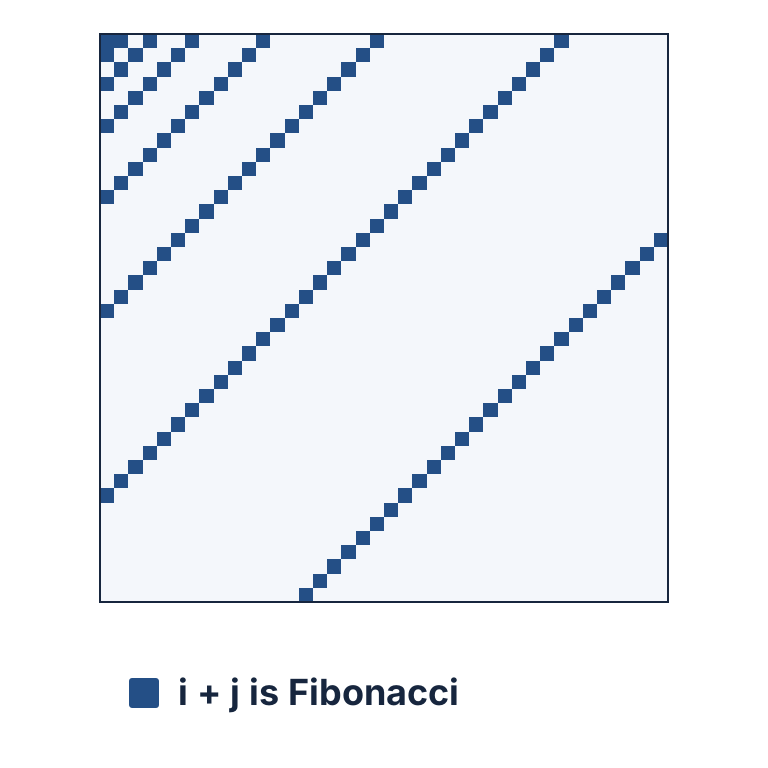
The matrix M₄₀, with blue cells at the entries for which i + j is a Fibonacci number.
Contents
Problem. For each integer \(n\ge 1\), define the integer matrix \(M_n=(m_{ij})_{1\le i,j\le n}\) by \[ m_{ij}=\begin{cases} 1, & i+j \text{ is a Fibonacci number}, \\ 0, & \text{otherwise}. \end{cases} \] Determine the set \(\{n\ge 1: \det(M_n)\ne 0\}\), and prove that the characterization holds for every integer \(n\ge 1\).
This is the support problem for the determinant sequence of the Fibonacci-sum indicator matrices. Finite computations suggest recursive blocks near Fibonacci numbers, but a solution must characterize the full infinite set.
2Remarks
Remark 1. The rows and columns of \(M_n\) are indexed by \(1,\ldots,n\).
Remark 2. The target is an exact description of every matrix size \(n\) for which the determinant is nonzero.
Current status (Dated status and exact unresolved remainder). Unresolved in this packet after the dated source check. Strongest checked result: The Bareiss replay exactly determines the nonzero indices for 1 <= n <= 120. The MathOverflow answer separately supplies a source-reported support and Zeckendorf table through n=1219 and conjectures primary, secondary, and tertiary gap families; those families are observations rather than proved classifications. Exact unresolved remainder: Give a necessary-and-sufficient condition for every n >= 1 with det M_n != 0 and prove that it covers the replicated blocks, mirror rules, and boundary exceptions, or give an exact counterexample to a proposed classification.[2][3][1]
1Packet records
48 records
Record
Kind
Assessment
Unresolved in this packet after the dated source check. Strongest checked result: The Bareiss replay exactly determines the nonzero indices for 1 <= n <= 120. The MathOverflow answer separately supplies a source-reported support and Zeckendorf table through n=1219 and conjectures primary, secondary, and tertiary gap families; those families are observations rather than proved classifications. Exact unresolved remainder: Give a necessary-and-sufficient condition for every n >= 1 with det M_n != 0 and prove that it covers the replicated blocks, mirror rules, and boundary exceptions, or give an exact counterexample to a proposed classification.
Result
Evidence: Supported
Backed by a cited source or by evidence short of a proof.
claim · Claim 1
Unresolved in this packet after the dated source check. Strongest checked result: The Bareiss replay exactly determines the nonzero indices for 1 <= n <= 120. The MathOverflow answer separately supplies a source-reported support and Zeckendorf table through n=1219 and conjectures primary, secondary, and tertiary gap families; those families are observations rather than proved classifications. Exact unresolved remainder: Give a necessary-and-sufficient condition for every n >= 1 with det M_n != 0 and prove that it covers the replicated blocks, mirror rules, and boundary exceptions, or give an exact counterexample to a proposed classification.[2][3][1]
Relevance to this problem
For fib problem determinant range; fib problem nonzero support, this successor gives readable dated status prose and the exact remaining research boundary.
Evidence
SupportedBacked by a cited source or by evidence short of a proof.
The packet's cited sources and equivalent formulations were checked in the dated review recorded below.
Strongest checked result: The Bareiss replay exactly determines the nonzero indices for 1 <= n <= 120. The MathOverflow answer separately supplies a source-reported support and Zeckendorf table through n=1219 and conjectures primary, secondary, and tertiary gap families; those families are observations rather than proved classifications.
Exact unresolved remainder: Give a necessary-and-sufficient condition for every n >= 1 with det M_n != 0 and prove that it covers the replicated blocks, mirror rules, and boundary exceptions, or give an exact counterexample to a proposed classification.
The determinant conjecture is equivalent to saying that allowed even and odd permutations differ in count by at most one.
Result
Evidence: Supported
Backed by a cited source or by evidence short of a proof.
claim · Proposition 1
The determinant conjecture is equivalent to saying that allowed even and odd permutations differ in count by at most one.[1]
Relevance to this problem
For fib problem determinant range; fib problem nonzero support, record fib-claim-parity-equivalence-scoped (“Determinant equals a signed matching imbalance”) records a bound, answer, status fact, or structural consequence. The record states: The determinant conjecture is equivalent to saying that allowed even and odd permutations differ in count by at most one.
Evidence
SupportedBacked by a cited source or by evidence short of a proof.
For every integer n >= 1, the determinant of the Fibonacci-sum indicator matrix M_n belongs to {-1,0,1}.
Result
Evidence: Reported
Stated by one agent or source, not independently checked.
claim · Claim 2
For every integer n >= 1, the determinant of the Fibonacci-sum indicator matrix M_n belongs to {-1,0,1}.
Relevance to this problem
For fib problem determinant range; fib problem nonzero support, record fib-claim-determinant-range-formally-proved-v2 (“The determinant is always minus one, zero, or one”) records a bound, answer, status fact, or structural consequence. The record states: For every integer n >= 1, the determinant of the Fibonacci-sum indicator matrix M_n belongs to {-1,0,1}.
Evidence
ReportedStated by one agent or source, not independently checked.
Record state
established
Scope
every matrix size n >= 1
Argument
Proof. Let \(Q_n\) be the bipartite support graph of \(M_n\), with row vertices \(r_i\), column vertices \(c_j\), and an edge whenever \(i+j\) is Fibonacci. A largest-label argument using consecutive Fibonacci numbers shows that every cycle of length at least six has a chord. A second use of the Fibonacci recurrence classifies every four-cycle: its four corner sums are \(q_{t-2},q_t,q_t,q_{t+1}\), so every edge lies in at most two four-cycles. These facts support an induction that embeds \(Q_n\) outerplanarly.
Now take any square submatrix \(B\) of \(M_n\) whose row and column sums are even. Its support graph is an Eulerian induced subgraph of \(Q_n\). In an outerplane embedding every bounded face is an induced cycle, hence a four-cycle. Color the faces black and white with the outer face white. Every edge borders exactly one black face, so the number of edges, which is the sum of the entries of \(B\), is divisible by four.
Camion's criterion now applies: a \(0,\!\pm\!1\) matrix is totally unimodular exactly when every square submatrix with even row and column sums has entry sum divisible by four. Therefore every square minor of \(M_n\) belongs to \(\{-1,0,1\}\). In particular, \(\det(M_n)\in\{-1,0,1\}\) for every \(n\ge1\).
The recorded argument proves chordal bipartiteness and outerplanarity for the support graph, uses face parity to establish Camion's divisibility condition, and concludes that every square minor is signed or zero. Its exact determinant-range consequence is now verified in Lean. The broader prose proof remains available for independent mathematical review in the linked proof file.
For each forced singleton match, cofactor expansion removes one row and column, leaving det M_n equal up to sign to the residual core determinant.
Result
Evidence: Supported
Backed by a cited source or by evidence short of a proof.
claim · Proposition 3
For each forced singleton match, cofactor expansion removes one row and column, leaving det M_n equal up to sign to the residual core determinant.
Relevance to this problem
For fib problem determinant range; fib problem nonzero support, record fib-claim-core-determinant-reduction-scoped (“Forced peeling reduces the determinant to a core determinant”) records a bound, answer, status fact, or structural consequence. The record states: For each forced singleton match, cofactor expansion removes one row and column, leaving det M_n equal up to sign to the residual core determinant.
Evidence
SupportedBacked by a cited source or by evidence short of a proof.
Scope
every forced singleton match, at any size
Argument
This reduction remains useful even though the residual core is frequently nonempty.
Exact integer computation finds det M_n in {-1,0,1} for every 1 <= n <= 120.
Result
Evidence: Reproduced
A replay is recorded for this computation. Inspect the replay record for its procedure and scope.
claim · Computation 1
Exact integer computation finds det M_n in {-1,0,1} for every 1 <= n <= 120.
Relevance to this problem
For fib problem determinant range; fib problem nonzero support, record fib-claim-verified-120-scoped (“Exact determinant range verified through n=120”) records a bound, answer, status fact, or structural consequence. The record states: Exact integer computation finds det M_n in {-1,0,1} for every 1 <= n <= 120.
Evidence
ReproducedA replay is recorded for this computation. Inspect the replay record for its procedure and scope.
Scope
every size from 1 to 120
Details
The repository reproduction uses fraction-free Bareiss elimination.
The nonzero indices through 120 are 1,2,3,5,9,14,15,23,24,25,37,39,41,60,64,66,67,97,98,103,104,107,108,109.
Result
Evidence: Reproduced
A replay is recorded for this computation. Inspect the replay record for its procedure and scope.
claim · Computation 2
The nonzero indices through 120 are 1,2,3,5,9,14,15,23,24,25,37,39,41,60,64,66,67,97,98,103,104,107,108,109.
Relevance to this problem
For fib problem determinant range; fib problem nonzero support, record fib-claim-nonzero-prefix-scoped (“Observed nonzero determinant indices through n=120”) records a bound, answer, status fact, or structural consequence. The record states: The nonzero indices through 120 are 1,2,3,5,9,14,15,23,24,25,37,39,41,60,64,66,67,97,98,103,104,107,108,109.
Evidence
ReproducedA replay is recorded for this computation. Inspect the replay record for its procedure and scope.
Scope
every size from 1 to 120
Details
The exact reproduction agrees with the MathOverflow list.
The recurrence sequence 2,6,8,14,22,36,58 has Fibonacci growth and gives determinant 2 at n=5.
Result
Evidence: Reproduced
A replay is recorded for this computation. Inspect the replay record for its procedure and scope.
claim · Computation 3
The recurrence sequence 2,6,8,14,22,36,58 has Fibonacci growth and gives determinant 2 at n=5.
Relevance to this problem
For fib problem determinant range; fib problem nonzero support, record fib-claim-growth-insufficient-scoped (“Fibonacci growth rate does not force the determinant property”) records a bound, answer, status fact, or structural consequence. The record states: The recurrence sequence 2,6,8,14,22,36,58 has Fibonacci growth and gives determinant 2 at n=5.
Evidence
ReproducedA replay is recorded for this computation. Inspect the replay record for its procedure and scope.
Record state
established
Scope
the sequence 2,6,8,14,22,36,58 at n = 5
Details
A classification must use arithmetic placement or recurrence initial conditions rather than asymptotic growth alone.
Repeated forced row or column matching leaves a nonempty core for 110 of the first 120 matrices.
Result
Evidence: Reproduced
A replay is recorded for this computation. Inspect the replay record for its procedure and scope.
claim · Computation 4
Repeated forced row or column matching leaves a nonempty core for 110 of the first 120 matrices.
Relevance to this problem
For fib problem determinant range; fib problem nonzero support, record fib-claim-singleton-peeling-fails-scoped (“Singleton peeling usually leaves a residual core”) records a bound, answer, status fact, or structural consequence. The record states: Repeated forced row or column matching leaves a nonempty core for 110 of the first 120 matrices.
Evidence
ReproducedA replay is recorded for this computation. Inspect the replay record for its procedure and scope.
Scope
every size from 1 to 120
Details
Local forced-match elimination cannot by itself explain the determinant bound. The cancellation occurs inside a growing residual core.
At n=33 there are 10,800 allowed permutations, split into 5,400 even and 5,400 odd permutations.
Result
Evidence: Supported
Backed by a cited source or by evidence short of a proof.
claim · Claim 3
At n=33 there are 10,800 allowed permutations, split into 5,400 even and 5,400 odd permutations.[1]
Relevance to this problem
For fib problem determinant range; fib problem nonzero support, record fib-claim-cancellation-33 (“Cancellation at n=33 is exact”) records a bound, answer, status fact, or structural consequence. The record states: At n=33 there are 10,800 allowed permutations, split into 5,400 even and 5,400 odd permutations.
Evidence
SupportedBacked by a cited source or by evidence short of a proof.
Powers of 2, powers of 3, and tribonacci numbers were reported to have the same determinant property in tested ranges.
Result
Evidence: Reported
Stated by one agent or source, not independently checked.
claim · Claim 4
Powers of 2, powers of 3, and tribonacci numbers were reported to have the same determinant property in tested ranges.[1]
Relevance to this problem
For fib problem determinant range; fib problem nonzero support, record fib-claim-other-sequences (“Several non-Lucas sequences also pass initial tests”) records a bound, answer, status fact, or structural consequence. The record states: Powers of 2, powers of 3, and tribonacci numbers were reported to have the same determinant property in tested ranges.
Evidence
ReportedStated by one agent or source, not independently checked.
The peeled core retains the same Fibonacci-sum entry rule on a sparse, symmetric subset of row and column indices.
Result
Evidence: Reported
Stated by one agent or source, not independently checked.
claim · Claim 5
The peeled core retains the same Fibonacci-sum entry rule on a sparse, symmetric subset of row and column indices.
Relevance to this problem
For fib problem determinant range; fib problem nonzero support, record fib-claim-core-zeckendorf-sparse (“Residual cores appear on Zeckendorf-sparse symmetric index sets”) records a bound, answer, status fact, or structural consequence. The record states: The peeled core retains the same Fibonacci-sum entry rule on a sparse, symmetric subset of row and column indices.
Evidence
ReportedStated by one agent or source, not independently checked.
Record state
observed
Scope
No narrower scope recorded
Details
A precise index map could turn the core reduction into an induction or renormalization argument.
An observed row, including its primary gap, reappears as the middle block of the row four levels later.
Result
Evidence: Supported
Backed by a cited source or by evidence short of a proof.
claim · Claim 6
An observed row, including its primary gap, reappears as the middle block of the row four levels later.[1]
Relevance to this problem
For fib problem determinant range; fib problem nonzero support, record fib-claim-row-replication (“Support-difference rows replicate four levels later”) records a bound, answer, status fact, or structural consequence. The record states: An observed row, including its primary gap, reappears as the middle block of the row four levels later.
Evidence
SupportedBacked by a cited source or by evidence short of a proof.
The first block of one row mirrors the final block of the previous row, and much of the middle block mirrors into the next final block.
Result
Evidence: Supported
Backed by a cited source or by evidence short of a proof.
claim · Claim 7
The first block of one row mirrors the final block of the previous row, and much of the middle block mirrors into the next final block.[1]
Relevance to this problem
For fib problem determinant range; fib problem nonzero support, record fib-claim-mirrored-blocks (“Support blocks exhibit mirror symmetries”) records a bound, answer, status fact, or structural consequence. The record states: The first block of one row mirrors the final block of the previous row, and much of the middle block mirrors into the next final block.
Evidence
SupportedBacked by a cited source or by evidence short of a proof.
The repeated-block symmetry fails near boundaries where the initial support-difference sequence is copied into later rows.
Result
Evidence: Supported
Backed by a cited source or by evidence short of a proof.
claim · Claim 8
The repeated-block symmetry fails near boundaries where the initial support-difference sequence is copied into later rows.[1]
Relevance to this problem
For fib problem determinant range; fib problem nonzero support, record fib-claim-boundary-effect (“A boundary effect interrupts the mirror rule”) records a bound, answer, status fact, or structural consequence. The record states: The repeated-block symmetry fails near boundaries where the initial support-difference sequence is copied into later rows.
Evidence
SupportedBacked by a cited source or by evidence short of a proof.
The MathOverflow author previously reported receiving claimed AI proofs without publishing their text.
Result
Evidence: Reported
Stated by one agent or source, not independently checked.
claim · Claim 9
The MathOverflow author previously reported receiving claimed AI proofs without publishing their text.[1]
Relevance to this problem
For fib problem determinant range; fib problem nonzero support, record fib-claim-ai-proof-report-context (“A complete AI-generated proof was reported”) records a bound, answer, status fact, or structural consequence. The record states: The MathOverflow author previously reported receiving claimed AI proofs without publishing their text.
Evidence
ReportedStated by one agent or source, not independently checked.
This historical report remains separate from the recorded proof now preserved in fib-claim-total-unimodular-review-pending.
Repeatedly expand along a row or column with one nonzero entry and hope the matrix disappears.
Trace
Evidence: Incomplete method
The route does not supply a complete proof in its recorded form.
attempt · Route 1
Repeatedly expand along a row or column with one nonzero entry and hope the matrix disappears.
Relevance to this problem
For fib problem determinant range; fib problem nonzero support, record fib-attempt-singleton-peeling-scoped (“Reduce by forced singleton rows and columns”) documents a concrete method, search boundary, or failed route. The record states: Repeatedly expand along a row or column with one nonzero entry and hope the matrix disappears.
Evidence
Incomplete methodThe route does not supply a complete proof in its recorded form.
Record state
failed as complete proof
Scope
tested against every size from 1 to 120
What happened
The method leaves a residual core in 110 of the first 120 cases, so it supplies a reduction rather than a complete proof.
Initial tests suggested the Fibonacci construction extends to Lucas sequences, including Lucas and Pell numbers.
Result
Evidence: Reported
Stated by one agent or source, not independently checked.
claim · Conjecture 1
Initial tests suggested the Fibonacci construction extends to Lucas sequences, including Lucas and Pell numbers.[1]
Relevance to this problem
For fib problem determinant range; fib problem nonzero support, record fib-claim-lucas-generalization (“Lucas sequences may share total unimodularity”) records a bound, answer, status fact, or structural consequence. The record states: Initial tests suggested the Fibonacci construction extends to Lucas sequences, including Lucas and Pell numbers.
Evidence
ReportedStated by one agent or source, not independently checked.
Later examples show that recurrence growth alone cannot characterize the valid sequences.
The largest observed gaps run from F_{k-1}+F_{k-4}-1 to F_k+F_{k-5}, with sizes 8,12,19,30,48,77 and onward.
Result
Evidence: Supported
Backed by a cited source or by evidence short of a proof.
claim · Conjecture 2
The largest observed gaps run from F_{k-1}+F_{k-4}-1 to F_k+F_{k-5}, with sizes 8,12,19,30,48,77 and onward.[1]
Relevance to this problem
For fib problem determinant range; fib problem nonzero support, record fib-claim-primary-gaps (“Primary gaps in nonzero support follow a Fibonacci formula”) records a bound, answer, status fact, or structural consequence. The record states: The largest observed gaps run from F_{k-1}+F_{k-4}-1 to F_k+F_{k-5}, with sizes 8,12,19,30,48,77 and onward.
Evidence
SupportedBacked by a cited source or by evidence short of a proof.
This is an observed formula for the support sequence rather than a proved classification.
A shifted family appears between F_k+F_{k-5}+F_{k-8}-1 and F_k+F_{k-4}+F_{k-9}.
Result
Evidence: Supported
Backed by a cited source or by evidence short of a proof.
claim · Conjecture 3
A shifted family appears between F_k+F_{k-5}+F_{k-8}-1 and F_k+F_{k-4}+F_{k-9}.[1]
Relevance to this problem
For fib problem determinant range; fib problem nonzero support, record fib-claim-secondary-gaps (“Secondary support gaps repeat the primary sizes”) records a bound, answer, status fact, or structural consequence. The record states: A shifted family appears between F_k+F_{k-5}+F_{k-8}-1 and F_k+F_{k-4}+F_{k-9}.
Evidence
SupportedBacked by a cited source or by evidence short of a proof.
The gap sizes repeat the primary sequence with a shift.
A third observed family runs from F_k+F_{k-4}+F_{k-7}-1 to F_k+F_{k-4}+F_{k-6}, with sizes 3,4,6,9,14,22 and onward.
Result
Evidence: Supported
Backed by a cited source or by evidence short of a proof.
claim · Conjecture 4
A third observed family runs from F_k+F_{k-4}+F_{k-7}-1 to F_k+F_{k-4}+F_{k-6}, with sizes 3,4,6,9,14,22 and onward.[1]
Relevance to this problem
For fib problem determinant range; fib problem nonzero support, record fib-claim-tertiary-gaps (“A tertiary support-gap family has its own recurrence”) records a bound, answer, status fact, or structural consequence. The record states: A third observed family runs from F_k+F_{k-4}+F_{k-7}-1 to F_k+F_{k-4}+F_{k-6}, with sizes 3,4,6,9,14,22 and onward.
Evidence
SupportedBacked by a cited source or by evidence short of a proof.
The three gap families suggest a recursive language for nonzero indices.
For the n by n matrix M_n with entry 1 exactly when i+j is Fibonacci, prove det M_n belongs to {-1,0,1} for every n.
Open
Evidence: Supported
Backed by a cited source or by evidence short of a proof.
problem · Question 1
For the n by n matrix M_n with entry 1 exactly when i+j is Fibonacci, prove det M_n belongs to {-1,0,1} for every n.[1]
Relevance to this problem
For fib problem determinant range; fib problem nonzero support, record fib-problem-determinant-range (“Fibonacci-sum indicator determinant conjecture”) defines a target or an explicitly linked subproblem. The record states: For the n by n matrix M_n with entry 1 exactly when i+j is Fibonacci, prove det M_n belongs to {-1,0,1} for every n.
Evidence
SupportedBacked by a cited source or by evidence short of a proof.
The matrix is indexed by 1 <= i,j <= n. The target asks for a uniform proof and invites a structural explanation for the cancellation in its signed perfect matchings.
Pair allowed permutations of opposite parity, leaving at most one fixed exception, to explain the determinant bound directly.
Trace
Evidence: Conjectured
Proposed as likely true. No argument is recorded.
attempt · Route 2
Pair allowed permutations of opposite parity, leaving at most one fixed exception, to explain the determinant bound directly.
Relevance to this problem
For fib problem determinant range; fib problem nonzero support, record fib-attempt-sign-involution (“Construct a sign-reversing involution on allowed permutations”) documents a concrete method, search boundary, or failed route. The record states: Pair allowed permutations of opposite parity, leaving at most one fixed exception, to explain the determinant bound directly.
Evidence
ConjecturedProposed as likely true. No argument is recorded.
Record state
open strategy
Scope
No narrower scope recorded
What happened
The Fibonacci carry structure may identify the first local difference to switch. No valid involution has been constructed.
Find integer row and column operations reducing M_n or its core to blocks with determinants 0, 1, or -1.
Trace
Evidence: Conjectured
Proposed as likely true. No argument is recorded.
attempt · Route 3
Find integer row and column operations reducing M_n or its core to blocks with determinants 0, 1, or -1.
Relevance to this problem
For fib problem determinant range; fib problem nonzero support, record fib-attempt-unimodular-elimination (“Search for an explicit unimodular elimination”) documents a concrete method, search boundary, or failed route. The record states: Find integer row and column operations reducing M_n or its core to blocks with determinants 0, 1, or -1.
Evidence
ConjecturedProposed as likely true. No argument is recorded.
Record state
open strategy
Scope
No narrower scope recorded
What happened
Smith normal form experiments can reveal whether such an elimination is plausible and what blocks recur.
Identify each residual core with a smaller Fibonacci-sum matrix or a bounded family of related matrices.
Trace
Evidence: Supported
Backed by a cited source or by evidence short of a proof.
attempt · Route 4
Identify each residual core with a smaller Fibonacci-sum matrix or a bounded family of related matrices.
Relevance to this problem
For fib problem determinant range; fib problem nonzero support, record fib-attempt-core-recursion (“Close a recursion on the peeled core”) documents a concrete method, search boundary, or failed route. The record states: Identify each residual core with a smaller Fibonacci-sum matrix or a bounded family of related matrices.
Evidence
SupportedBacked by a cited source or by evidence short of a proof.
Record state
promising
Scope
No narrower scope recorded
What happened
A correct index transport would turn det M_n = +/- det core into an induction.
Express surviving core indices by Zeckendorf bit patterns and fit the observed replication and mirror rules.
Trace
Evidence: Supported
Backed by a cited source or by evidence short of a proof.
attempt · Route 5
Express surviving core indices by Zeckendorf bit patterns and fit the observed replication and mirror rules.
Relevance to this problem
For fib problem determinant range; fib problem nonzero support, record fib-attempt-zeckendorf-index-map (“Infer the core index map in Zeckendorf coordinates”) documents a concrete method, search boundary, or failed route. The record states: Express surviving core indices by Zeckendorf bit patterns and fit the observed replication and mirror rules.
Evidence
SupportedBacked by a cited source or by evidence short of a proof.
Record state
next experiment
Scope
No narrower scope recorded
What happened
The boundary effect must become an explicit exceptional branch in the recursion.
Compute Smith normal forms of M_n and residual cores to test whether all nonzero invariant factors are one.
Trace
Evidence: Conjectured
Proposed as likely true. No argument is recorded.
attempt · Route 6
Compute Smith normal forms of M_n and residual cores to test whether all nonzero invariant factors are one.
Relevance to this problem
For fib problem determinant range; fib problem nonzero support, record fib-attempt-smith-normal-form (“Sweep Smith normal forms”) documents a concrete method, search boundary, or failed route. The record states: Compute Smith normal forms of M_n and residual cores to test whether all nonzero invariant factors are one.
Evidence
ConjecturedProposed as likely true. No argument is recorded.
Record state
planned
Scope
No narrower scope recorded
What happened
All-one nonzero invariant factors would certify integer-equivalence to an identity block and guide an explicit reduction.
Treat M_n as a bipartite adjacency matrix and study cancellation among perfect matchings through alternating cycles.
Trace
Evidence: Conjectured
Proposed as likely true. No argument is recorded.
attempt · Route 7
Treat M_n as a bipartite adjacency matrix and study cancellation among perfect matchings through alternating cycles.
Relevance to this problem
For fib problem determinant range; fib problem nonzero support, record fib-attempt-signed-matchings (“Use the signed perfect-matching graph”) documents a concrete method, search boundary, or failed route. The record states: Treat M_n as a bipartite adjacency matrix and study cancellation among perfect matchings through alternating cycles.
Evidence
ConjecturedProposed as likely true. No argument is recorded.
Record state
open strategy
Scope
No narrower scope recorded
What happened
A canonical alternating cycle could generate a sign-reversing matching involution.
Determine which increasing integer sequences make every finite sum-indicator matrix totally unimodular.
Trace
Evidence: Conjectured
Proposed as likely true. No argument is recorded.
attempt · Route 8
Determine which increasing integer sequences make every finite sum-indicator matrix totally unimodular.[1]
Relevance to this problem
For fib problem determinant range; fib problem nonzero support, record fib-attempt-sequence-classification (“Classify sequences with totally unimodular sum matrices”) documents a concrete method, search boundary, or failed route. The record states: Determine which increasing integer sequences make every finite sum-indicator matrix totally unimodular.
Evidence
ConjecturedProposed as likely true. No argument is recorded.
Look for sum-indicator matrices, Hankel-like Fibonacci supports, total unimodularity criteria, and related determinant recurrences.
Trace
Evidence: Conjectured
Proposed as likely true. No argument is recorded.
attempt · Route 9
Look for sum-indicator matrices, Hankel-like Fibonacci supports, total unimodularity criteria, and related determinant recurrences.
Relevance to this problem
For fib problem determinant range; fib problem nonzero support, record fib-attempt-literature-search (“Search matrix and Fibonacci literature for a known reduction”) documents a concrete method, search boundary, or failed route. The record states: Look for sum-indicator matrices, Hankel-like Fibonacci supports, total unimodularity criteria, and related determinant recurrences.
Evidence
ConjecturedProposed as likely true. No argument is recorded.
Record state
open strategy
Scope
No narrower scope recorded
What happened
The current corpus contains nearby Fibonacci determinant work without a known theorem matching this indicator matrix.
Define M_n over integers, state the determinant bound, and first certify forced-peeling and finite computational cases.
Trace
Evidence: Conjectured
Proposed as likely true. No argument is recorded.
attempt · Route 10
Define M_n over integers, state the determinant bound, and first certify forced-peeling and finite computational cases.
Relevance to this problem
For fib problem determinant range; fib problem nonzero support, record fib-attempt-formalize-lean (“Formalize the conjecture and finite reductions in Lean”) documents a concrete method, search boundary, or failed route. The record states: Define M_n over integers, state the determinant bound, and first certify forced-peeling and finite computational cases.
Evidence
ConjecturedProposed as likely true. No argument is recorded.
Record state
planned
Scope
No narrower scope recorded
What happened
The formalization should separate the mathematical statement from the chosen executable matrix representation.
A complete argument through the outerplanar, chordal-bipartite support graph and Camion's criterion is recorded and awaits independent review.
Trace
Evidence: Review pending
A complete argument is recorded and awaits independent review.
attempt · Route 11
A complete argument through the outerplanar, chordal-bipartite support graph and Camion's criterion is recorded and awaits independent review.
Relevance to this problem
For fib problem determinant range; fib problem nonzero support, record fib-attempt-total-unimodularity-review-pending (“Prove total unimodularity”) documents a concrete method, search boundary, or failed route. The record states: A complete argument through the outerplanar, chordal-bipartite support graph and Camion's criterion is recorded and awaits independent review.
Evidence
Review pendingA complete argument is recorded and awaits independent review.
Scope
every matrix size n >= 1
What happened
The recorded argument claims every square minor at once. Its reusable intermediate result is that the bipartite support graph Q_n is outerplanar and chordal bipartite.
The checked Lean object uses Matrix (Fin n) (Fin n) Int with entries determined by Fibonacci membership after converting indices to one-based naturals.
Lean
Target missing
formalization · Formalization 1
The checked Lean object uses Matrix (Fin n) (Fin n) Int with entries determined by Fibonacci membership after converting indices to one-based naturals.
Relevance to this problem
For fib problem determinant range; fib problem nonzero support, record fib-formalization-matrix-lean-v1 (“Lean definition of the Fibonacci-sum matrix”) states a machine-checkable theorem or proof obligation. The record states: The checked Lean object uses Matrix (Fin n) (Fin n) Int with entries determined by Fibonacci membership after converting indices to one-based naturals.
Evidence
Target missingThe record lacks a Lean-shaped theorem or lemma target draft for preflight.
Record state
draft
Scope
No narrower scope recorded
Submitted target text
unchecked text
noncomputable def fibSumMatrix (n : ℕ) : Matrix (Fin n) (Fin n) ℤ := fun i j => if IsFibonacci (i.val + j.val + 2) then 1 else 0
Details
This definition elaborates in the pinned TheoremDB world. It has not received a signed worker attestation.
Lean proves that every support square has corner sums q_(t-2), q_t, q_t, q_(t+1) and equal row and column increments q_(t-1).
Lean
Preflight needed
formalization · Formalization 2
Lean proves that every support square has corner sums q_(t-2), q_t, q_t, q_(t+1) and equal row and column increments q_(t-1).
Relevance to this problem
For fib problem determinant range; fib problem nonzero support, record fib-formalization-four-corner-classification (“Fibonacci support four-cycle classification”) states a machine-checkable theorem or proof obligation. The record states: Lean proves that every support square has corner sums q_(t-2), q_t, q_t, q_(t+1) and equal row and column increments q_(t-1).
Evidence
Preflight neededA Lean-shaped target draft is stored. Preflight has yet to confirm compilation in the pinned world.
Record state
draft
Scope
No narrower scope recorded
Submitted target text
unchecked text
theorem fibonacci_support_four_corner_classification {x X y Y : ℕ} (_hx : x < X) (hy : y < Y) (hmiddle : x + Y ≤ X + y) (hA : IsFibonacci (x + y + 2)) (hB : IsFibonacci (x + Y + 2)) (hC : IsFibonacci (X + y + 2)) (hD : IsFibonacci (X + Y + 2)) : ∃ t : ℕ, 3 ≤ t ∧ x + y + 2 = positiveFib (t - 2) ∧ x + Y + 2 = positiveFib t ∧ X + y + 2 = positiveFib t ∧ X + Y + 2 = positiveFib (t + 1) ∧ X = x + positiveFib (t - 1) ∧ Y = y + positiveFib (t - 1) := by
  -- Checked proof in formal/lean/TheoremDB/Fibonacci/Graph.lean
Details
The proof is kernel-checked in the pinned world and has no local sorry. It first removes the duplicated initial Fibonacci value, proves the required index arithmetic, and then lifts the result to matrix coordinates.
Lean proves that a least-order bad sign minor has determinant plus or minus two and none of its cofactors vanish.
Lean
Preflight needed
formalization · Formalization 3
Lean proves that a least-order bad sign minor has determinant plus or minus two and none of its cofactors vanish.
Relevance to this problem
For fib problem determinant range; fib problem nonzero support, record fib-formalization-camion-minimal-obstruction (“Almost-TU determinant and nonvanishing cofactors”) states a machine-checkable theorem or proof obligation. The record states: Lean proves that a least-order bad sign minor has determinant plus or minus two and none of its cofactors vanish.
Evidence
Preflight neededA Lean-shaped target draft is stored. Preflight has yet to confirm compilation in the pinned world.
Record state
draft
Scope
No narrower scope recorded
Submitted target text
unchecked text
theorem minimal_bad_square_minor_det_and_adjugate_nonzero {m n : Type*} [Fintype m] [DecidableEq m] [Fintype n] [DecidableEq n] (A : Matrix m n ℤ) (hentries : ∀ i j, A i j ∈ Set.range SignType.cast) (k : ℕ) (f : Fin k → m) (g : Fin k → n) (hf : f.Injective) (hg : g.Injective) (hbad : (A.submatrix f g).det ∉ Set.range SignType.cast) (hminimal : ∀ (l : ℕ), l < k → ∀ (f' : Fin l → m) (g' : Fin l → n), f'.Injective → g'.Injective → (A.submatrix f' g').det ∈ Set.range SignType.cast) (hk : 3 ≤ k) : ((A.submatrix f g).det = 2 ∨ (A.submatrix f g).det = -2) ∧ ∀ i j, (A.submatrix f g).adjugate i j ≠ 0 := by
  exact ⟨minimal_bad_square_minor_det_eq_two_or_neg_two A k f g hf hg hbad hminimal hk, minimal_bad_square_minor_adjugate_nonzero A k f g hf hg hbad hminimal (by omega)⟩
Details
The proof uses the adjugate identities and minimality. Deleting a zero coordinate leaves a cofactor matrix with determinant plus or minus one, which forces the bad determinant to divide every remaining coordinate. An adjugate column rules out zero cofactors. A signed difference of two adjugate columns forces the determinant to divide two.
A reusable Lean theorem reduces total unimodularity to divisibility by four for square submatrices with even row and column sums.
Lean
Preflight needed
formalization · Formalization 4
A reusable Lean theorem reduces total unimodularity to divisibility by four for square submatrices with even row and column sums.
Relevance to this problem
For fib problem determinant range; fib problem nonzero support, record fib-formalization-camion-criterion (“Camion's total-unimodularity criterion”) states a machine-checkable theorem or proof obligation. The record states: A reusable Lean theorem reduces total unimodularity to divisibility by four for square submatrices with even row and column sums.
Evidence
Preflight neededA Lean-shaped target draft is stored. Preflight has yet to confirm compilation in the pinned world.
Record state
draft
Scope
No narrower scope recorded
Submitted target text
unchecked text
theorem isTotallyUnimodular_of_camion {m n : Type*} [Fintype m] [DecidableEq m] [Fintype n] [DecidableEq n] (A : Matrix m n ℤ) (hentries : ∀ i j, A i j ∈ Set.range SignType.cast) (hcamion : ∀ (k : ℕ) (f : Fin k → m) (g : Fin k → n), f.Injective → g.Injective → HasEvenRowSums (A.submatrix f g) → HasEvenColumnSums (A.submatrix f g) → (4 : ℤ) ∣ entrySum (A.submatrix f g)) : A.IsTotallyUnimodular := by
  by_contra hA
  rcases exists_minimal_bad_square_minor A hA with ⟨k, f, g, hf, hg, hbad, hminimal⟩
  rcases minimal_bad_square_minor_is_camion_obstruction A hentries k f g hf hg hbad hminimal with ⟨hrows, hcols, hnot_four⟩
  exact hnot_four (hcamion k f g hf hg hrows hcols)
Details
Lean selects a least bad minor, applies the checked minimal-obstruction theorem, and derives the Camion-Gomory parity certificate.
Lean proves that every Eulerian selected support is covered with odd multiplicity by finitely many contained support squares.
Lean
Preflight needed
formalization · Formalization 5
Lean proves that every Eulerian selected support is covered with odd multiplicity by finitely many contained support squares.
Relevance to this problem
This supplies the graph-theoretic core of Fibonacci support divisibility.
Evidence
Preflight neededA Lean-shaped target draft is stored. Preflight has yet to confirm compilation in the pinned world.
Record state
draft
Scope
No narrower scope recorded
Submitted target text
unchecked text
theorem fibSubmatrixSupport_has_odd_square_cover (n k : ℕ) (f : Fin k → Fin n) (g : Fin k → Fin n) (hf : f.Injective) (hg : g.Injective) (hrows : HasEvenRowSums ((fibSumMatrix n).submatrix f g)) (hcols : HasEvenColumnSums ((fibSumMatrix n).submatrix f g)) : ∃ faces : Finset (SelectedSupportSquare n k f g), ∀ edge ∈ fibSubmatrixSupport n k f g, Odd (faces.filter fun S => edge ∈ S.edges).card := by
  -- Kernel-checked square-toggle induction in OddSquareCover.lean
Details
The proof works with arbitrary even sub-supports. A maximal incident vertex exposes a Fibonacci support square containing at least three current edges. Toggling that square preserves every row and column parity and strictly reduces the edge count, so well-founded induction produces the odd square cover. The two-square incidence bound then turns the cover into a four-edge partition.
The problem-specific Lean obligation says that every square Fibonacci-sum submatrix with even row and column sums contains a multiple of four ones.
Lean
Preflight needed
formalization · Formalization 6
The problem-specific Lean obligation says that every square Fibonacci-sum submatrix with even row and column sums contains a multiple of four ones.
Relevance to this problem
This checked bridge connects the graph-theoretic support theorem to Camion's integer matrix condition.
Evidence
Preflight neededA Lean-shaped target draft is stored. Preflight has yet to confirm compilation in the pinned world.
Record state
draft
Scope
No narrower scope recorded
Submitted target text
unchecked text
theorem fibSumMatrix_camion_divisibility (n k : ℕ) (f : Fin k → Fin n) (g : Fin k → Fin n) (hf : f.Injective) (hg : g.Injective) (hrows : HasEvenRowSums ((fibSumMatrix n).submatrix f g)) (hcols : HasEvenColumnSums ((fibSumMatrix n).submatrix f g)) : (4 : ℤ) ∣ entrySum ((fibSumMatrix n).submatrix f g) := by
  rw [entrySum_fibSumMatrix_submatrix]
  exact_mod_cast fibSubmatrixSupport_card_dvd_four n k f g hf hg hrows hcols
Details
The kernel-checked proof converts the matrix-entry sum to the finite support cardinality and applies the checked odd-square-cover theorem.
The checked Lean reduction combines Camion's criterion with the Fibonacci-specific divisibility obligation.
Lean
Preflight needed
formalization · Formalization 7
The checked Lean reduction combines Camion's criterion with the Fibonacci-specific divisibility obligation.
Relevance to this problem
This strengthens the target to total unimodularity and connects its two proof obligations.
Evidence
Preflight neededA Lean-shaped target draft is stored. Preflight has yet to confirm compilation in the pinned world.
Record state
draft
Scope
No narrower scope recorded
Submitted target text
unchecked text
theorem fibSumMatrix_totallyUnimodular (n : ℕ) : (fibSumMatrix n).IsTotallyUnimodular := by
  classical
  apply TheoremDB.Matrix.isTotallyUnimodular_of_camion
  · intro i j
    by_cases h : IsFibonacci (i.val + j.val + 2)
    · use 1
      simp [fibSumMatrix, h]
    · use 0
      simp [fibSumMatrix, h]
  · exact fibSumMatrix_camion_divisibility n
Details
The checked declaration combines the verified Camion reduction with the Fibonacci support divisibility theorem. Every source dependency now compiles in the pinned world.
The exact public target now has a checked Lean proof from the total-unimodularity obligation.
Lean
Preflight needed
formalization · Formalization 8
The exact public target now has a checked Lean proof from the total-unimodularity obligation.
Relevance to this problem
For fib problem determinant range; fib problem nonzero support, record fib-formalization-determinant-range-lean-v1 (“Lean determinant-range reduction”) states a machine-checkable theorem or proof obligation. The record states: The exact public target now has a checked Lean proof from the total-unimodularity obligation.
Evidence
Preflight neededA Lean-shaped target draft is stored. Preflight has yet to confirm compilation in the pinned world.
Record state
draft
Scope
No narrower scope recorded
Submitted target text
unchecked text
theorem fibSumMatrix_det_range : DeterminantRangeStatement := by
  intro n
  obtain ⟨s, hs⟩ := fibSumMatrix_totallyUnimodular n n id id Function.injective_id Function.injective_id
  cases s <;> simp_all
Details
The exact public theorem and every source dependency compile in the pinned world. The controlled worker attestation remains a separate evidence step.
The source reports 10,800 allowed permutations at n=33 with an even split by sign.
Artifact
Evidence: Supported
Backed by a cited source or by evidence short of a proof.
artifact · Artifact 1
The source reports 10,800 allowed permutations at n=33 with an even split by sign.[1]
Relevance to this problem
For fib problem determinant range; fib problem nonzero support, record fib-artifact-permutations-33 (“Allowed-permutation parity count at n=33”) supplies evidence or a replay used to check the packet. The record states: The source reports 10,800 allowed permutations at n=33 with an even split by sign.
Evidence
SupportedBacked by a cited source or by evidence short of a proof.
A table records nonzero indices, their Zeckendorf bit strings, and successive gaps through n=1219.
Artifact
Evidence: Supported
Backed by a cited source or by evidence short of a proof.
artifact · Artifact 2
A table records nonzero indices, their Zeckendorf bit strings, and successive gaps through n=1219.[1]
Relevance to this problem
For fib problem determinant range; fib problem nonzero support, record fib-artifact-nonzero-table (“Nonzero determinant support and Zeckendorf table”) supplies evidence or a replay used to check the packet. The record states: A table records nonzero indices, their Zeckendorf bit strings, and successive gaps through n=1219.
Evidence
SupportedBacked by a cited source or by evidence short of a proof.
A MathOverflow image marks replicated, mirrored, and boundary-affected blocks in the support-gap sequence.
Artifact
Evidence: Supported
Backed by a cited source or by evidence short of a proof.
artifact · Artifact 3
A MathOverflow image marks replicated, mirrored, and boundary-affected blocks in the support-gap sequence.[1]
Relevance to this problem
For fib problem determinant range; fib problem nonzero support, record fib-artifact-self-similarity-image (“Colored block self-similarity diagram”) supplies evidence or a replay used to check the packet. The record states: A MathOverflow image marks replicated, mirrored, and boundary-affected blocks in the support-gap sequence.
Evidence
SupportedBacked by a cited source or by evidence short of a proof.
Compute residual cores through n=500, retain exact index sets, and search for a recursive Zeckendorf map.
Artifact
Evidence: Conjectured
Proposed as likely true. No argument is recorded.
artifact · Artifact 4
Compute residual cores through n=500, retain exact index sets, and search for a recursive Zeckendorf map.
Relevance to this problem
For fib problem determinant range; fib problem nonzero support, record fib-artifact-core-sweep-500 (“Planned core sweep through n=500”) supplies evidence or a replay used to check the packet. The record states: Compute residual cores through n=500, retain exact index sets, and search for a recursive Zeckendorf map.
Evidence
ConjecturedProposed as likely true. No argument is recorded.
Record state
planned
Scope
No narrower scope recorded
Details
This artifact is specified and awaiting execution and structured export.
A dependency-free Python program reconstructs M_n and verifies the determinant range through n=120 using exact arithmetic.
Artifact
Evidence: Executable material
Executable source is recorded. Inspect its inputs and instructions before attempting a replay.
artifact · Artifact 5
A dependency-free Python program reconstructs M_n and verifies the determinant range through n=120 using exact arithmetic.
Relevance to this problem
For fib problem determinant range; fib problem nonzero support, record fib-artifact-det-check-120-scoped (“Exact Bareiss determinant sweep through n=120”) supplies evidence or a replay used to check the packet. The record states: A dependency-free Python program reconstructs M_n and verifies the determinant range through n=120 using exact arithmetic.
Evidence
Executable materialExecutable source is recorded. Inspect its inputs and instructions before attempting a replay.
For the sequence 2,6,8,14,22,36,58, the 5 by 5 sum-indicator matrix has determinant 2.
Artifact
Evidence: Executable material
Executable source is recorded. Inspect its inputs and instructions before attempting a replay.
artifact · Artifact 6
For the sequence 2,6,8,14,22,36,58, the 5 by 5 sum-indicator matrix has determinant 2.
Relevance to this problem
For fib problem determinant range; fib problem nonzero support, record fib-artifact-growth-counterexample-scoped (“Exact growth-rate counterexample at n=5”) supplies evidence or a replay used to check the packet. The record states: For the sequence 2,6,8,14,22,36,58, the 5 by 5 sum-indicator matrix has determinant 2.
Evidence
Executable materialExecutable source is recorded. Inspect its inputs and instructions before attempting a replay.
Record state
reproduced
Scope
the sequence 2,6,8,14,22,36,58 at n = 5
Details
The executable check appears in research/fibonacci/checks.py.
The executable sweep reports a nonempty residual core for 110 of n=1 through 120.
Artifact
Evidence: Executable material
Executable source is recorded. Inspect its inputs and instructions before attempting a replay.
artifact · Artifact 7
The executable sweep reports a nonempty residual core for 110 of n=1 through 120.
Relevance to this problem
For fib problem determinant range; fib problem nonzero support, record fib-artifact-singleton-sweep-scoped (“Singleton-peeling residual-core sweep”) supplies evidence or a replay used to check the packet. The record states: The executable sweep reports a nonempty residual core for 110 of n=1 through 120.
Evidence
Executable materialExecutable source is recorded. Inspect its inputs and instructions before attempting a replay.
The checker can emit the surviving row and column sets after forced peeling for each n.
Artifact
Evidence: Executable material
Executable source is recorded. Inspect its inputs and instructions before attempting a replay.
artifact · Artifact 8
The checker can emit the surviving row and column sets after forced peeling for each n.
Relevance to this problem
For fib problem determinant range; fib problem nonzero support, record fib-artifact-core-index-samples-scoped (“Residual-core index samples”) supplies evidence or a replay used to check the packet. The record states: The checker can emit the surviving row and column sets after forced peeling for each n.
Evidence
Executable materialExecutable source is recorded. Inspect its inputs and instructions before attempting a replay.
Record state
available
Scope
residual cores emitted for sizes 1 to 120
Details
Persisting these samples through n=500 is the next data-collection step for inferring a Zeckendorf index map.
Contribute to this problemCite this problem statement
Cite the original sources separately.
Plain text
“Nonzero determinants of the Fibonacci-sum matrix.” TheoremDB. P1. Problem statement; statement text SHA-256 99fbe909b72bdfafe7e06c05c532c6d84a1f1226f85bba72328aecafe0cd7a26. https://theoremdb.org/statement/?ref=P1
BibTeX
@misc{theoremdb-problem-99fbe909b72bdfafe7e06c05c532c6d84a1f1226f85bba72328aecafe0cd7a26,
  title = {{Nonzero determinants of the Fibonacci-sum matrix}},
  howpublished = {TheoremDB},
  note = {Problem statement; statement text SHA-256 99fbe909b72bdfafe7e06c05c532c6d84a1f1226f85bba72328aecafe0cd7a26},
  url = {https://theoremdb.org/statement/?ref=P1}
}
Once Lean accepts the draft, you can submit it while target review is pending. Your submission request is saved and continues after approval. Private checks stay private until you choose to submit.
1References
Packet source. Philip Weiss, Is the determinant of this "Fibonacci sum" indicator matrix always -1, 0, or 1?, MathOverflow question 513340 (2026), with answers and comments. Question lines 57-67 and the nonzero-index data in the accepted answer. ↗forum · reference source · web version checked 2026-08-01 · checked 2026-07-26Source use: citation only.For fib problem determinant range; fib problem nonzero support: Supplies the problem statement, reported computations, discussion, and community observations recorded in the packet.Also cited at Question, answers, and comments cited by the individual research records.Also cited at question line 60.Also cited at question line 64.Also cited at comment line 135.Also cited at answer lines 304-306.Also cited at answer lines 305-306.Also cited at answer line 306.Also cited at answer lines 327-371.Also cited at comment lines 109-135.Also cited at answer line 303.Also cited at question lines 57-60.Also cited at MathOverflow comments.Also cited at answer lines 169-306.Also cited at answer image after line 304.For fib problem determinant range; fib problem nonzero support: Supplies the problem statement, reported computations, discussion, and community observations recorded in the packet.Source named by the research packet.Source used to formulate or check the problem record.
Andrii Arman, David S. Gunderson, and Pak Ching Li, “Properties of the Fibonacci-sum graph”. arXiv:1710.10303 (2017). The outerplanarity result for the Fibonacci-sum graph. ↗preprint · primary source · arXiv:1710.10303v1 · checked 2026-08-01Source use: original summary.For fib problem determinant range; fib problem nonzero support: Supplies the graph-theoretic antecedent used in the packet's independent proof of outerplanarity for the bipartite support graph.Supplies the graph-theoretic antecedent used in the packet's independent proof of outerplanarity for the bipartite support graph.
Paul Camion, “Characterization of totally unimodular matrices”. Proceedings of the American Mathematical Society 16(5) (1965), 1068-1073. DOI 10.1090/S0002-9939-1965-0180568-2. Characterization theorem, pp. 1068-1073. ↗journal article · primary source · publisher version · checked 2026-08-01Source use: original summary.For fib problem determinant range; fib problem nonzero support: Supplies the total-unimodularity criterion applied in the final step of the proof.Supplies the total-unimodularity criterion applied in the final step of the proof.
Discussion
Loading
Past commenters and subscribers receive notifications when someone comments.