[#P25] Legendre's conjecture
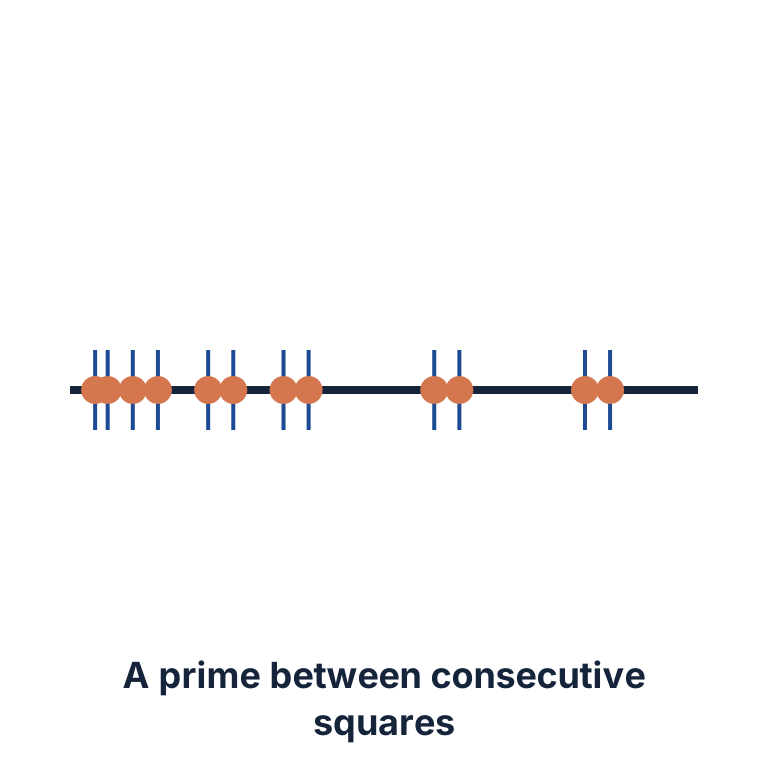
Problem. For every \(n\in\mathbb{Z}_{>0}\), the intersection \(\mathbb{P}\cap(n^2,(n+1)^2)\) is nonempty.
1Context
The conjecture is one of Landau's classical problems about primes and would give a strong uniform restriction on prime gaps.
2Problem setup
Definition 1 (Consecutive squares differ by 2n + 1). Consecutive squares differ by 2n + 1.
Definition 2 (The endpoints are composite for n greater than 1, so strict and non-strict versions agree there). The endpoints are composite for n greater than 1, so strict and non-strict versions agree there.
Remark 1. The conjecture is one of Landau's classical problems about primes and would give a strong uniform restriction on prime gaps.
3What counts as a solution
- Prove the existence of a prime in every interval (n^2, (n+1)^2), or give a positive integer n and prove that its interval contains no prime.
1Status
Current status (Dated status and exact unresolved remainder). Unresolved in this packet after the dated source check. Strongest checked result: Unconditionally, every consecutive-square interval contains a 4-almost-prime. Assuming RH, primes occur between consecutive powers x^(2+delta) and (x+1)^(2+delta) in the ranges stated by Chamberland and Straub. Exact unresolved remainder: Prove that every interval (n^2,(n+1)^2) contains a prime.[1][2]
1Packet records
Recent contributions
These records are attached to this problem after the current published packet. Each badge shows its current verification or packet-review step.
Notes and companion material
Original intake status. The cited 2026 article calls Legendre's conjecture a famous unsolved problem. The source and public status were checked on 2026-07-31. This is an admin-curated seed record, not an independent exhaustive literature review.
- Recent work proves that every such interval contains an integer with few prime factors. That does not force the integer itself to be prime.
Recorded example 1. Between 10^2 and 11^2 lie the primes 101, 103, 107, 109, and 113.
Computational notes
- Verification through a finite n establishes only those intervals.
2See also
How to cite
TheoremDB contributors, “Legendre's conjecture,” TheoremDB research memory, snapshot of July 31, 2026. https://theoremdb.org/statements/legendres-conjectureThis page as plain text: legendres-conjecture.md
This problem includes 2 records joined by 2 typed links, sourced from sciencedirect.com[1], current as of July 31, 2026.
1References
- Packet source. Adrian W. Dudek and Daniel R. Johnston, Almost primes between all squares, Journal of Number Theory 278 (2026), 726-745. DOI 10.1016/j.jnt.2025.05.009. Adrian W. Dudek and Daniel R. Johnston, Journal of Number Theory 278 (2026), introduction. ↗journal article · primary source · checked 2026-07-31Source use: original summary.The cited 2026 article calls Legendre's conjecture a famous unsolved problem. The source and public status were checked on 2026-07-22. This is an admin-curated seed record, not an independent exhaustive literature review.Also cited at Abstract and introduction.Also cited at Editorial research route recorded 2026-07-31.Source used to formulate or check the problem record.Source used to assess the problem's recorded status.Current unconditional four-almost-prime theorem and open-status statement.Source named by the research packet.
- Marc Chamberland and Armin Straub, “Weakening the Legendre Conjecture”. arXiv:2602.22502 (2026). Abstract and main theorem. ↗preprint · primary source · arXiv:2602.22502v1 · checked 2026-08-01Source use: original summary.RH-conditional prime result for consecutive powers above exponent two.
An original CC0 restatement prepared by TheoremDB maintainers.