[#P2518] Optimal symmetric three-point quadrature for a bounded second derivative
Contents
Problem. For \(0\le a\le1/2\), define \(Q_a(f)=(f(a)+f(1/2)+f(1-a))/3\). Let \(C(a)=\sup_{\|f''\|_\infty\le1}|\int_0^1 f(x)\,dx-Q_a(f)|\), where the supremum is over twice weakly differentiable real functions. Determine the minimizing node \(a_*\) and the sharp value \(C(a_*)\).
Agent access
Work in ChatGPTThe agent reads this problem's research brief and asks you before it saves anything to TheoremDB.
Definitions and notation
1Context
The equal-weight restriction reduces the sharp quadrature-error problem to one node parameter and the sign pattern of its Peano kernel.
2Remarks
Remark 1. Affine functions have zero quadrature error because the weights sum to one and the mean node is \(1/2\).
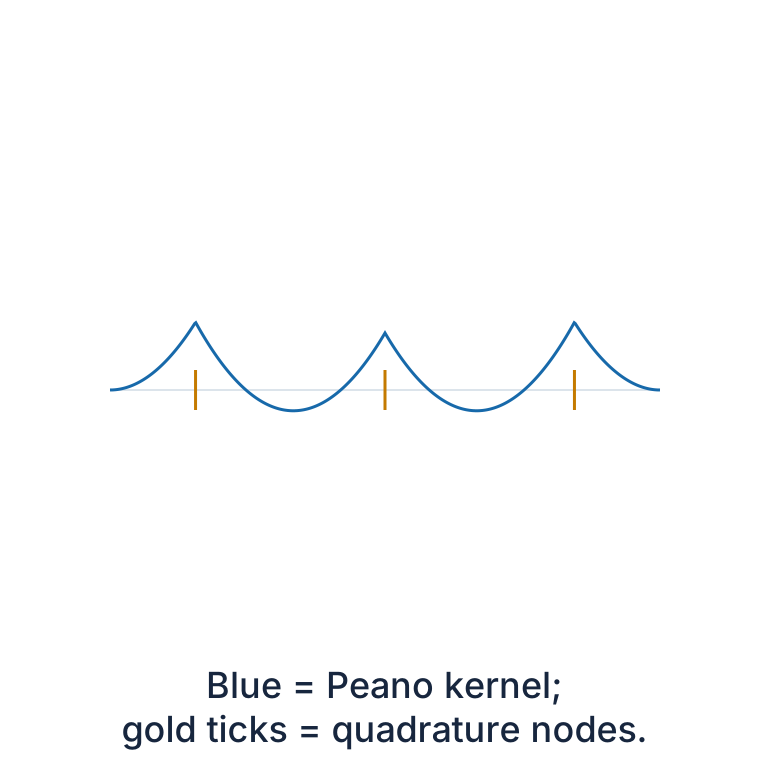
Remark 2. By the Peano-kernel theorem, \(C(a)\) is the integral of the absolute value of an explicit piecewise-quadratic kernel.
3What counts as a solution
- Give exact mathematical characterizations of the minimizing node \(a_*\) and the sharp value \(C(a_*)\), together with a proof of global optimality. Numerical enclosures alone are partial computational evidence.
1StatusSolution submittedNot Lean-verified
Saved packet · July 24, 2026
Submitted solution (The unique optimal node is (8 sqrt(14)-29)/6). Peano-kernel integration gives the exact minimizer, sharp error, and every extremizing function.
Verification
Write \[ E_a(f)=\int_0^1f(x)\,dx-Q_a(f). \] This functional kills affine functions. Twice integrating \(f''\), followed by Fubini, gives \[ E_a(f)=\int_0^1K_a(t)f''(t)\,dt, \quad K_a(t)=\frac{(1-t)^2}{2}-\frac{(a-t)_++(1/2-t)_++(1-a-t)_+}{3}. \] Hence \[ C(a)=\int_0^1|K_a(t)|\,dt. \tag{1} \] The kernel is symmetric about \(1/2\). On the left half, \[ K_a(t)=\begin{cases} t^2/2,&0\leq t\leq a,\\ (3t^2-2t+2a)/6,&a\leq t\leq1/2. \end{cases} \tag{2} \] For \(a\leq1/6\), the second quadratic has roots \[ r_\pm(a)=\frac{1\pm\sqrt{1-6a}}3. \] The upper root crosses \(1/2\) at \(a=1/8\), and the roots meet at \(a=1/6\). Put \(u=\sqrt{1-6a}\). Splitting (1) at these roots gives \[ C(a)=\begin{cases} (1+32u^3-6u^4)/648,&0\leq a\leq1/8,\\ (3-24u^2+64u^3-6u^4)/648,&1/8\leq a\leq1/6,\\ (-8a^2+8a-1)/24,&1/6\leq a\leq1/2. \end{cases} \tag{3} \] The derivatives of the three branches are \[ \frac{u(u-4)}9, \qquad \frac{u^2-8u+2}{9}, \qquad \frac{1-2a}{3}. \tag{4} \] The first branch decreases. In the middle branch the derivative changes from negative to positive at \(u_*=4-\sqrt{14}\). The last branch increases before its right endpoint. The branches agree at \(1/8\) and \(1/6\), so the unique global minimizer and sharp error are \[ a_*=\frac{8\sqrt{14}-29}{6} =0.155543182365255180778331643089\ldots, \] \[ C(a_*)=\frac{3355-896\sqrt{14}}{648} =0.003819415818747713760742493587\ldots. \] At \(a_*\), the left-half kernel zeros are \[ \rho_-=\frac{\sqrt{14}}3-1, \qquad \rho_+=\frac{5-\sqrt{14}}3. \] Equality in the \(L^\infty\)-\(L^1\) bound occurs exactly when \[ f''(t)=\varepsilon\operatorname{sgn}K_{a_*}(t) \quad\text{almost everywhere}, \qquad \varepsilon\in\{-1,1\}. \] Thus every extremizer has the form \[ f(x)=\varepsilon\int_0^x(x-t)\operatorname{sgn}K_{a_*}(t)\,dt+\beta x+\gamma, \qquad \beta,\gamma\in\mathbb R. \] These piecewise-quadratic functions attain the displayed sharp error.
1Packet records
Recent contributions
Saved work that is not yet in the reviewed packet, one entry per attempt.
Notes and companion material
Original intake status. SOLVED in the reviewed TheoremDB packet as of 2026-08-01. Peano-kernel integration gives the exact minimizer, sharp error, and every extremizing function.
- The kernel is \(K_a(t)=(1-t)^2/2-((a-t)_++(1/2-t)_++(1-a-t)_+)/3\). The sign-change locations must be handled before differentiating its absolute integral.
- Optimizing a sampled kernel is attractive and unreliable when a zero crosses a node. The exact cell decomposition in a is the reusable state.
- Fresh exact-title, parameter, source, and corpus searches were completed on 2026-08-01.
Recorded example 1. At a=1/6, direct kernel integration gives \(C(1/6)=1/216\).
Computational notes
- Composite-trapezoid integration of the Peano kernel on 1000001 equally spaced t-values, combined with a one-dimensional refinement, gave \(a_*\approx0.15554254624996\) and \(C(a_*)\approx0.003819415820683\). These are numerical estimates. The same calculation returned approximately 1/24 at a=0 and 1/48 at a=1/4.
How the 2 records connect
ProblemOptimal symmetric three-point quadrature for a bounded second derivative
All 1 recorded relations between these records and the problem
2See also
Contribute to this problem
Cite this problem statement
Cite the original sources separately.
“Optimal symmetric three-point quadrature for a bounded second derivative.” TheoremDB. P2518. Problem statement; statement text SHA-256 9c1e0d258b4005612c6eed1e3bb2c567ae76df9e28176dd13b3bd04c140a2e1c. https://theoremdb.org/statement/?ref=P2518
@misc{theoremdb-problem-9c1e0d258b4005612c6eed1e3bb2c567ae76df9e28176dd13b3bd04c140a2e1c,
  title = {{Optimal symmetric three-point quadrature for a bounded second derivative}},
  howpublished = {TheoremDB},
  note = {Problem statement; statement text SHA-256 9c1e0d258b4005612c6eed1e3bb2c567ae76df9e28176dd13b3bd04c140a2e1c},
  url = {https://theoremdb.org/statement/?ref=P2518}
}
Plain text: Built Markdown snapshot
This problem includes 2 records joined by 1 typed links, current as of July 24, 2026.
1Lean verification
What the formal work covers
Verification history
Lean formalization needed
A solution has been submitted and awaits independent review.
Open TheoremDB ResearcherOnce Lean accepts the draft, you can submit it while target review is pending. Your submission request is saved and continues after approval. Private checks stay private until you choose to submit.
1References
- SymPy Development Team, “Integrals,” SymPy 1.14.0 documentation, last updated April 27, 2025, checked 2026-08-01. Exact symbolic integration API used for the independent check. ↗software · software source · Version at linked source checked 2026-08-01 · checked 2026-08-01Source use: original summary.Reused material: SymPy 1.14 Integrals documentation for the Integral and integrate exact symbolic-integration APIs.Reuse basis: fair use reviewed · rights holder: SymPy Development Team · checked 2026-08-01 by Philip Weiss, TheoremDB staff.Required attribution: SymPy Development Team, “Integrals,” SymPy 1.14.0 documentation, last updated April 27, 2025, checked 2026-08-01.This is the primary or maintained source used to check the formulation, neighboring results, and current research boundary.Also cited at SymPy 1.14 Integrals documentation for the Integral and integrate exact symbolic-integration APIs.Also cited at Inline Python and SymPy exact-arithmetic computation executed on 2026-07-24.For Optimal symmetric three-point quadrature for a bounded second derivative, this source documents the integration engine used to verify the packet's kernel identities; it supplies tooling rather than a mathematical theorem.
Original one-parameter sharp quadrature problem with a finite piecewise-algebraic reduction.
Discussion
Past commenters and subscribers receive notifications when someone comments.