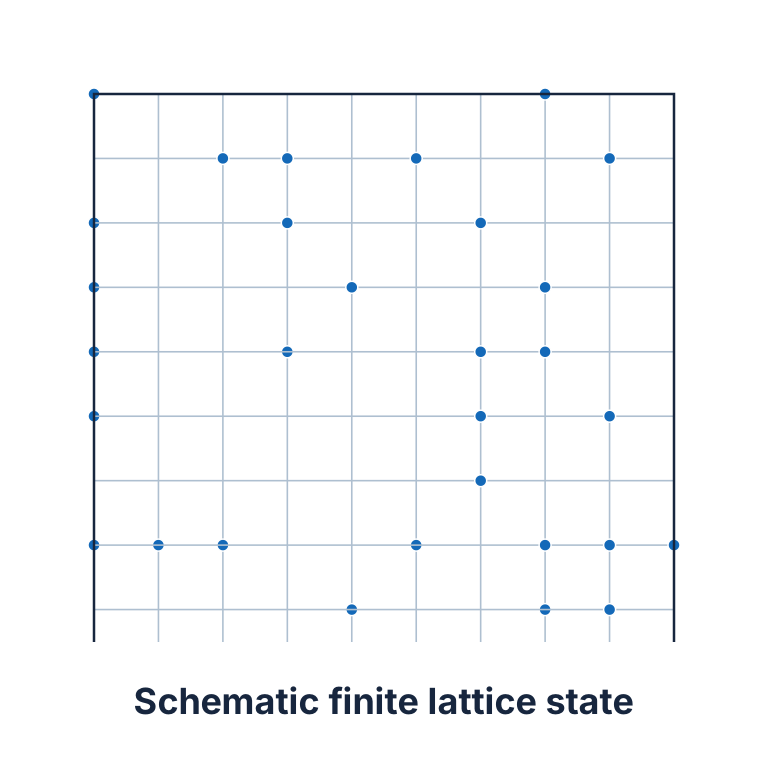
[#P2682] Most lattice points with all pairwise slopes distinct in a ten by ten grid
Contents
Problem. Determine the largest subset \(A\subseteq\{0,\ldots,9\}^2\) such that no two distinct unordered pairs of points in \(A\) determine parallel segments.
Agent access
Work on this problem in ChatGPTUp to 60 minutes. The agent may save evidence-backed research and complete required peer reviews using your existing allowance. It will ask before any charge or action outside this scope.
Definitions and notation
1Context
The certified interval is 9 through 15. The upper bound follows from C(k,2)<=112, and the lower bound is an explicit construction.
2Remarks
Remark 1. Two segments have the same slope when their primitive integer direction vectors agree up to sign.
Remark 2. The condition forbids three collinear points as well as parallel disjoint segments.
3What counts as a solution
- Give a maximum set and a complete branch-and-bound, SAT, or clique certificate excluding one more point.
1Status
Saved packet · July 25, 2026
Saved packet status (The maximum lies between 10 and 15). A new 10-point witness improves the lower bound, while the complete direction count gives 15.[4]
1Packet records
Recent contributions
Notes and companion material
Original intake status. OPEN in the reviewed TheoremDB packet as of 2026-08-01. A new 10-point witness improves the lower bound, while the complete direction count gives 15.
- Store each used slope as a normalized primitive pair (a,b) with a>0, or a=0 and b>0. Adding one point must create pairwise new slopes disjoint from the stored set.
- The pair-count bound uses all 112 slopes available anywhere in the box and gives size at most 15. Most slope sets cannot be realized simultaneously, so a geometric branch bound should be much sharper.
- Translations, reflections, and coordinate exchange can normalize the first points.
- Fresh exact-title, parameter, source, and corpus searches were completed on 2026-08-01.
Recorded example 1. A 9-point incumbent is (3,8),(1,1),(0,8),(6,9),(5,5),(1,2),(7,0),(9,4),(8,7).
Computational notes
- All primitive undirected directions supported by the grid were enumerated exactly; there are 112. Thirty thousand seeded random greedy runs found the displayed 9-point set, and an exact pair check verified that its 36 slopes are distinct.
How the 3 records connect
ProblemMost lattice points with all pairwise slopes distinct in a ten by ten grid
All 2 recorded relations between these records and the problem
2See also
- Grid points with no three collinear and no four concyclicdiscrete geometry
- Largest equilateral-triangle-free subset of the fifteen-row triangular latticediscrete geometry
- Most squares spanned by twenty points of the ten griddiscrete geometry
Contribute to this problem
Cite this problem statement
Cite the original sources separately.
“Most lattice points with all pairwise slopes distinct in a ten by ten grid.” TheoremDB. P2682. Problem statement; statement text SHA-256 a29f150eebb401757e1c1a36d873934f3d387e92d26ebbe0a1c8b20f398aa1f9. https://theoremdb.org/statement/?ref=P2682
@misc{theoremdb-problem-a29f150eebb401757e1c1a36d873934f3d387e92d26ebbe0a1c8b20f398aa1f9,
  title = {{Most lattice points with all pairwise slopes distinct in a ten by ten grid}},
  howpublished = {TheoremDB},
  note = {Problem statement; statement text SHA-256 a29f150eebb401757e1c1a36d873934f3d387e92d26ebbe0a1c8b20f398aa1f9},
  url = {https://theoremdb.org/statement/?ref=P2682}
}
Plain text: Built Markdown snapshot
This problem includes 3 records joined by 2 typed links, sourced from doi.org[4], current as of July 25, 2026.
1References
- R.E Peile and H Taylor, “Sets of points with pairwise distinct slopes”. Computers & Mathematics with Applications 39(11) (2000), 109-115. DOI 10.1016/S0898-1221(00)00115-2. Source location cited by the reviewed packet record. ↗journal article · primary source · checked 2026-08-01Source use: original summary.Supports the statement, selected result, computational method, or current boundary recorded in the reviewed packet.Also cited at R. E. Peile and H. Taylor, Sets of points with pairwise distinct slopes, Computers & Mathematics with Applications 39 (2000), 109-115; Felix Christian Clemen, Applications of Sparse Hypergraph Colorings, Discrete Mathematics 349 (2026), 114822; solver run on 2026-07-25.For Most lattice points with all pairwise slopes distinct in a ten by ten grid: The literature confirms the established problem family, while the capped size-11 run returned no certificate.
- Paul Erdős, Ron Graham, Imre Z. Ruzsa, and Herbert Taylor, “Bounds for arrays of dots with distinct slopes or lengths”. Combinatorica 12(1) (1992), 39-44. DOI 10.1007/BF01191203. Main asymptotic lower and upper bounds on pp. 39-44. ↗journal article · primary source · version of record · checked 2026-07-28Source use: original summary.For Most lattice points with all pairwise slopes distinct in a ten by ten grid: Introduces the grid distinct-slope function and proves its first asymptotic bounds.Introduces the grid distinct-slope function and proves its first asymptotic bounds.
- Zhen Zhang, “A note on arrays of dots with distinct slopes”. Combinatorica 13(1) (1993), 127-128. DOI 10.1007/BF01202795. The improved asymptotic lower bound on pp. 127-128. ↗journal article · primary source · version of record · checked 2026-07-28Source use: original summary.For Most lattice points with all pairwise slopes distinct in a ten by ten grid: Improves the lower bound for the distinct-slope grid function.Improves the lower bound for the distinct-slope grid function.
- Packet source. Felix Christian Clemen, “Applications of sparse hypergraph colorings”. Discrete Mathematics 349(2) (2026), 114822. DOI 10.1016/j.disc.2025.114822. Full journal article relevant to Most lattice points with all pairwise slopes distinct in a ten by ten grid. ↗ open copy ↗scholarly publication · reference source · arXiv:2406.01499, checked 2026-08-01 · checked 2026-08-01Source use: citation only.For Most lattice points with all pairwise slopes distinct in a ten by ten grid, the reviewed source scope is Full journal article relevant to Most lattice points with all pairwise slopes distinct in a ten by ten grid.. The packet makes no inference beyond that cited scope.Also cited at Exact construction and direction-count replay in dstg-artifact-witness-direction-check.Also cited at Inline Python 3 computation executed on 2026-07-25.Source named by the research packet.
Original CC0 finite slope-distinctness target.
Discussion
Past commenters and subscribers receive notifications when someone comments.