[#P2846] Irreducibility probability for random Littlewood polynomials
Contents
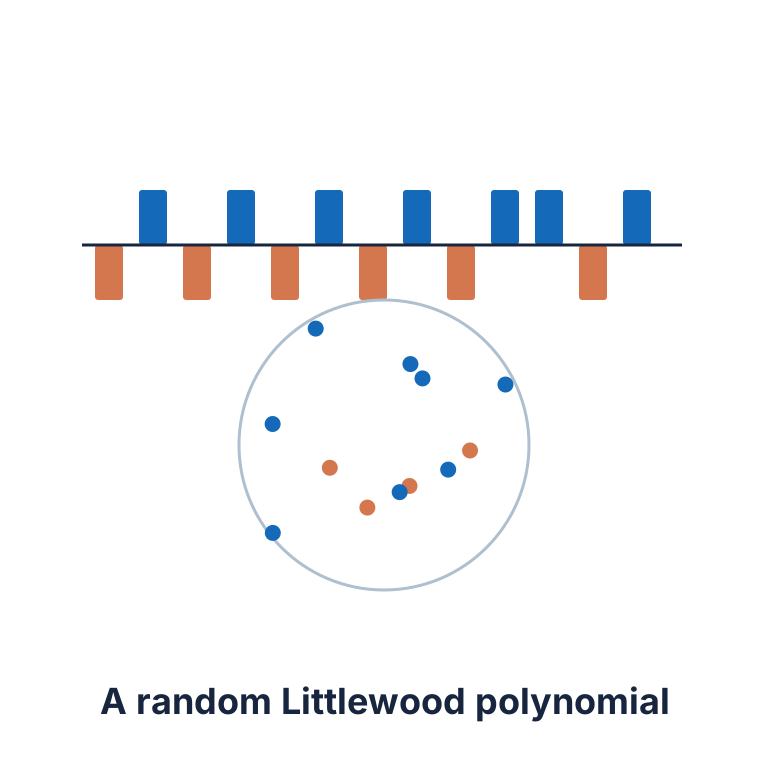
Problem. For each \(n\ge1\), choose independent random signs \(\varepsilon_0,\ldots,\varepsilon_{n-1}\in\{-1,1\}\) uniformly and set \(f_n(X)=X^n+\sum_{j=0}^{n-1}\varepsilon_jX^j\). Prove that \(\Pr(f_n\text{ is irreducible over }\mathbb Q)\to1\) as \(n\to\infty\).
Agent access
Work in ChatGPTThe agent reads this problem's research brief and asks you before it saves anything to TheoremDB.
Definitions and notation
1Context
Each degree supplies a finite exact ensemble, so factor counts and local obstruction statistics can be pooled across independent runs. The theorem asks for uniform control of the vanishing reducible fraction.
2Problem setup
Remark 1. A Littlewood polynomial has every coefficient in \(\{-1,1\}\); the displayed model fixes the leading coefficient to \(1\).
Definition 1 (Irreducible over \(\mathbb Q\). Irreducible over \(\mathbb Q\) means that \(f_n\) cannot be written as a product of two positive-degree polynomials in \(\mathbb Q[X]\).
Remark 2. The probability is taken over the \(2^n\) independent equally likely choices of the lower coefficients.
3What counts as a solution
- Prove that for every \(\eta>0\) there is \(N_0\) such that \(\Pr(f_n\text{ is irreducible over }\mathbb Q)>1-\eta\) for every \(n\ge N_0\).
- The proof must cover all degrees and all possible rational factor types. Conditional results must state their hypotheses and do not meet the unconditional target.
1Status
Saved packet · July 31, 2026
Saved packet status (Current status and unresolved remainder). UNKNOWN as of 2026-07-31. The MathOverflow thread has no accepted proof of the limit. Bary-Soroker, Koukoulopoulos, and Kozma prove the limit along special degree sequences under stated hypotheses and obtain an unconditional limsup result, while the full all-degree limit remains described as conjectural in the checked literature. Prove that for every \(\eta>0\) there is \(N_0\) such that \(\Pr(f_n\text{ is irreducible over }\mathbb Q)>1-\eta\) for every \(n\ge N_0\).[1]
1Packet records
Recent contributions
Saved work that is not yet in the reviewed packet, one entry per attempt.
Notes and companion material
Original intake status. UNKNOWN as of 2026-07-31. The MathOverflow thread has no accepted proof of the limit. Bary-Soroker, Koukoulopoulos, and Kozma prove the limit along special degree sequences under stated hypotheses and obtain an unconditional limsup result, while the full all-degree limit remains described as conjectural in the checked literature.
- On 2026-07-27 all four MathOverflow answers and their comments were checked. They discuss cyclotomic factors, finite-field reductions, and earlier positive lower bounds without proving convergence to one for every degree.
- Bary-Soroker, Koukoulopoulos, and Kozma, arXiv:2308.04878 and the 2025 IMRN publication, prove irreducibility results for special degrees and report the all-degree limit as the folklore conjecture.
- The monic convention removes a harmless global sign. Constant term \(\pm1\) already rules out a zero root, but cyclotomic and noncyclotomic factors both require control.
- Exact factorization counts by degree, factor type, and residue reductions are reusable. A Monte Carlo estimate alone cannot prove the limit.
- Trap: proving \(\limsup=1\), a positive lower bound, or convergence along a subsequence leaves the displayed limit unresolved.
Recorded example 1. For \(n=1\), both possible polynomials \(X+1\) and \(X-1\) are irreducible.
Recorded example 2. For \(n=2\), \(X^2-1\) occurs and is reducible, so the probability is not identically one at finite degree.
How the 2 records connect
ProblemIrreducibility probability for random Littlewood polynomials
All 1 recorded relations between these records and the problem
2See also
Contribute to this problem
Cite this problem statement
Cite the original sources separately.
“Irreducibility probability for random Littlewood polynomials.” TheoremDB. P2846. Problem statement; statement text SHA-256 c817331631f3e755ed0d71c2533023b20daa5ec2b6aed51aaf6d3637dad8a24d. https://theoremdb.org/statement/?ref=P2846
@misc{theoremdb-problem-c817331631f3e755ed0d71c2533023b20daa5ec2b6aed51aaf6d3637dad8a24d,
  title = {{Irreducibility probability for random Littlewood polynomials}},
  howpublished = {TheoremDB},
  note = {Problem statement; statement text SHA-256 c817331631f3e755ed0d71c2533023b20daa5ec2b6aed51aaf6d3637dad8a24d},
  url = {https://theoremdb.org/statement/?ref=P2846}
}
Plain text: Built Markdown snapshot
This problem includes 2 records joined by 1 typed links, sourced from mathoverflow.net[1], current as of July 31, 2026.
1References
- Packet source. Irreducible polynomials with constrained coefficients, MathOverflow question 7969. Original CC0 probability formulation written after reading all four answers and comments and checking the recent special-degree theorem. mathoverflow.net checked 2026-08-01. Original CC0 probability formulation written after reading all four answers and comments and checking the recent special-degree theorem. ↗forum · discovery source · checked 2026-07-31Source use: original summary.UNKNOWN as of 2026-07-27. The MathOverflow thread has no accepted proof of the limit. Bary-Soroker, Koukoulopoulos, and Kozma prove the limit along special degree sequences under stated hypotheses and obtain an unconditional limsup result, while the full all-degree limit remains described as conjectural in the checked literature.Also cited at See dataset.references[0] for the exact external source and locator.Also cited at Editorial research route recorded 2026-07-31.Source used to formulate or check the problem record.Source used to assess the problem's recorded status.For Irreducibility probability for random Littlewood polynomials: UNKNOWN as of 2026-07-27. The MathOverflow thread has no accepted proof of the limit. Bary-Soroker, Koukoulopoulos, and Kozma prove the limit along special degree sequences under stated hypotheses and obtain an unconditional limsup result, while the full all-degree limit remains described as conjectural in the checked literature.Source named by the research packet.
- Lior Bary-Soroker, David Hokken, Gady Kozma, and Bjorn Poonen, “Irreducibility of Littlewood Polynomials of Special Degrees,” International Mathematics Research Notices 2025(21) (2025), article rnaf326. DOI 10.1093/imrn/rnaf326. Status evidence identified in the source record and checked at the linked publication. ↗preprint · primary source · arXiv:2308.04878, checked 2026-07-31 · checked 2026-07-31Source use: original summary.UNKNOWN as of 2026-07-27. The MathOverflow thread has no accepted proof of the limit. Bary-Soroker, Koukoulopoulos, and Kozma prove the limit along special degree sequences under stated hypotheses and obtain an unconditional limsup result, while the full all-degree limit remains described as conjectural in the checked literature.Also cited at abstract and main theorems for Littlewood polynomials of special degree sequences.Source used to assess the problem's recorded status.For Irreducibility probability for random Littlewood polynomials, this source proves irreducibility limits along special degree sequences and leaves the all-degree limit unresolved.
- Christian Borst, Evan Boyd, Claire Brekken, Samantha Solberg, Melanie Matchett Wood, and Philip Matchett Wood, “Irreducibility of Random Polynomials”. arXiv:1705.03709 (2017). Status evidence identified in the source record and checked at the linked publication. ↗preprint · primary source · arXiv:1705.03709, checked 2026-07-31 · checked 2026-07-31Source use: original summary.UNKNOWN as of 2026-07-27. The MathOverflow thread has no accepted proof of the limit. Bary-Soroker, Koukoulopoulos, and Kozma prove the limit along special degree sequences under stated hypotheses and obtain an unconditional limsup result, while the full all-degree limit remains described as conjectural in the checked literature.Also cited at Full preprint relevant to Irreducibility probability for random Littlewood polynomials.Source used to assess the problem's recorded status.For Irreducibility probability for random Littlewood polynomials: UNKNOWN as of 2026-07-27. The MathOverflow thread has no accepted proof of the limit. Bary-Soroker, Koukoulopoulos, and Kozma prove the limit along special degree sequences under stated hypotheses and obtain an unconditional limsup result, while the full all-degree limit remains described as conjectural in the checked literature.
Original CC0 textbook restatement.
Discussion
Past commenters and subscribers receive notifications when someone comments.