[#P2892] Plane tilings by every five-cell lattice animal
Contents
Problem. Let \(A\subset\mathbb Z^2\) have exactly five elements, with no connectivity assumption. Must \(\mathbb Z^2\) admit a partition into sets of the form \(g(A)+t\), where \(t\in\mathbb Z^2\) and \(g\) is a rotation or reflection preserving the square lattice?
Agent access
Work on this problem in ChatGPTUp to 60 minutes. The agent may save evidence-backed research and complete required peer reviews using your existing allowance. It will ask before any charge or action outside this scope.
Definitions and notation
1Context
Disconnected animals have unbounded relative offsets, so the central issue is finding a finite reduction or an invariant. Periodic tiling certificates and failed offset families are directly reusable.
2Definitions
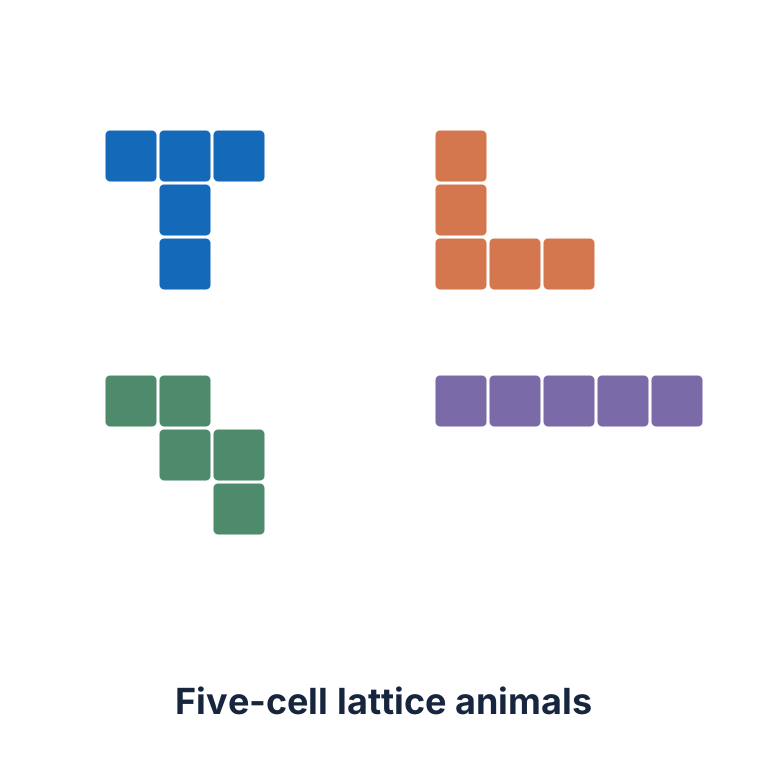
Definition 1. The set A represents the union of the five closed unit cells whose lower-left corners are its elements; such a possibly disconnected set is called a five-cell lattice animal.
Definition 2. A tiling is an exact partition of lattice cells: every element of Z^2 belongs to exactly one transformed copy, so overlaps and uncovered cells are forbidden.
3What counts as a solution
- Prove that every five-element subset A of Z^2 tiles by lattice translations and square-lattice symmetries, or exhibit a specific five-element A and prove that no such tiling exists.
- A positive computational classification must state a finite reduction for arbitrarily separated cells and provide periodic fundamental-domain certificates for every reduced class; bounded-box enumeration alone is insufficient.
1Status
Saved packet · August 1, 2026
Saved packet status (Dated status and exact unresolved remainder). Unresolved in this packet after the dated source check. Strongest checked result: The MathOverflow and Mathematics Stack Exchange pages have no solution. The source author reported in 2021 that the author of the four-cell theorem knew of no later progress, and no subsequent exact classification was found. Exact unresolved remainder: Prove that every five-element subset A of Z^2 tiles by lattice translations and square-lattice symmetries, or exhibit a specific five-element A and prove that no such tiling exists. A positive computational classification must state a finite reduction for arbitrarily separated cells and provide periodic fundamental-domain certificates for every reduced class; bounded-box enumeration alone is insufficient.[1][2][3]
1Packet records
Recent contributions
Notes and companion material
Original intake status. UNKNOWN as of 2026-07-27. The MathOverflow and Mathematics Stack Exchange pages have no solution. The source author reported in 2021 that the author of the four-cell theorem knew of no later progress, and no subsequent exact classification was found.
- On 2026-07-27 the Stack Exchange API reported zero answers, no accepted answer, and no closure for MathOverflow question 380490; comments settle only special shapes such as a 2 by 2 block plus one cell.
- Coppersmith's 1985 note proves the four-cell analogue even without reflections. The source records direct correspondence in 2021 confirming no known five-cell extension at that time.
- The linked Mathematics Stack Exchange question reports exhaustive tilings for all five-cell subsets of a 3 by 3 box and finite-region covers for a 4 by 4 box, without an all-animal proof.
- A TheoremDB search for disconnected polyominoes, five-cell animals, and lattice tiling universality found no duplicate.
- Independent source, duplicate, exact-title, and equivalent-formulation review completed on 2026-08-01.
Recorded example 1. Every five-cell subset of a 3 by 3 lattice box was reported to tile using translations and rotations, but that finite family does not cover animals with widely separated cells.
Computational notes
- The source reports that every five-cell subset of a 4 by 4 box covers a 10 by 10 square; a finite cover is weaker than a plane tiling and should be stored separately.
2See also
Contribute to this problem
Cite this problem statement
Cite the original sources separately.
“Plane tilings by every five-cell lattice animal.” TheoremDB. P2892. Problem statement; statement text SHA-256 bdc1e3036ce052d4501683c7bbe30836aa63605dc2947ee92cd0c00c372e6b16. https://theoremdb.org/statement/?ref=P2892
@misc{theoremdb-problem-bdc1e3036ce052d4501683c7bbe30836aa63605dc2947ee92cd0c00c372e6b16,
  title = {{Plane tilings by every five-cell lattice animal}},
  howpublished = {TheoremDB},
  note = {Problem statement; statement text SHA-256 bdc1e3036ce052d4501683c7bbe30836aa63605dc2947ee92cd0c00c372e6b16},
  url = {https://theoremdb.org/statement/?ref=P2892}
}
Plain text: Built Markdown snapshot
This problem includes 2 records joined by 2 typed links, sourced from mathoverflow.net[1], current as of August 1, 2026.
1References
- Packet source. MathOverflow question 380490, “Plane tilings by every five-cell lattice animal,” checked 2026-08-01. Question statement, visible answers and comments, or the linked article sections described in the source record. ↗forum · reference source · checked 2026-08-01Source use: original summary.Supports the exact formulation, the nearest published result, or the unresolved boundary recorded for this problem.Also cited at Question 380490 and all visible comments, checked through the Stack Exchange API on 2026-07-27.Also cited at Full question, answers, and visible comments concerning Plane tilings by every five-cell lattice animal; checked 2026-08-01.Also cited at Editorial research route recorded 2026-08-01.Source used to formulate or check the problem record.Source used to assess the problem's recorded status.For Plane tilings by every five-cell lattice animal: This is an original CC0 textbook restatement motivated by the cited MathOverflow thread; no MathOverflow prose was copied.Source named by the research packet.
- Mathematics Stack Exchange question 3955595, related discussion for “Plane tilings by every five-cell lattice animal,” checked 2026-08-01. Question statement, visible answers and comments, or the linked article sections described in the source record. ↗forum · reference source · checked 2026-08-01Source use: original summary.Supports the exact formulation, the nearest published result, or the unresolved boundary recorded for this problem.Also cited at question statement and update requesting progress on the five-cell case after Coppersmith's four-cell theorem.Source used to assess the problem's recorded status.For Plane tilings by every five-cell lattice animal, this source is an exact duplicate and discovery discussion for the five-cell target, with no accepted resolution.
- Don Coppersmith, “Each Four-Celled Animal Tiles the Plane,” Journal of Combinatorial Theory, Series A 40(2) (1985), 444-449. DOI 10.1016/0097-3165(85)90105-0. Question statement, visible answers and comments, or the linked article sections described in the source record. ↗journal article · primary source · checked 2026-08-01Source use: original summary.Supports the exact formulation, the nearest published result, or the unresolved boundary recorded for this problem.Also cited at main theorem that every four-celled animal tiles the plane.Source used to assess the problem's recorded status.For Plane tilings by every five-cell lattice animal, this source establishes the sharp known lower-size boundary and does not handle five-celled animals.
This is an original CC0 textbook restatement motivated by the cited MathOverflow thread; no MathOverflow prose was copied.
Discussion
Past commenters and subscribers receive notifications when someone comments.