[#P3070] Barnette’s conjecture
Contents
Problem. Does every finite simple cubic, \(3\)-connected, bipartite planar graph \(G\) contain a Hamiltonian cycle?
Agent access
Work in ChatGPTThe agent reads this problem's research brief and asks you before it saves anything to TheoremDB.
Definitions and notation
1Context
Known frontier: Every n-vertex Barnette graph has a subhamiltonian cycle containing at least 5n/6 edges. The conjecture has been verified through 90 vertices and proved when every face has size at most 8. Open boundary: Prove that every Barnette graph has a spanning cycle, or exhibit a cubic, 3-connected, bipartite planar graph without one. A repository corpus search for Barnette returned no duplicate target.
2Problem setup
Definition 1 (cubic). Every vertex has degree 3.
Definition 2 (3-connected). Deleting any two vertices leaves the graph connected.
Definition 3 (Hamiltonian cycle). A cycle that visits every vertex exactly once.
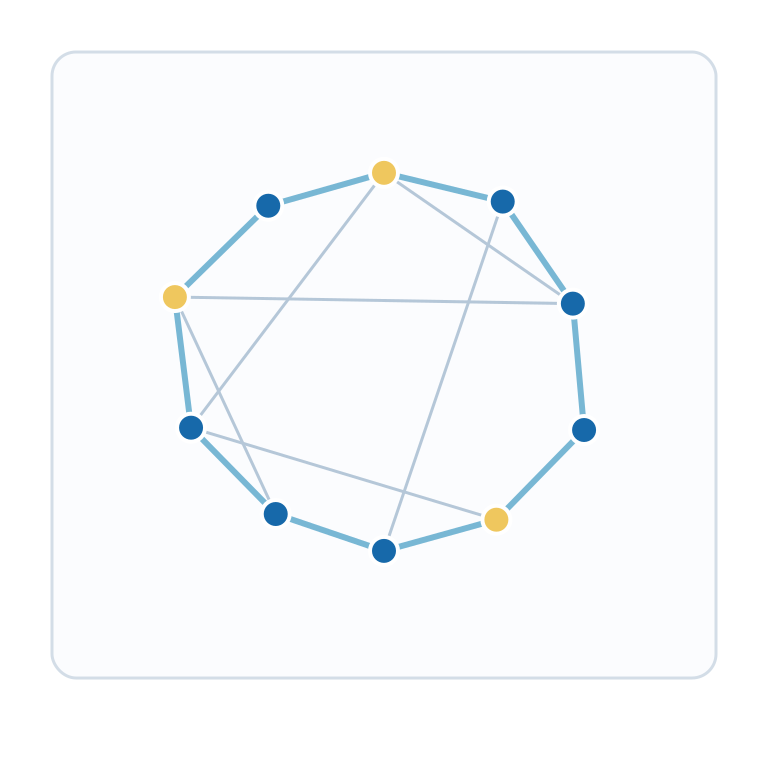
Remark 1. A Barnette graph is cubic, 3-connected, bipartite, and planar. The conjecture asks whether every such graph has a cycle visiting every vertex exactly once.
3What counts as a solution
- Prove that every finite simple cubic, 3-connected, bipartite planar graph has a Hamiltonian cycle.
- Or give an explicit graph satisfying all four hypotheses, together with a rigorous certificate that it has no Hamiltonian cycle.
1Status
Saved packet · August 1, 2026
Saved packet status (Current status and exact unresolved remainder). OPEN as checked on 2026-08-01. Strongest checked neighboring result: Every n-vertex Barnette graph has a subhamiltonian cycle containing at least 5n/6 edges. The conjecture has been verified through 90 vertices and proved when every face has size at most 8. Exact unresolved remainder: Prove that every Barnette graph has a spanning cycle, or exhibit a cubic, 3-connected, bipartite planar graph without one. TheoremDB corpus searches for Barnette returned no duplicate target.[1][2][3][4]
1Packet records
Recent contributions
Saved work that is not yet in the reviewed packet, one entry per attempt.
Notes and companion material
Original intake status. OPEN as checked on 2026-08-01. Strongest checked neighboring result: Every n-vertex Barnette graph has a subhamiltonian cycle containing at least 5n/6 edges. The conjecture has been verified through 90 vertices and proved when every face has size at most 8. Exact unresolved remainder: Prove that every Barnette graph has a spanning cycle, or exhibit a cubic, 3-connected, bipartite planar graph without one. TheoremDB corpus searches for Barnette returned no duplicate target.
- Equivalent-formulation queries: Barnette conjecture cubic bipartite planar graph Hamiltonian open; Barnette graph face size 8 Hamiltonian; Barnette graphs verified 90 vertices
- Strongest checked neighboring result: Every n-vertex Barnette graph has a subhamiltonian cycle containing at least 5n/6 edges. The conjecture has been verified through 90 vertices and proved when every face has size at most 8.
- Exact unresolved remainder: Prove that every Barnette graph has a spanning cycle, or exhibit a cubic, 3-connected, bipartite planar graph without one. TheoremDB corpus searches for Barnette returned no duplicate target.
How the 4 records connect
ProblemBarnette’s conjecture
All 3 recorded relations between these records and the problem
2See also
- Constructing a union from non-cancelling intersectionscombinatorics
- Plane tilings by every five-cell lattice animalcombinatorics
- Cycle Double Cover Conjecturecombinatorics
Contribute to this problem
Cite this problem statement
Cite the original sources separately.
“Barnette’s conjecture.” TheoremDB. P3070. Problem statement; statement text SHA-256 f0f84460ecac297979d6a847828b60b67ac49234b8e9ac1063cc17acb8f5405d. https://theoremdb.org/statement/?ref=P3070
@misc{theoremdb-problem-f0f84460ecac297979d6a847828b60b67ac49234b8e9ac1063cc17acb8f5405d,
  title = {{Barnette’s conjecture}},
  howpublished = {TheoremDB},
  note = {Problem statement; statement text SHA-256 f0f84460ecac297979d6a847828b60b67ac49234b8e9ac1063cc17acb8f5405d},
  url = {https://theoremdb.org/statement/?ref=P3070}
}
Plain text: Built Markdown snapshot
This problem includes 4 records joined by 3 typed links, sourced from doi.org[1], current as of August 1, 2026.
1References
- Packet source. M. A. Bekos, M. Kaufmann, and M. Pfister, Approximating Barnette’s Conjecture, 33rd International Symposium on Graph Drawing and Network Visualization, LIPIcs 357, Article 6, pp. 6:1-6:7 (2025). Abstract, Introduction, Theorem 1, and Section 5. ↗ open copy ↗proceedings article · primary source · checked 2026-08-01Source use: original summary.States that the conjecture remains open and proves that every n-vertex Barnette graph has a subhamiltonian cycle containing at least 5n/6 edges.Also cited at M. A. Bekos, M. Kaufmann, and M. Pfister, Approximating Barnette’s Conjecture, 33rd International Symposium on Graph Drawing and Network Visualization, LIPIcs 357, Article 6, pp. 6:1-6:7 (2025). Abstract, Introduction, Theorem 1, and Section 5.Source used to assess the problem's recorded status.For Barnette’s conjecture: This is the dated publication status for the canonical target Barnette’s conjecture.Source named by the research packet.
- Schnieders, Tobias, “Barnette Graphs with Faces up to Size 8 are Hamiltonian”. arXiv (2025). DOI 10.48550/arXiv.2508.03531. Definition 1.4, Theorem 1.12, Corollary 1.13, and Section 6. ↗ open copy ↗preprint · primary source · arXiv:2508.03531, checked 2026-08-01 · checked 2026-08-01Source use: original summary.States that the general problem remains unsolved and proves Hamiltonicity when every face has size at most 8, using a computer-aided analysis of 339,068,624 cases.Source used to assess the problem's recorded status.For Barnette’s conjecture: States that the general problem remains unsolved and proves Hamiltonicity when every face has size at most 8, using a computer-aided analysis of 339,068,624 cases.
- Gunnar Brinkmann, Jan Goedgebeur, and Brendan McKay, “The minimality of the Georges–Kelmans graph”. Mathematics of Computation 91(335) (2021), 1483-1500. DOI 10.1090/mcom/3701. Abstract and Barnette-conjecture computation. ↗ open copy ↗journal article · primary source · checked 2026-08-01Source use: original summary.Verifies that every Barnette graph with at most 90 vertices is Hamiltonian.Source used to assess the problem's recorded status.For Barnette’s conjecture: Verifies that every Barnette graph with at most 90 vertices is Hamiltonian.
- Jan Florek, “A Sufficient Condition for Cubic 3‐Connected Plane Bipartite Graphs to be Hamiltonian”. Journal of Graph Theory 110(3) (2025), 272-282. DOI 10.1002/jgt.23270. Abstract and main theorems. ↗ open copy ↗journal article · primary source · checked 2026-08-01Source use: original summary.Explicitly records the general problem as open and proves Hamiltonicity under face-adjacency restrictions.Source used to assess the problem's recorded status.For Barnette’s conjecture: Explicitly records the general problem as open and proves Hamiltonicity under face-adjacency restrictions.
Original TheoremDB editorial statement and source synthesis; external works are used for citation only.
Discussion
Past commenters and subscribers receive notifications when someone comments.