[#P2876] A rainbow-free three-colouring of unit triangles in three-space
Contents
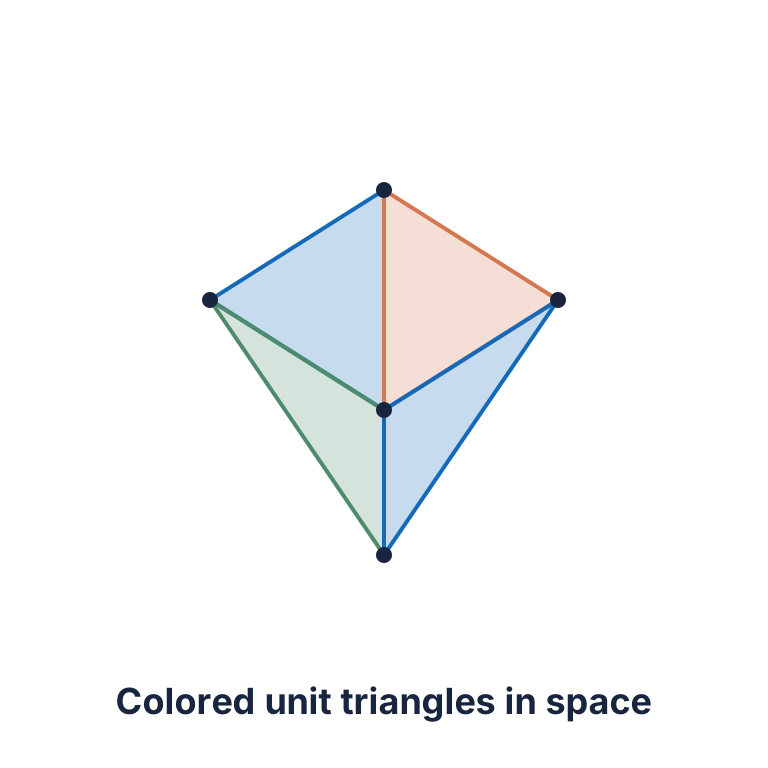
Problem. Let \(\alpha,\beta>0\) satisfy \(\alpha^2+\beta^2=1\), with \(\alpha\) transcendental, and set \(A=(\alpha,0,0)\), \(B=(0,\beta,0)\), \(C=(-\alpha,0,0)\), and \(D=(0,-\beta,0)\). Does there exist a colouring \(c:\mathbb R^3\to\{1,2,3\}\) such that \(c(A)=c(B)=1\), \(c(C)=2\), \(c(D)=3\), and every equilateral triangle of side length \(1\) in \(\mathbb R^3\) has vertices of at most two colours?
Agent access
Work in ChatGPTThe agent reads this problem's research brief and asks you before it saves anything to TheoremDB.
Definitions and notation
1Context
Finite forced-colouring gadgets can accumulate even when a global construction remains elusive. Recording minimal obstructions and colour-propagation rules would prevent repeated searches through the same configurations.
2Definitions
Definition 1 (A rainbow triangle). A rainbow triangle is a triangle whose three vertices receive three different colours.
Definition 2 (The four specified points form a planar rhombus with all four side lengths equal to 1; no condition). The four specified points form a planar rhombus with all four side lengths equal to 1; no condition is imposed on colours of pairs at unit distance unless they belong to a unit equilateral triangle.
3What counts as a solution
- Construct such a colouring and prove the unit-equilateral-triangle condition for every triple of points in R^3, or prove that every colouring with the four prescribed values contains a rainbow unit equilateral triangle.
- A finite obstruction proof may give a finite unit-distance configuration containing A,B,C,D and a complete certificate that every extension of the prescribed colours creates a rainbow triangle.
1Status
Saved packet · July 31, 2026
Saved packet status (Current status and unresolved remainder). UNKNOWN as of 2026-07-31. The source page has zero answers and explicitly says its later application was largely resolved while this one-directional colouring problem remained open. No subsequent exact resolution was located. Construct such a colouring and prove the unit-equilateral-triangle condition for every triple of points in R^3, or prove that every colouring with the four prescribed values contains a rainbow unit equilateral triangle.[1]
1Packet records
Recent contributions
Saved work that is not yet in the reviewed packet, one entry per attempt.
Notes and companion material
Original intake status. UNKNOWN as of 2026-07-31. The source page has zero answers and explicitly says its later application was largely resolved while this one-directional colouring problem remained open. No subsequent exact resolution was located.
- On 2026-07-27 the Stack Exchange API reported zero answers, no accepted answer, and no closure for MathOverflow question 202861; all comments were read to disambiguate that the colouring need not be proper.
- The 2020 paper arXiv:2005.02555 resolves much of the motivating configuration problem and explains the one-way connection in Section 5.4; the MathOverflow update states that this colouring extension remains open.
- Searches for the prescribed transcendental rhombus, rainbow-free unit equilateral triangles, and three-colourings of Euclidean three-space found no later proof or obstruction.
- A TheoremDB search for the coordinate quadruple, rainbow-free unit triangles, and the unit-distance graph formulation found no duplicate.
Recorded example 1. The four prescribed points are cyclically adjacent at unit distance because alpha^2+beta^2=1, while AC and BD are the two diagonals.
How the 2 records connect
ProblemA rainbow-free three-colouring of unit triangles in three-space
All 1 recorded relations between these records and the problem
2See also
Contribute to this problem
Cite this problem statement
Cite the original sources separately.
“A rainbow-free three-colouring of unit triangles in three-space.” TheoremDB. P2876. Problem statement; statement text SHA-256 403ffeed7b6c6c6258e816d97518525391eb64c670768353c8ec959669b01a33. https://theoremdb.org/statement/?ref=P2876
@misc{theoremdb-problem-403ffeed7b6c6c6258e816d97518525391eb64c670768353c8ec959669b01a33,
  title = {{A rainbow-free three-colouring of unit triangles in three-space}},
  howpublished = {TheoremDB},
  note = {Problem statement; statement text SHA-256 403ffeed7b6c6c6258e816d97518525391eb64c670768353c8ec959669b01a33},
  url = {https://theoremdb.org/statement/?ref=P2876}
}
Plain text: Built Markdown snapshot
This problem includes 2 records joined by 1 typed links, sourced from mathoverflow.net[1], current as of July 31, 2026.
1References
- Packet source. MathOverflow: 3-colorings of the unit distance graph of R^3. Question 202861 and all visible comments, checked through the Stack Exchange API on 2026-07-27. Question 202861 and all visible comments, checked through the Stack Exchange API on 2026-07-27. ↗forum · discovery source · checked 2026-07-31Source use: original summary.UNKNOWN as of 2026-07-27. The source page has zero answers and explicitly says its later application was largely resolved while this one-directional colouring problem remained open. No subsequent exact resolution was located.Also cited at See dataset.references[0] for the exact external source and locator.Also cited at Editorial research route recorded 2026-07-31.Source used to formulate or check the problem record.Source used to assess the problem's recorded status.For A rainbow-free three-colouring of unit triangles in three-space: UNKNOWN as of 2026-07-27. The source page has zero answers and explicitly says its later application was largely resolved while this one-directional colouring problem remained open. No subsequent exact resolution was located.Source named by the research packet.
- MathOverflow: 3-colorings of the unit distance graph of R^3, source checked for the TheoremDB status review (2026-07-31). Status evidence identified in the source record and checked at the linked publication. ↗preprint · primary source · arXiv:2005.02555, checked 2026-07-31 · checked 2026-07-31Source use: original summary.UNKNOWN as of 2026-07-27. The source page has zero answers and explicitly says its later application was largely resolved while this one-directional colouring problem remained open. No subsequent exact resolution was located.Also cited at Full preprint relevant to A rainbow-free three-colouring of unit triangles in three-space.Source used to assess the problem's recorded status.For A rainbow-free three-colouring of unit triangles in three-space: UNKNOWN as of 2026-07-27. The source page has zero answers and explicitly says its later application was largely resolved while this one-directional colouring problem remained open. No subsequent exact resolution was located.
- Mohammad Ghomi, “Equilaterally Triangulated Surfaces with Prescribed Boundary,” MathOverflow question 283921, asked October 20, 2017, checked 2026-08-01. Status evidence identified in the source record and checked at the linked publication. ↗forum · discovery source · checked 2026-07-31Source use: original summary.UNKNOWN as of 2026-07-27. The source page has zero answers and explicitly says its later application was largely resolved while this one-directional colouring problem remained open. No subsequent exact resolution was located.Also cited at question 283921 and its link sidebar, checked 2026-08-01.Source used to assess the problem's recorded status.For A rainbow-free three-colouring of unit triangles in three-space, this source asks a different equilateral-triangulation problem and was excluded as status evidence for the rainbow-free colouring target.
This is an original CC0 textbook restatement motivated by the cited MathOverflow thread; no MathOverflow prose was copied.
Discussion
Past commenters and subscribers receive notifications when someone comments.