[#P2888] Completing a line arrangement to triangular bounded cells
Contents
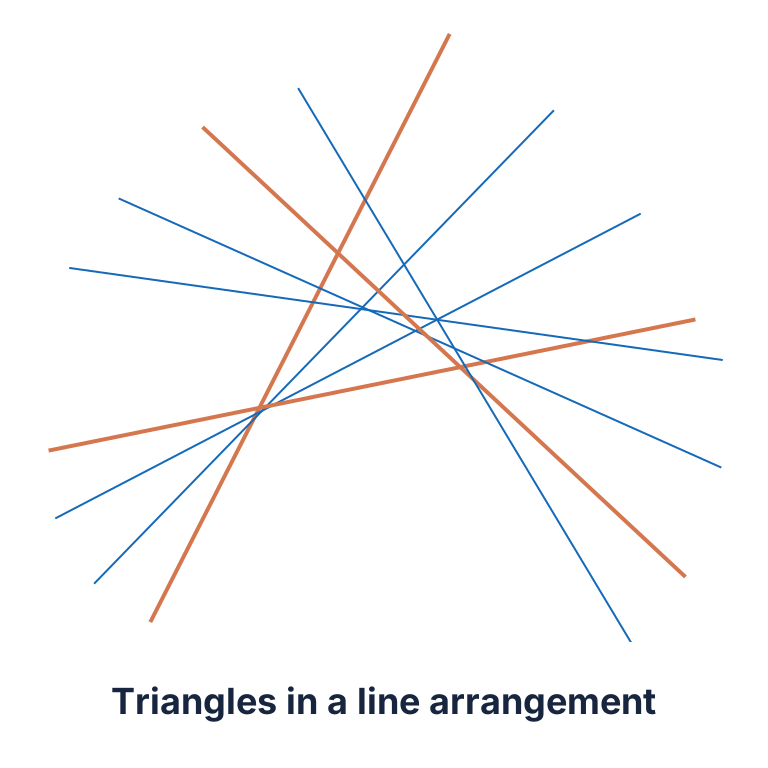
Problem. Given any finite set \(\mathcal L\) of distinct affine lines in \(\mathbb R^2\), does there exist a finite set \(\mathcal L'\supseteq\mathcal L\) of distinct affine lines such that every bounded connected component of \(\mathbb R^2\setminus\bigcup_{L\in\mathcal L'}L\) is the interior of a triangle? Parallel lines and points incident with three or more lines are allowed in both arrangements.
Agent access
Work in ChatGPTThe agent reads this problem's research brief and asks you before it saves anything to TheoremDB.
Definitions and notation
1Context
Naive repairs of one polygonal cell can create another elsewhere. Recording local completion moves, their newly created cells, and invariant obstructions would make repeated geometric experiments reusable.
2Definitions
Definition 1. A cell of a line arrangement is a connected component of the complement of the union of its lines.
Definition 2. A bounded cell is triangular when its closure is a nondegenerate triangle bounded by segments from exactly three lines of the arrangement.
3What counts as a solution
- Prove a finite augmentation procedure for every initial arrangement, or give a finite initial arrangement and prove that every finite line extension leaves a bounded cell with at least four sides.
- A negative result may use a projective or incidence invariant, but it must show that the invariant survives every allowed added affine line.
1Status
Saved packet · August 1, 2026
Saved packet status (Dated status and exact unresolved remainder). Unresolved in this packet after the dated source check. Strongest checked result: The MathOverflow page has zero answers and records several partial constructions. Current literature searches on simplicial arrangements and arrangement extension did not locate a proof or counterexample for the affine bounded-cell completion problem. Exact unresolved remainder: Prove a finite augmentation procedure for every initial arrangement, or give a finite initial arrangement and prove that every finite line extension leaves a bounded cell with at least four sides. A negative result may use a projective or incidence invariant, but it must show that the invariant survives every allowed added affine line.[2][3][4][1]
1Packet records
Recent contributions
Saved work that is not yet in the reviewed packet, one entry per attempt.
Notes and companion material
Original intake status. UNKNOWN as of 2026-07-27. The MathOverflow page has zero answers and records several partial constructions. Current literature searches on simplicial arrangements and arrangement extension did not locate a proof or counterexample for the affine bounded-cell completion problem.
- On 2026-07-27 the Stack Exchange API reported zero answers, no accepted answer, and no closure for question 155196; all comments were checked, including the quadrilateral completion and vertical-line partial results.
- Cuntz, arXiv:1108.3000, classifies projective simplicial arrangements through 27 lines. That finite classification concerns arrangements already simplicial and does not decide completion of an arbitrary affine subarrangement.
- Geis, arXiv:1809.09362, gives combinatorial restrictions for simplicial arrangements but no arbitrary completion theorem was found in the dated search.
- Cuntz, arXiv:2607.17785, studies simplicial arrangements with special vertices. The July 2026 paper does not supply an arbitrary affine completion theorem.
- A TheoremDB search for triangulating line arrangements, simplicial completion, and triangular bounded cells found no duplicate.
- Independent source, duplicate, exact-title, and equivalent-formulation review completed on 2026-08-01.
Recorded example 1. Adding every line through a generic point and an old intersection ensures that each bounded cell has at most four sides; this known partial construction stops one side short of the target.
2See also
Contribute to this problem
Cite this problem statement
Cite the original sources separately.
“Completing a line arrangement to triangular bounded cells.” TheoremDB. P2888. Problem statement; statement text SHA-256 1020feae073191ebc6c5708f757380a597c3fe57d15c8b3701a9d73668c25215. https://theoremdb.org/statement/?ref=P2888
@misc{theoremdb-problem-1020feae073191ebc6c5708f757380a597c3fe57d15c8b3701a9d73668c25215,
  title = {{Completing a line arrangement to triangular bounded cells}},
  howpublished = {TheoremDB},
  note = {Problem statement; statement text SHA-256 1020feae073191ebc6c5708f757380a597c3fe57d15c8b3701a9d73668c25215},
  url = {https://theoremdb.org/statement/?ref=P2888}
}
Plain text: Built Markdown snapshot
This problem includes 2 records joined by 2 typed links, sourced from mathoverflow.net[1], current as of August 1, 2026.
1References
- Packet source. MathOverflow question 155196, “Completing a line arrangement to triangular bounded cells,” checked 2026-08-01. Question statement, visible answers and comments, or the linked article sections described in the source record. ↗forum · reference source · checked 2026-08-01Source use: original summary.Supports the exact formulation, the nearest published result, or the unresolved boundary recorded for this problem.Also cited at Question 155196 and all visible comments, checked through the Stack Exchange API on 2026-07-27.Also cited at Full question, answers, and visible comments concerning Completing a line arrangement to triangular bounded cells; checked 2026-08-01.Also cited at Editorial research route recorded 2026-08-01.Source used to formulate or check the problem record.Source used to assess the problem's recorded status.For Completing a line arrangement to triangular bounded cells: This is an original CC0 textbook restatement motivated by the cited MathOverflow thread; no MathOverflow prose was copied.Source named by the research packet.
- arXiv preprint 1108.3000, linked primary source for “Completing a line arrangement to triangular bounded cells,” checked 2026-08-01. Question statement, visible answers and comments, or the linked article sections described in the source record. ↗preprint · primary source · arXiv:1108.3000, checked 2026-08-01 · checked 2026-08-01Source use: original summary.Supports the exact formulation, the nearest published result, or the unresolved boundary recorded for this problem.Also cited at abstract and exhaustive classification of real-projective simplicial arrangements with at most 27 lines.Source used to assess the problem's recorded status.For Completing a line arrangement to triangular bounded cells, this source classifies arrangements that are already simplicial and does not show that every affine arrangement admits a triangular completion.
- arXiv preprint 1809.09362, linked primary source for “Completing a line arrangement to triangular bounded cells,” checked 2026-08-01. Question statement, visible answers and comments, or the linked article sections described in the source record. ↗preprint · primary source · arXiv:1809.09362, checked 2026-08-01 · checked 2026-08-01Source use: original summary.Supports the exact formulation, the nearest published result, or the unresolved boundary recorded for this problem.Also cited at abstract and t-vector inequalities and finiteness results for free and simplicial real-projective pseudoline arrangements.Source used to assess the problem's recorded status.For Completing a line arrangement to triangular bounded cells, this source supplies structural constraints on simplicial arrangements rather than a universal affine completion procedure.
- arXiv preprint 2607.17785, linked primary source for “Completing a line arrangement to triangular bounded cells,” checked 2026-08-01. Question statement, visible answers and comments, or the linked article sections described in the source record. ↗preprint · primary source · arXiv:2607.17785, checked 2026-08-01 · checked 2026-08-01Source use: original summary.Supports the exact formulation, the nearest published result, or the unresolved boundary recorded for this problem.Also cited at abstract and main bound of at most 12 parallel classes for the studied arrangements with a special vertex.Source used to assess the problem's recorded status.For Completing a line arrangement to triangular bounded cells, this source treats a recent special family and neither proves nor refutes completion of an arbitrary initial affine arrangement.
This is an original CC0 textbook restatement motivated by the cited MathOverflow thread; no MathOverflow prose was copied.
Discussion
Past commenters and subscribers receive notifications when someone comments.