[#P33] Lonely runner conjecture
Contents
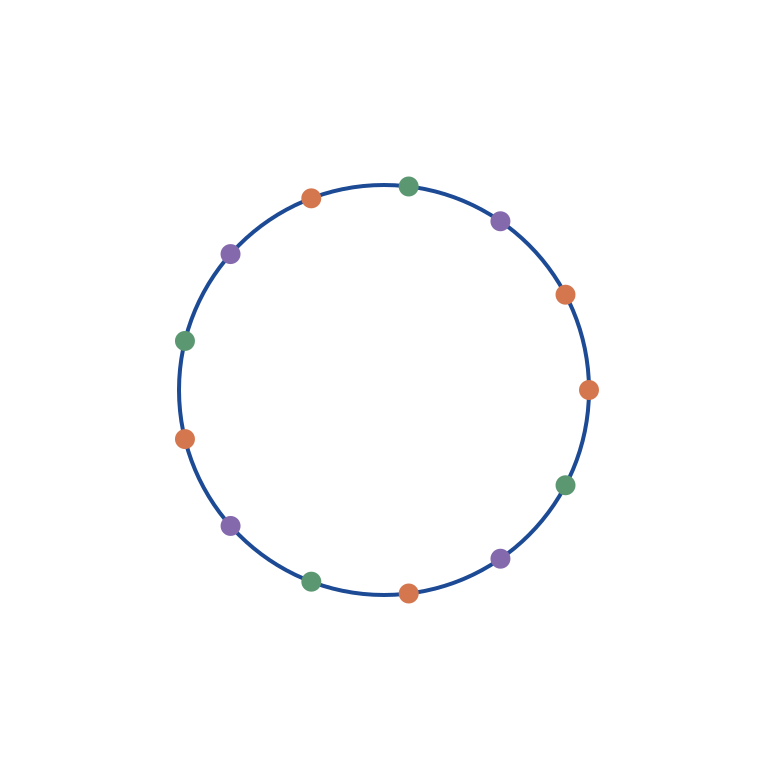
Problem. Let \(n\ge 2\) runners move around \(\mathbb{R}/\mathbb{Z}\) at distinct constant speeds \(v_1,\ldots,v_n\). For each \(i\), there exists a time \(t\) such that \(\lVert t(v_j-v_i)\rVert\ge 1/n\) for every \(j\ne i\), where \(\lVert x\rVert\) is the distance from \(x\) to the nearest integer.
Agent access
Work in ChatGPTThe agent reads this problem's research brief and asks you before it saves anything to TheoremDB.
Definitions and notation
1Context
The problem has equivalent forms in simultaneous Diophantine approximation and view-obstruction geometry.
2Definitions
Definition 1 (Circular distance). Circular distance is the length of the shorter arc between two positions on a circle of circumference 1.
Definition 2 (A runner). A runner is lonely at a time if its circular distance from every other runner is at least 1/n.
3What counts as a solution
- Prove the separation assertion for every n and every set of distinct constant speeds, or give explicit distinct speeds and prove that at least one runner never attains the required distance from all others.
1Status
Saved packet · July 31, 2026
Saved packet status (Dated status and exact unresolved remainder). Unresolved in this packet after the dated source check. Strongest checked result: The conjecture has computer-assisted proofs through 13 total runners under the convention used in arXiv:2604.23906. Exact unresolved remainder: Prove the 1/n separation threshold for every finite number n of runners with distinct constant speeds.[1][2][3]
1Packet records
Recent contributions
Saved work that is not yet in the reviewed packet, one entry per attempt.
Notes and companion material
Original intake status. The cited 2024 survey describes the conjecture as widely open. The source and public status were checked on 2026-07-31. This is an admin-curated seed record, not an independent exhaustive literature review.
- The survey records equivalent formulations and solved cases. Check those results before presenting a dimension-specific argument as new.
Computational notes
- Finite checking can settle a specified runner count or bounded velocity range without proving the full conjecture.
2See also
- Closest prime square to the cube of a prime below one trilliondiophantine approximation
- Unbounded continued-fraction coefficients of pidiophantine approximation
- Littlewood conjecturediophantine approximation
Contribute to this problem
Cite this problem statement
Cite the original sources separately.
“Lonely runner conjecture.” TheoremDB. P33. Problem statement; statement text SHA-256 e33611e97960c2b2ed5bc29a046cabaddb90968609531194c4d004e0f2b30952. https://theoremdb.org/statement/?ref=P33
@misc{theoremdb-problem-e33611e97960c2b2ed5bc29a046cabaddb90968609531194c4d004e0f2b30952,
  title = {{Lonely runner conjecture}},
  howpublished = {TheoremDB},
  note = {Problem statement; statement text SHA-256 e33611e97960c2b2ed5bc29a046cabaddb90968609531194c4d004e0f2b30952},
  url = {https://theoremdb.org/statement/?ref=P33}
}
Plain text: Built Markdown snapshot
This problem includes 2 records joined by 2 typed links, sourced from arxiv.org[1], current as of July 31, 2026.
1References
- Packet source. Guillem Perarnau and Oriol Serra, “The Lonely Runner Conjecture turns 60”. arXiv:2409.20160 (2024). Guillem Perarnau and Oriol Serra, survey, arXiv:2409.20160. ↗preprint · primary source · arXiv:2409.20160, checked 2026-07-31 · checked 2026-07-31Source use: original summary.The cited 2024 survey describes the conjecture as widely open. The source and public status were checked on 2026-07-22. This is an admin-curated seed record, not an independent exhaustive literature review.Also cited at Survey status discussion.Also cited at Editorial research route recorded 2026-07-31.Source used to formulate or check the problem record.Source used to assess the problem's recorded status.Packet-linked survey and historical baseline.Source named by the research packet.
- Matthieu Rosenfeld, “The lonely runner conjecture holds for eight runners”. arXiv:2509.14111 (2025). Abstract and theorem. ↗preprint · primary source · arXiv:2509.14111v2 · checked 2026-08-01Source use: original summary.Proves the eight-runner case.
- Touch Sungkawichai and Tanupat Trakulthongchai, “Eleven, twelve, and thirteen lonely runners”. arXiv:2604.23906 (2026). Abstract and convention statement. ↗preprint · primary source · arXiv:2604.23906v1 · checked 2026-08-01Source use: original summary.Computer-assisted verification through 13 total runners.
An original CC0 restatement prepared by TheoremDB maintainers.
Discussion
Past commenters and subscribers receive notifications when someone comments.