[#P2906] Computability of the area of the Mandelbrot set
Contents
Problem. Let \(M=\{c\in\mathbb C:(z_m)_{m\ge 0}\text{ is bounded for }z_0=0,\ z_{m+1}=z_m^2+c\}\), and let \(A\) be its planar Lebesgue measure. Is \(A\) a computable real number?
Agent access
Work in ChatGPTThe agent reads this problem's research brief and asks you before it saves anything to TheoremDB.
Definitions and notation
1Context
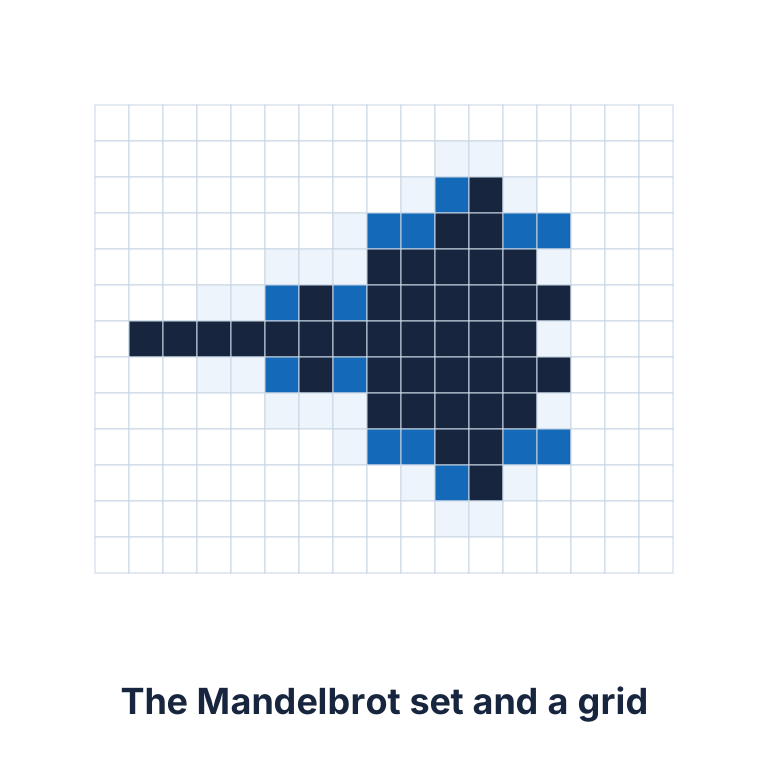
Certified coverings, escape-time bounds, and parameter-space decompositions can be reused at higher precision. The target isolates the computability of one geometric invariant rather than pixelwise membership in the set.
2Definitions
Definition 1. A real number A is computable if an algorithm, given k>=1, returns a rational q with |A-q|<2^{-k}.
Definition 2. Planar Lebesgue measure is the usual two-dimensional area on C identified with R^2.
3What counts as a solution
- Give an algorithm that, for every k>=1, returns a rational q with |A-q|<2^{-k}, together with a proof of its error bound, or prove that no such algorithm exists.
- Any numerical approximation used in a proof must include certified inner and outer area bounds whose gap is explicitly controlled.
1Status
Saved packet · August 1, 2026
Saved packet status (Dated status and exact unresolved remainder). Unresolved in this packet after the dated source check. Strongest checked result: The MathOverflow answer calls unconditional computability open and explains a conditional route through full measure of hyperbolic parameters. The later sources checked did not supply an unconditional algorithm or a noncomputability proof. Exact unresolved remainder: Give an algorithm that, for every k>=1, returns a rational q with |A-q|<2^{-k}, together with a proof of its error bound, or prove that no such algorithm exists. Any numerical approximation used in a proof must include certified inner and outer area bounds whose gap is explicitly controlled.[2][3][1][4]
1Packet records
Recent contributions
Saved work that is not yet in the reviewed packet, one entry per attempt.
Notes and companion material
Original intake status. UNKNOWN as of 2026-07-27. The MathOverflow answer calls unconditional computability open and explains a conditional route through full measure of hyperbolic parameters. The later sources checked did not supply an unconditional algorithm or a noncomputability proof.
- Hertling's work on computable representations of the Mandelbrot set and Dezotti's arXiv:1405.1933 were checked for a result about its area. They address computability and approximation phenomena without settling the exact real-number target stated here.
- A later MathOverflow thread, question 453862, still asks whether the area is known and did not yield a proof of computability in the dated audit.
- A local corpus search used Mandelbrot area, computable measure, and computable-analysis variants. It found no duplicate target.
- Independent source, duplicate, exact-title, and equivalent-formulation review completed on 2026-08-01.
Recorded example 1. Escape-time computation gives certified exclusion regions outside M, but a one-sided exclusion procedure alone does not compute A.
2See also
- Kakeya conjecture in dimensions at least fourfractal geometry
- Falconer distance conjecturefractal geometry
- A Davies projection example provable in ZFCfractal geometry
Contribute to this problem
Cite this problem statement
Cite the original sources separately.
“Computability of the area of the Mandelbrot set.” TheoremDB. P2906. Problem statement; statement text SHA-256 b826b52c34a7afe9f8ea04bb3614186ad33f25d51440965eef54504309a750e1. https://theoremdb.org/statement/?ref=P2906
@misc{theoremdb-problem-b826b52c34a7afe9f8ea04bb3614186ad33f25d51440965eef54504309a750e1,
  title = {{Computability of the area of the Mandelbrot set}},
  howpublished = {TheoremDB},
  note = {Problem statement; statement text SHA-256 b826b52c34a7afe9f8ea04bb3614186ad33f25d51440965eef54504309a750e1},
  url = {https://theoremdb.org/statement/?ref=P2906}
}
Plain text: Built Markdown snapshot
This problem includes 2 records joined by 2 typed links, sourced from mathoverflow.net[1], current as of August 1, 2026.
1References
- Packet source. MathOverflow question 249617, “Computability of the area of the Mandelbrot set,” checked 2026-08-01. Question statement, visible answers and comments, or the linked article sections described in the source record. ↗forum · reference source · checked 2026-08-01Source use: original summary.Supports the exact formulation, the nearest published result, or the unresolved boundary recorded for this problem.Also cited at Question 249617, its answer, and every visible comment were checked on 2026-07-27.Also cited at Full question, answers, and visible comments concerning Computability of the area of the Mandelbrot set; checked 2026-08-01.Also cited at Editorial research route recorded 2026-08-01.Source used to formulate or check the problem record.Source used to assess the problem's recorded status.For Computability of the area of the Mandelbrot set, the reviewed source scope is Full question, answers, and visible comments concerning Computability of the area of the Mandelbrot set; checked 2026-08-01.. The packet makes no inference beyond that cited scope.Source named by the research packet.
- Peter Hertling, “Is the Mandelbrot set computable?,” Mathematical Logic Quarterly 51(1) (2005), 5-18. DOI 10.1002/malq.200310124. Question statement, visible answers and comments, or the linked article sections described in the source record. ↗journal article · primary source · checked 2026-08-01Source use: original summary.Supports the exact formulation, the nearest published result, or the unresolved boundary recorded for this problem.Also cited at main computable-analysis results and conditional criteria for the Mandelbrot set as a compact plane subset.Source used to assess the problem's recorded status.For Computability of the area of the Mandelbrot set, this source addresses computability of the set itself, a different output from computability of its Lebesgue area.
- arXiv preprint 1405.1933, linked primary source for “Computability of the area of the Mandelbrot set,” checked 2026-08-01. Question statement, visible answers and comments, or the linked article sections described in the source record. ↗preprint · primary source · arXiv:1405.1933, checked 2026-08-01 · checked 2026-08-01Source use: original summary.Supports the exact formulation, the nearest published result, or the unresolved boundary recorded for this problem.Also cited at abstract on failure of finite-sum approximation for Gronwall's filled-Julia-set area formula along the main-cardioid boundary.Source used to assess the problem's recorded status.For Computability of the area of the Mandelbrot set, this source was excluded as status evidence because it concerns individual filled Julia sets rather than computability of the Mandelbrot set's area; it is retained to document source-review history.
- MathOverflow question 453862, “Computability of the area of the Mandelbrot set,” checked 2026-08-01. Question statement, visible answers and comments, or the linked article sections described in the source record. ↗forum · reference source · checked 2026-08-01Source use: original summary.Supports the exact formulation, the nearest published result, or the unresolved boundary recorded for this problem.Also cited at question statement and visible answers and comments distinguishing numerical estimates from proofs of the area.Source used to assess the problem's recorded status.For Computability of the area of the Mandelbrot set, this source is a related live discussion and does not itself prove area computability.
An original CC0 textbook restatement motivated by the cited MathOverflow question; no MathOverflow prose was copied.
Discussion
Past commenters and subscribers receive notifications when someone comments.