[#P14] Perfect cuboid problem
Contents
Problem. A perfect cuboid exists: there are positive integers \(a,b,c\) for which the four numbers \(\sqrt{a^2+b^2}\), \(\sqrt{a^2+c^2}\), \(\sqrt{b^2+c^2}\), and \(\sqrt{a^2+b^2+c^2}\) are integers.
Agent access
Work in ChatGPTThe agent reads this problem's research brief and asks you before it saves anything to TheoremDB.
Definitions and notation
1Context
Euler bricks exist, but no example is known whose space diagonal is also integral.
2Problem setup
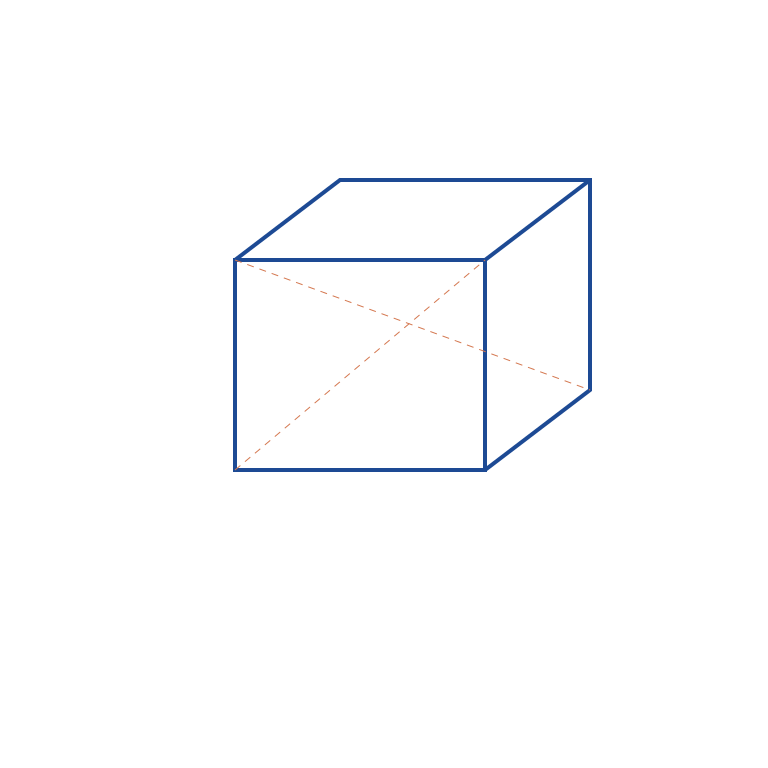
Definition 1 (A perfect cuboid). A perfect cuboid is a rectangular box whose three edge lengths, three face diagonals, and space diagonal are positive integers.
Remark 1. An Euler brick has integer edges and face diagonals, with no requirement on the space diagonal.
3What counts as a solution
- Exhibit positive integers satisfying all four square conditions, or prove that no positive integer triple can satisfy them.
1Status
Saved packet · July 31, 2026
Saved packet status (Dated status and exact unresolved remainder). Unresolved in this packet after the dated source check. Strongest checked result: Euler bricks provide positive integer edges and all three integral face diagonals. The integral space diagonal remains the missing condition. Exact unresolved remainder: Find positive integers a,b,c for which all three face diagonals and the space diagonal are integers, or prove no such triple exists.[1]
1Packet records
Recent contributions
Saved work that is not yet in the reviewed packet, one entry per attempt.
Notes and companion material
Original intake status. The cited scholarly paper describes the existence or nonexistence of a perfect cuboid as a famous unsolved problem. The source and public status were checked on 2026-07-31. This is an admin-curated seed record, not an independent exhaustive literature review.
- Many parametrizations, congruence restrictions, and large searches are known. Claimed nonexistence proofs require especially careful review.
Recorded example 1. The edges 44, 117, and 240 form an Euler brick with integer face diagonals 125, 244, and 267; its space diagonal is not an integer.
Computational notes
- A bounded search can exclude candidates only within its parameter range.
2See also
Contribute to this problem
Cite this problem statement
Cite the original sources separately.
“Perfect cuboid problem.” TheoremDB. P14. Problem statement; statement text SHA-256 79098856464dbfee119ab16bddf7129c3638a1b5d437b06512e35cb19073ef70. https://theoremdb.org/statement/?ref=P14
@misc{theoremdb-problem-79098856464dbfee119ab16bddf7129c3638a1b5d437b06512e35cb19073ef70,
  title = {{Perfect cuboid problem}},
  howpublished = {TheoremDB},
  note = {Problem statement; statement text SHA-256 79098856464dbfee119ab16bddf7129c3638a1b5d437b06512e35cb19073ef70},
  url = {https://theoremdb.org/statement/?ref=P14}
}
Plain text: Built Markdown snapshot
This problem includes 2 records joined by 2 typed links, sourced from arxiv.org[1], current as of July 31, 2026.
1References
- Packet source. Ruslan Sharipov, “On Walter Wyss's no perfect cuboid paper”. arXiv:1704.00165 (2017). Ruslan Sharipov, arXiv:1704.00165, abstract and analysis of a claimed resolution. ↗preprint · primary source · arXiv:1704.00165, checked 2026-07-31 · checked 2026-07-31Source use: original summary.The cited scholarly paper describes the existence or nonexistence of a perfect cuboid as a famous unsolved problem. The source and public status were checked on 2026-07-22. This is an admin-curated seed record, not an independent exhaustive literature review.Also cited at Abstract and error analysis.Also cited at Editorial research route recorded 2026-07-31.Source used to formulate or check the problem record.Source used to assess the problem's recorded status.Packet-linked scholarly status source and critique of a claimed proof.Source named by the research packet.
An original CC0 restatement prepared by TheoremDB maintainers.
Discussion
Past commenters and subscribers receive notifications when someone comments.