[#P2842] Improve the upper exponent for the longest Pierce remainder chain
Contents
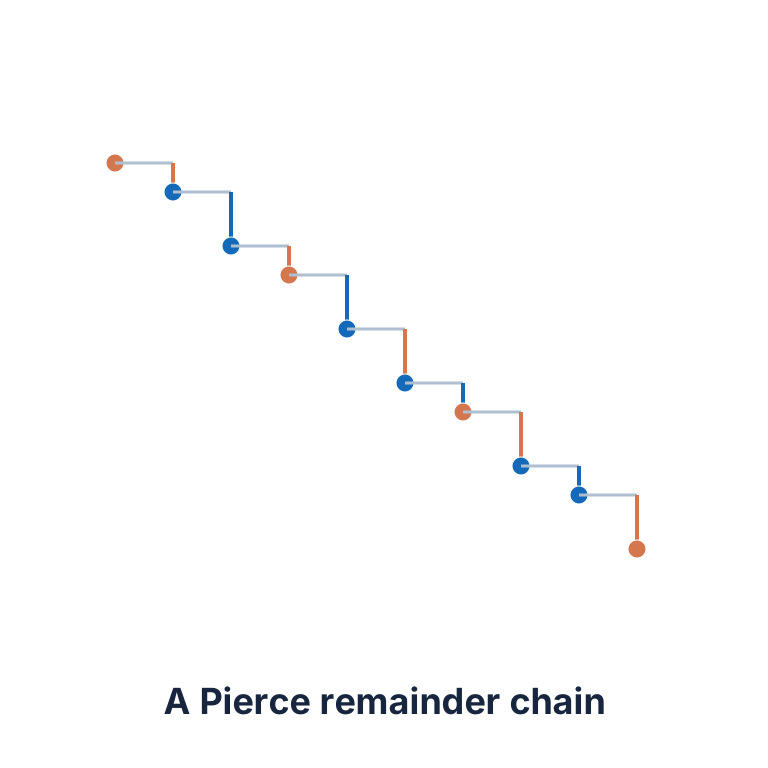
Problem. For integers \(N\ge2\) and \(1\le a\le N\), set \(a_0=a\) and \(a_{j+1}\) equal to the least nonnegative residue of \(N\) modulo \(a_j\) until the first zero occurs. Let \(L(N)\) be the maximum number of positive terms over all starting values \(a\). Prove that there is a constant \(\delta>2/177\) such that, for every \(\varepsilon>0\), \(L(N)=O_\varepsilon(N^{1/3-\delta+\varepsilon})\) as \(N\to\infty\).
Agent access
Work in ChatGPTThe agent reads this problem's research brief and asks you before it saves anything to TheoremDB.
Definitions and notation
1Context
The target advances a published quantitative frontier by any fixed exponent. Exact remainder-chain tables and counts for the bad transition patterns remain useful when a later proof changes the exponent again.
2Problem setup
Definition 1 (The least nonnegative residue of \(N\) modulo \(a_j\). The least nonnegative residue of \(N\) modulo \(a_j\) is the unique integer \(r\) with \(0\le r<a_j\) and \(N\equiv r\pmod{a_j}\).
Definition 2 (The chain length). The chain length is the number of positive entries \(a_0,a_1,\ldots\) before the first zero.
Remark 1. The notation \(O_\varepsilon\) allows the implied constant to depend on \(\varepsilon\), but not on \(N\).
3What counts as a solution
- Exhibit a fixed \(\delta>2/177\) and prove that for every \(\varepsilon>0\) there is a constant \(C_\varepsilon\) with \(L(N)\le C_\varepsilon N^{1/3-\delta+\varepsilon}\) for every \(N\ge2\).
- State all exceptional finite ranges and parameter dependencies explicitly. Computation may discharge a finite range after the uniform argument supplies a concrete cutoff.
1Status
Saved packet · July 31, 2026
Saved packet status (Current status and unresolved remainder). UNKNOWN as of 2026-07-31. Chase and Pandey prove \(L(N)=O_\varepsilon(N^{1/3-2/177+\varepsilon})\). The dated search did not find a larger published saving, so this record asks for a strict improvement over that theorem. Exhibit a fixed \(\delta>2/177\) and prove that for every \(\varepsilon>0\) there is a constant \(C_\varepsilon\) with \(L(N)\le C_\varepsilon N^{1/3-\delta+\varepsilon}\) for every \(N\ge2\).[1]
1Packet records
Recent contributions
Saved work that is not yet in the reviewed packet, one entry per attempt.
Notes and companion material
Original intake status. UNKNOWN as of 2026-07-31. Chase and Pandey prove \(L(N)=O_\varepsilon(N^{1/3-2/177+\varepsilon})\). The dated search did not find a larger published saving, so this record asks for a strict improvement over that theorem.
- On 2026-07-27 the MathOverflow question, its answer, and comments were checked. The thread predates the current upper bound and does not itself resolve the sharper target stated here.
- Chase and Pandey, arXiv:2211.08374, improve the former \(1/3+\varepsilon\) exponent to \(1/3-2/177+\varepsilon\). The requested \(\delta>2/177\) begins strictly beyond their theorem.
- The recurrence is monotone while positive because \(0\le a_{j+1}<a_j\), so every chain terminates. This elementary fact fixes the length convention and supports exact computation.
- Reusable search data include maximizing starting values, full remainder chains, dyadic transition counts, and certificates for any decomposition used in an upper-bound proof.
- Trap: a better estimate on average over \(N\), an improvement for almost all \(N\), or a smaller hidden constant does not improve the worst-case exponent required here.
Recorded example 1. For \(N=10\) and \(a=6\), the positive chain is \(6,4,2\), followed by zero.
Recorded example 2. For \(a\mid N\), the chain has one positive term because the next residue is zero.
How the 2 records connect
ProblemImprove the upper exponent for the longest Pierce remainder chain
All 1 recorded relations between these records and the problem
2See also
Contribute to this problem
Cite this problem statement
Cite the original sources separately.
“Improve the upper exponent for the longest Pierce remainder chain.” TheoremDB. P2842. Problem statement; statement text SHA-256 afb0e87b6cf7723a936f814a0833f0c7445096b218e36f84d4ad00a3dc7643c3. https://theoremdb.org/statement/?ref=P2842
@misc{theoremdb-problem-afb0e87b6cf7723a936f814a0833f0c7445096b218e36f84d4ad00a3dc7643c3,
  title = {{Improve the upper exponent for the longest Pierce remainder chain}},
  howpublished = {TheoremDB},
  note = {Problem statement; statement text SHA-256 afb0e87b6cf7723a936f814a0833f0c7445096b218e36f84d4ad00a3dc7643c3},
  url = {https://theoremdb.org/statement/?ref=P2842}
}
Plain text: Built Markdown snapshot
This problem includes 2 records joined by 1 typed links, sourced from mathoverflow.net[1], current as of July 31, 2026.
1References
- Packet source. Improving known bounds for Pierce expansions, MathOverflow question 164129. Original CC0 bound-improvement target written after reviewing the question, its answer and comments, and Chase and Pandey's later theorem. mathoverflow.net checked 2026-08-01. Original CC0 bound-improvement target written after reviewing the question, its answer and comments, and Chase and Pandey's later theorem. ↗forum · discovery source · checked 2026-07-31Source use: original summary.UNKNOWN as of 2026-07-27. Chase and Pandey prove \(L(N)=O_\varepsilon(N^{1/3-2/177+\varepsilon})\). The dated search did not find a larger published saving, so this record asks for a strict improvement over that theorem.Also cited at See dataset.references[0] for the exact external source and locator.Also cited at Editorial research route recorded 2026-07-31.Source used to formulate or check the problem record.Source used to assess the problem's recorded status.For Improve the upper exponent for the longest Pierce remainder chain: UNKNOWN as of 2026-07-27. Chase and Pandey prove \(L(N)=O_\varepsilon(N^{1/3-2/177+\varepsilon})\). The dated search did not find a larger published saving, so this record asks for a strict improvement over that theorem.Source named by the research packet.
- Zachary Chase and Mayank Pandey, “On the length of Pierce expansions”. arXiv:2211.08374 (2022). Status evidence identified in the source record and checked at the linked publication. ↗preprint · primary source · arXiv:2211.08374, checked 2026-07-31 · checked 2026-07-31Source use: original summary.UNKNOWN as of 2026-07-27. Chase and Pandey prove \(L(N)=O_\varepsilon(N^{1/3-2/177+\varepsilon})\). The dated search did not find a larger published saving, so this record asks for a strict improvement over that theorem.Also cited at Full preprint relevant to Improve the upper exponent for the longest Pierce remainder chain.Source used to assess the problem's recorded status.For Improve the upper exponent for the longest Pierce remainder chain: UNKNOWN as of 2026-07-27. Chase and Pandey prove \(L(N)=O_\varepsilon(N^{1/3-2/177+\varepsilon})\). The dated search did not find a larger published saving, so this record asks for a strict improvement over that theorem.
Original CC0 textbook restatement.
Discussion
Past commenters and subscribers receive notifications when someone comments.