[#P3130] Polynomial-time recovery of planted cliques below the square-root scale
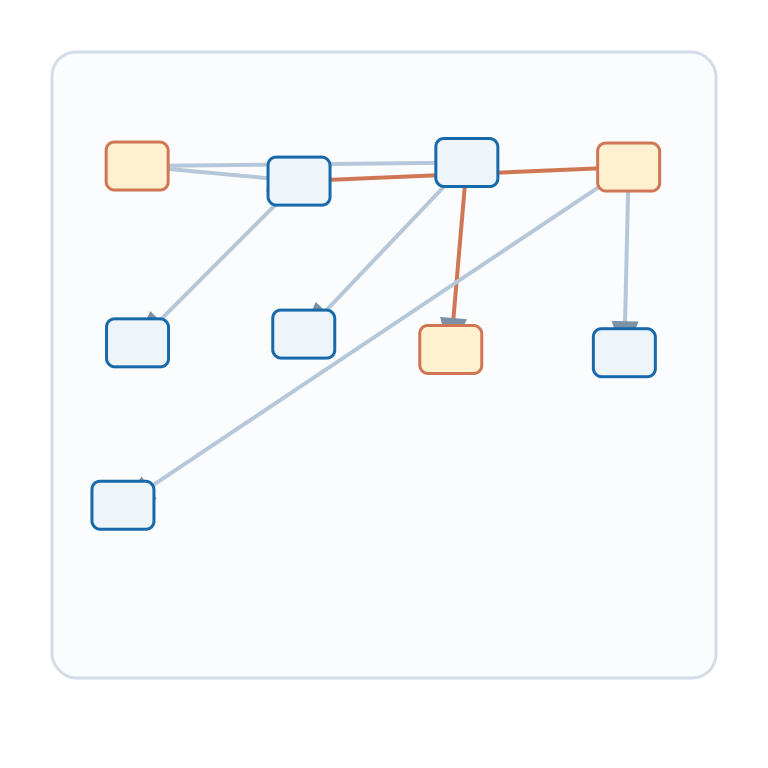
Contents
Problem. Fix \(\delta>0\). Given a graph sampled by first drawing \(G(n,1/2)\) and then planting a uniformly random clique of size \(k=\lceil n^{1/2-\delta}\rceil\), is there a randomized polynomial-time algorithm that recovers the planted vertex set with probability tending to one?
Agent access
Work on this problem in ChatGPTDefinitions and notation
1Context
Known frontier: Polynomial-time recovery works at k on the order of √n, while low-degree, sum-of-squares, and several algorithm families have lower bounds below it. Open boundary: No unrestricted polynomial-time algorithm or unconditional average-case lower bound is known for k=n^{1/2−δ}.
2Problem setup
Definition 1 (planted clique model). G(n,1/2) with every missing edge inside a random k-set added.
Definition 2 (recovery). Output the exact planted vertex set with probability 1−o(1).
Remark 1. Information-theoretic recovery is possible near logarithmic size, while known general polynomial-time methods require roughly the square-root scale. The packet fixes one constant δ to avoid mixing regimes.
3What counts as a solution
- For some fixed δ>0, give and prove a polynomial-time exact-recovery algorithm.
- Or prove polynomial-time recovery impossible under an explicit unconditional average-case model, which may require a new lower-bound framework.
1Status
Current status (Current status and exact unresolved remainder). OPEN as checked on 2026-08-01. Strongest checked neighboring result: Polynomial-time recovery works at k on the order of √n, while low-degree, SoS, and several algorithm families have lower bounds below it. Exact unresolved remainder: No unrestricted polynomial-time algorithm or unconditional average-case lower bound is known for k=n^{1/2−δ}.[1][2]
1Packet records
Recent contributions
Notes and companion material
Original intake status. OPEN as checked on 2026-08-01. Strongest checked neighboring result: Polynomial-time recovery works at k on the order of √n, while low-degree, SoS, and several algorithm families have lower bounds below it. Exact unresolved remainder: No unrestricted polynomial-time algorithm or unconditional average-case lower bound is known for k=n^{1/2−δ}.
- Equivalent-formulation queries: planted clique polynomial time below sqrt n current 2026; planted clique n one half minus delta recovery open
- Strongest checked neighboring result: Polynomial-time recovery works at k on the order of √n, while low-degree, SoS, and several algorithm families have lower bounds below it.
- Exact unresolved remainder: No unrestricted polynomial-time algorithm or unconditional average-case lower bound is known for k=n^{1/2−δ}.
How the 4 records connect
ProblemPolynomial-time recovery of planted cliques below the square-root scale
All 3 recorded relations between these records and the problem
2See also
- Multiplicative complexity of the six-bit threshold-at-least-three functiontheoretical computer science
- Polynomial determinization of two-way finite automatatheoretical computer science
- Logarithmic DFA separation of binary wordstheoretical computer science
Contribute to this problem
Cite this problem statement
Cite the original sources separately.
“Polynomial-time recovery of planted cliques below the square-root scale.” TheoremDB. P3130. Problem statement; statement text SHA-256 81f5ed0a6ec363dcd4533907249ba409827959f323ffc404a6fddb4020874d89. https://theoremdb.org/statement/?ref=P3130
@misc{theoremdb-problem-81f5ed0a6ec363dcd4533907249ba409827959f323ffc404a6fddb4020874d89,
  title = {{Polynomial-time recovery of planted cliques below the square-root scale}},
  howpublished = {TheoremDB},
  note = {Problem statement; statement text SHA-256 81f5ed0a6ec363dcd4533907249ba409827959f323ffc404a6fddb4020874d89},
  url = {https://theoremdb.org/statement/?ref=P3130}
}
Plain text: Built Markdown snapshot
This problem includes 4 records joined by 3 typed links, sourced from arxiv.org[1], current as of August 1, 2026.
1References
- Packet source. R. Meka, A. Potechin, and A. Wigderson, Sum-of-squares lower bounds for planted clique, STOC 2015. main SoS lower bounds. ↗preprint · primary source · arXiv:1503.06447, checked 2026-08-01 · checked 2026-08-01Source use: original summary.Shows strong lower bounds for a major algorithmic hierarchy below the square-root regime.Also cited at R. Meka, A. Potechin, and A. Wigderson, Sum-of-squares lower bounds for planted clique, STOC 2015. main SoS lower bounds.Source used to assess the problem's recorded status.For Polynomial-time recovery of planted cliques below the square-root scale: This is the dated publication status for the canonical target Polynomial-time recovery of planted cliques below the square-root scale.Source named by the research packet.
- Reza Gheissari, Aukosh Jagannath, and Yiming Xu, “Finding Planted Cliques Using Gradient Descent”. SIAM Journal on Mathematics of Data Science 7(2) (2025), 643-669. DOI 10.1137/24M1680489. abstract and main results. ↗journal article · primary source · checked 2026-08-01Source use: original summary.States the continuing square-root algorithmic threshold and analyzes another broad method.Source used to assess the problem's recorded status.For Polynomial-time recovery of planted cliques below the square-root scale: States the continuing square-root algorithmic threshold and analyzes another broad method.
Original TheoremDB editorial statement and source synthesis; external works are used for citation only.
Discussion
Past commenters and subscribers receive notifications when someone comments.