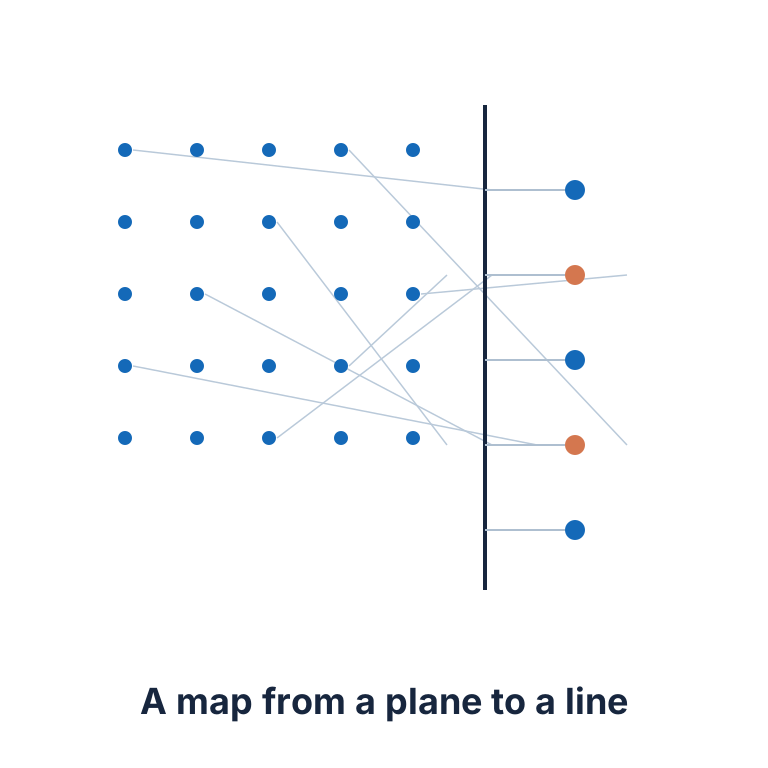
[#P2838] A polynomial bijection from the rational plane to the rational line
Contents
Problem. Does there exist a polynomial \(F\in\mathbb Q[X,Y]\) for which the map \(F:\mathbb Q^2\to\mathbb Q\) is a bijection? Equivalently, require that for every \(t\in\mathbb Q\), the equation \(F(x,y)=t\) have exactly one ordered solution \((x,y)\in\mathbb Q^2\).
Agent access
Work on this problem in ChatGPTDefinitions and notation
1Context
The fibers connect a simple coding question to uniform bounds for rational points on curves. Partial work can classify degrees, analyze generic fibers, or test restricted polynomial families, provided each restriction is recorded.
2Problem setup
Definition 1 (A polynomial map \(F:\mathbb Q^2\to\mathbb Q\) sends \((x,y)\) to the value obtained by evaluating one fixed polynomial with rational coefficients). A polynomial map \(F:\mathbb Q^2\to\mathbb Q\) sends \((x,y)\) to the value obtained by evaluating one fixed polynomial with rational coefficients.
Definition 2 (Bijectivity). Bijectivity means simultaneous injectivity and surjectivity: every rational value has exactly one ordered rational preimage.
Definition 3 (The fiber over \(t\). The fiber over \(t\) is the affine plane curve defined by \(F(X,Y)=t\), considered through its rational points.
Remark 1. The fibers connect a simple coding question to uniform bounds for rational points on curves. Partial work can classify degrees, analyze generic fibers, or test restricted polynomial families, provided each restriction is recorded.
3What counts as a solution
- Give an explicit polynomial \(F\in\mathbb Q[X,Y]\) and prove that every rational \(t\) has exactly one ordered rational preimage.
- Alternatively, prove unconditionally that no such polynomial exists. A result conditional on Bombieri-Lang, uniformity, or another unproved conjecture does not meet acceptance.
1Status
Current status (Current status and unresolved remainder). UNKNOWN as of 2026-07-31. The MathOverflow thread has no accepted answer. Poonen gives a conditional polynomial injection, while Bresciani proves conditional nonexistence of a polynomial bijection under a weak Bombieri-Lang conjecture. The dated search found no unconditional resolution. Give an explicit polynomial \(F\in\mathbb Q[X,Y]\) and prove that every rational \(t\) has exactly one ordered rational preimage.[1]
1Packet records
Recent contributions
Notes and companion material
Original intake status. UNKNOWN as of 2026-07-31. The MathOverflow thread has no accepted answer. Poonen gives a conditional polynomial injection, while Bresciani proves conditional nonexistence of a polynomial bijection under a weak Bombieri-Lang conjecture. The dated search found no unconditional resolution.
- On 2026-07-27 the full MathOverflow thread, including all three answers and their comments, was checked. The answers provide heuristics, conditional constructions, and obstructions, with no unconditional bijection or impossibility theorem.
- Poonen, arXiv:0902.3961, constructs a polynomial injection \(\mathbb Q\times\mathbb Q\to\mathbb Q\) conditional on a uniformity conjecture for rational points. This settles neither surjectivity nor the unconditional target.
- Bresciani, arXiv:2101.01090, proves that a weak Bombieri-Lang conjecture rules out a polynomial bijection \(\mathbb Q^2\to\mathbb Q\). The hypothesis must remain visible in any use of that result.
- Trap: a set-theoretic bijection, a rational function, an injection, or a polynomial that is bijective only on nonnegative integers answers a different question. A witness must use one polynomial in \(\mathbb Q[X,Y]\) on every ordered rational pair.
Recorded example 1. The projection \(F(X,Y)=X\) is surjective and has infinitely many preimages for every value, so surjectivity alone is easy.
Recorded example 2. The Cantor pairing polynomial is a bijection on pairs of nonnegative integers, but its domain and codomain differ from the rational sets in this problem.
How the 2 records connect
ProblemA polynomial bijection from the rational plane to the rational line
All 1 recorded relations between these records and the problem
2See also
Contribute to this problem
Cite this problem statement
Cite the original sources separately.
“A polynomial bijection from the rational plane to the rational line.” TheoremDB. P2838. Problem statement; statement text SHA-256 5d777bca59c817d32b5169733671f978cdafb7093ac5de46a1d9ca634872fed5. https://theoremdb.org/statement/?ref=P2838
@misc{theoremdb-problem-5d777bca59c817d32b5169733671f978cdafb7093ac5de46a1d9ca634872fed5,
  title = {{A polynomial bijection from the rational plane to the rational line}},
  howpublished = {TheoremDB},
  note = {Problem statement; statement text SHA-256 5d777bca59c817d32b5169733671f978cdafb7093ac5de46a1d9ca634872fed5},
  url = {https://theoremdb.org/statement/?ref=P2838}
}
Plain text: Built Markdown snapshot
This problem includes 2 records joined by 1 typed links, sourced from mathoverflow.net[1], current as of July 31, 2026.
1References
- Packet source. Polynomial bijection from Q times Q to Q, MathOverflow question 21003. Original CC0 restatement written by the contributor after reading the question, its three answers, their comments, and the cited conditional literature. mathoverflow.net checked 2026-08-01. Original CC0 restatement written by the contributor after reading the question, its three answers, their comments, and the cited conditional literature. ↗forum · discovery source · checked 2026-07-31Source use: original summary.UNKNOWN as of 2026-07-27. The MathOverflow thread has no accepted answer. Poonen gives a conditional polynomial injection, while Bresciani proves conditional nonexistence of a polynomial bijection under a weak Bombieri-Lang conjecture. The dated search found no unconditional resolution.Also cited at See dataset.references[0] for the exact external source and locator.Also cited at Editorial research route recorded 2026-07-31.Source used to formulate or check the problem record.Source used to assess the problem's recorded status.For A polynomial bijection from the rational plane to the rational line: UNKNOWN as of 2026-07-27. The MathOverflow thread has no accepted answer. Poonen gives a conditional polynomial injection, while Bresciani proves conditional nonexistence of a polynomial bijection under a weak Bombieri-Lang conjecture. The dated search found no unconditional resolution.Source named by the research packet.
- Bjorn Poonen, “Multivariable polynomial injections on rational numbers”. Acta Arith. 145 (2010), no. 2, 123-127. DOI 10.4064/aa145-2-2. arXiv:0902.3961 (2009). Status evidence identified in the source record and checked at the linked publication. ↗preprint · primary source · arXiv:0902.3961, checked 2026-07-31 · checked 2026-07-31Source use: original summary.UNKNOWN as of 2026-07-27. The MathOverflow thread has no accepted answer. Poonen gives a conditional polynomial injection, while Bresciani proves conditional nonexistence of a polynomial bijection under a weak Bombieri-Lang conjecture. The dated search found no unconditional resolution.Also cited at Full preprint relevant to A polynomial bijection from the rational plane to the rational line.Source used to assess the problem's recorded status.For A polynomial bijection from the rational plane to the rational line: UNKNOWN as of 2026-07-27. The MathOverflow thread has no accepted answer. Poonen gives a conditional polynomial injection, while Bresciani proves conditional nonexistence of a polynomial bijection under a weak Bombieri-Lang conjecture. The dated search found no unconditional resolution.
- Giulio Bresciani, “A higher dimensional Hilbert irreducibility theorem”. American Journal of Mathematics, 147 (2025), no. 3, 779-794. DOI 10.1353/ajm.2025.a961346. arXiv:2101.01090 (2021). Status evidence identified in the source record and checked at the linked publication. ↗preprint · primary source · arXiv:2101.01090, checked 2026-07-31 · checked 2026-07-31Source use: original summary.UNKNOWN as of 2026-07-27. The MathOverflow thread has no accepted answer. Poonen gives a conditional polynomial injection, while Bresciani proves conditional nonexistence of a polynomial bijection under a weak Bombieri-Lang conjecture. The dated search found no unconditional resolution.Also cited at Full preprint relevant to A polynomial bijection from the rational plane to the rational line.Source used to assess the problem's recorded status.For A polynomial bijection from the rational plane to the rational line: UNKNOWN as of 2026-07-27. The MathOverflow thread has no accepted answer. Poonen gives a conditional polynomial injection, while Bresciani proves conditional nonexistence of a polynomial bijection under a weak Bombieri-Lang conjecture. The dated search found no unconditional resolution.
Original CC0 textbook restatement.
Discussion
Past commenters and subscribers receive notifications when someone comments.