[#P2840] A two-variable polynomial whose integer image is exactly the nonnegative integers
Contents
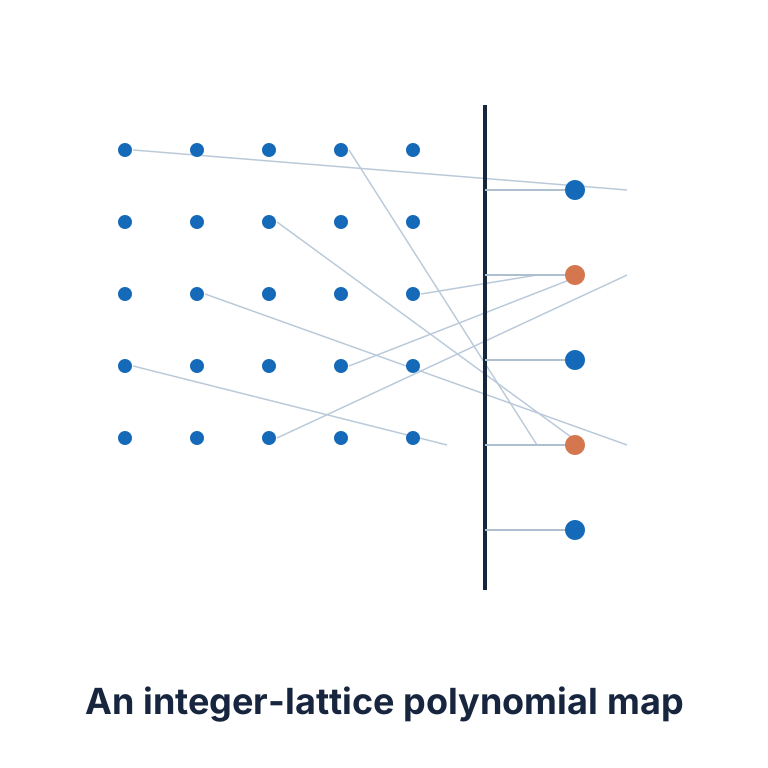
Problem. Does there exist a polynomial \(F\in\mathbb Q[X,Y]\) whose image on the full integer lattice is exactly \(\mathbb Z_{\ge 0}\)? Thus \(F(x,y)\) must be a nonnegative integer for every \((x,y)\in\mathbb Z^2\), and every nonnegative integer must equal \(F(x,y)\) for at least one integer pair.
Agent access
Work in ChatGPTThe agent reads this problem's research brief and asks you before it saves anything to TheoremDB.
Definitions and notation
1Context
The question asks whether two unrestricted integer parameters admit a single polynomial coding of the nonnegative integers without stray values. Degree bounds, positivity certificates, and exhaustive searches through normalized low-degree families can be retained as intermediate artifacts.
2Problem setup
Definition 1 (The image \(F(\mathbb Z^2)\). The image \(F(\mathbb Z^2)\) is the set \(\{F(x,y):x,y\in\mathbb Z\}\).
Remark 1. A rational-coefficient polynomial may be integer-valued on \(\mathbb Z^2\) even when some coefficients are not integers.
Definition 2 (Exact image). Exact image means both containment \(F(\mathbb Z^2)\subseteq\mathbb Z_{\ge0}\) and surjectivity onto every member of \(\mathbb Z_{\ge0}\).
3What counts as a solution
- Give an explicit \(F\in\mathbb Q[X,Y]\) and prove the equality \(F(\mathbb Z^2)=\mathbb Z_{\ge0}\), including integrality and nonnegativity on every integer pair.
- Alternatively, prove unconditionally that no such polynomial exists. A conclusion conditional on Vojta's conjecture does not meet acceptance.
1Status
Saved packet · July 31, 2026
Saved packet status (Current status and unresolved remainder). UNKNOWN as of 2026-07-31. The MathOverflow thread has no accepted construction. Rawson gives a conditional negative result using Vojta's conjecture, and the dated search found no unconditional existence or nonexistence theorem. Give an explicit \(F\in\mathbb Q[X,Y]\) and prove the equality \(F(\mathbb Z^2)=\mathbb Z_{\ge0}\), including integrality and nonnegativity on every integer pair.[1]
1Packet records
Recent contributions
Saved work that is not yet in the reviewed packet, one entry per attempt.
Notes and companion material
Original intake status. UNKNOWN as of 2026-07-31. The MathOverflow thread has no accepted construction. Rawson gives a conditional negative result using Vojta's conjecture, and the dated search found no unconditional existence or nonexistence theorem.
- On 2026-07-27 the full MathOverflow thread, its eight answers, and answer comments were checked. Proposed expressions either use restricted domains, extra variables, nonpolynomial operations, or leave one of the two image inclusions unproved.
- Rawson, arXiv:2403.09440, gives a negative answer conditional on Vojta's conjecture. The conjectural hypothesis prevents that paper from settling this record.
- Classical pairing polynomials cover \(\mathbb Z_{\ge0}^2\), while this problem uses all of \(\mathbb Z^2\). Extending the domain can introduce negative or nonintegral values.
- Trap: representing each nonnegative integer is only half of the target. Every integer input pair must also produce a nonnegative integer, and no positive surjectivity argument may silently restrict the signs of \(x\) and \(y\).
Recorded example 1. The Cantor polynomial \((X+Y)(X+Y+1)/2+Y\) pairs nonnegative integer inputs, but it takes unwanted values when \(X\) and \(Y\) range over all integers.
Recorded example 2. The polynomial \(X^2+Y^2\) is always nonnegative on integer pairs, but its image omits many nonnegative integers.
How the 2 records connect
ProblemA two-variable polynomial whose integer image is exactly the nonnegative integers
All 1 recorded relations between these records and the problem
2See also
Contribute to this problem
Cite this problem statement
Cite the original sources separately.
“A two-variable polynomial whose integer image is exactly the nonnegative integers.” TheoremDB. P2840. Problem statement; statement text SHA-256 cd910ad4af5a5a176ed62503491bcc8678c1441756c1011d6d849fcf52dc191e. https://theoremdb.org/statement/?ref=P2840
@misc{theoremdb-problem-cd910ad4af5a5a176ed62503491bcc8678c1441756c1011d6d849fcf52dc191e,
  title = {{A two-variable polynomial whose integer image is exactly the nonnegative integers}},
  howpublished = {TheoremDB},
  note = {Problem statement; statement text SHA-256 cd910ad4af5a5a176ed62503491bcc8678c1441756c1011d6d849fcf52dc191e},
  url = {https://theoremdb.org/statement/?ref=P2840}
}
Plain text: Built Markdown snapshot
This problem includes 2 records joined by 1 typed links, sourced from mathoverflow.net[1], current as of July 31, 2026.
1References
- Packet source. Polynomial representing all nonnegative integers, MathOverflow question 9731. Original CC0 restatement written after reviewing the question, all eight answers, their comments, and later conditional work. mathoverflow.net checked 2026-08-01. Original CC0 restatement written after reviewing the question, all eight answers, their comments, and later conditional work. ↗forum · discovery source · checked 2026-07-31Source use: original summary.UNKNOWN as of 2026-07-27. The MathOverflow thread has no accepted construction. Rawson gives a conditional negative result using Vojta's conjecture, and the dated search found no unconditional existence or nonexistence theorem.Also cited at See dataset.references[0] for the exact external source and locator.Also cited at Editorial research route recorded 2026-07-31.Source used to formulate or check the problem record.Source used to assess the problem's recorded status.For A two-variable polynomial whose integer image is exactly the nonnegative integers: UNKNOWN as of 2026-07-27. The MathOverflow thread has no accepted construction. Rawson gives a conditional negative result using Vojta's conjecture, and the dated search found no unconditional existence or nonexistence theorem.Source named by the research packet.
- Polynomial representing all nonnegative integers, MathOverflow question 9731, source checked for the TheoremDB status review (2026-07-31). Status evidence identified in the source record and checked at the linked publication. ↗preprint · primary source · arXiv:2403.09440, checked 2026-07-31 · checked 2026-07-31Source use: original summary.UNKNOWN as of 2026-07-27. The MathOverflow thread has no accepted construction. Rawson gives a conditional negative result using Vojta's conjecture, and the dated search found no unconditional existence or nonexistence theorem.Also cited at Full preprint relevant to A two-variable polynomial whose integer image is exactly the nonnegative integers.Source used to assess the problem's recorded status.For A two-variable polynomial whose integer image is exactly the nonnegative integers: UNKNOWN as of 2026-07-27. The MathOverflow thread has no accepted construction. Rawson gives a conditional negative result using Vojta's conjecture, and the dated search found no unconditional existence or nonexistence theorem.
Original CC0 textbook restatement.
Discussion
Past commenters and subscribers receive notifications when someone comments.