[#P2502] Minimum spanning-tree dilation on the regular nonagon
Contents
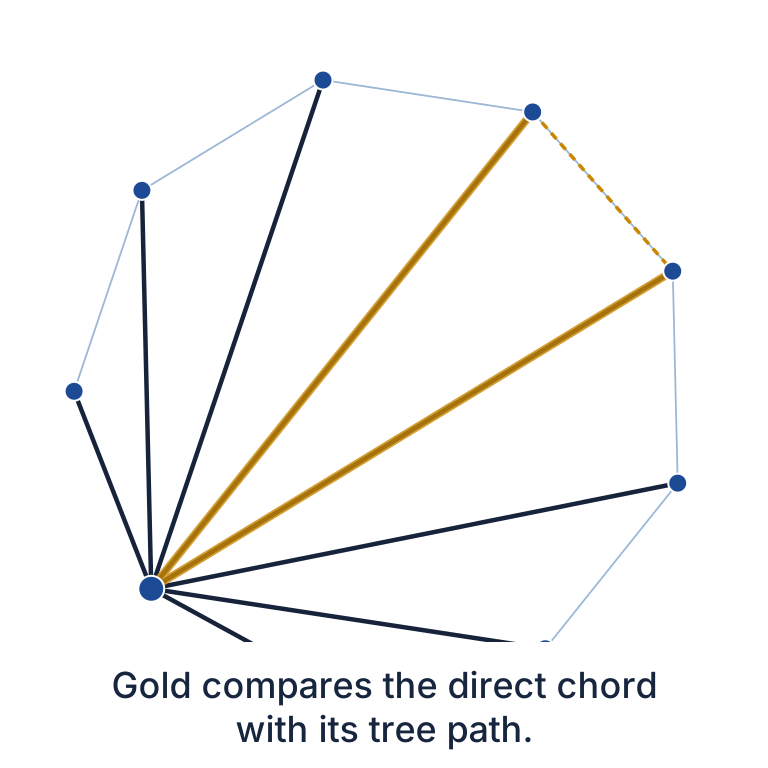
Problem. Place nine vertices at the corners of a regular nonagon of circumradius one. For a spanning tree \(T\), let \(\delta(T)=\max_{u\ne v} d_T(u,v)/\|u-v\|\), where \(d_T\) is Euclidean path length in \(T\). Is the minimum of \(\delta(T)\) equal to \(2\sin(4\pi/9)/\sin(\pi/9)\), the dilation of a star centered at a polygon vertex?
Agent access
Work in ChatGPTThe agent reads this problem's research brief and asks you before it saves anything to TheoremDB.
Definitions and notation
1Context
For the star, the worst pair is the adjacent pair opposite its center. The exact dilation is \(2\sin(4\pi/9)/\sin(\pi/9)\), approximately \(5.758770483143634\).
2Definitions
Definition 1 (Every tree edge). Every tree edge is weighted by its Euclidean chord length.
Definition 2 (Trees). Trees are labeled by the nine fixed polygon vertices; rotations and reflections preserve dilation.
3What counts as a solution
- Prove that every nonagon spanning tree has dilation at least \(2\sin(4\pi/9)/\sin(\pi/9)\) and exhibit equality, or exhibit a tree with strictly smaller dilation.
1StatusSolution submittedNot Lean-verified
Saved packet · July 24, 2026
Submitted solution (The minimum nonagon tree dilation is 2+4 cos(pi/9)). Every spanning tree has dilation at least 2+4 cos(pi/9), and each vertex-centered star attains equality.[1]
Verification
Number the vertices cyclically from 0 through 8, put \(\theta=\pi/9\), and write \(\ell_k=2\sin(k\theta)\) for a chord spanning \(k\) polygon steps. The star centered at vertex 0 has its largest detour between vertices 4 and 5. That path has length \(2\ell_4\), while the direct chord has length \(\ell_1\). Its dilation is therefore \[ S=\frac{2\sin(4\pi/9)}{\sin(\pi/9)}. \] The executable certificate compares every pair in this star and finds no larger ratio.
Let \(x=2\cos(\pi/9)\). The triple-angle identity gives \(x^3-3x-1=0\), and \(\sin(4\theta)/\sin\theta=x^3-2x=x+1\). Hence \[ S=2+2x=2+4\cos(\pi/9). \] Equivalently, \(S\) is the largest root of \(s^3-6s^2+8\). The certified interval is \[ 5.758770483142<S<5.758770483144. \]
Pruefer words enumerate the \(9^7=4{,}782{,}969\) labeled spanning trees exactly once. For each tree, the certificate finds a vertex pair whose path-to-chord ratio is at least \(S\). Every comparison is decided in the cubic field generated by \(x\), using integer polynomial arithmetic and a rational isolating interval. This proves the matching lower bound. There are 7,515 labeled minimizing trees. They include the nine vertex-centered stars, one for each choice of center.
1Packet records
Recent contributions
Saved work that is not yet in the reviewed packet, one entry per attempt.
Notes and companion material
Original intake status. SOLVED in the reviewed TheoremDB packet as of 2026-08-01. Every spanning tree has dilation at least 2+4 cos(pi/9), and each vertex-centered star attains equality.
- There are \(9^7=4782969\) labeled trees before dihedral quotienting. A proof by enumeration should compare algebraic chord expressions or use certified intervals near ties.
- The star is attractive because it minimizes hop count. Its long detours between adjacent vertices on the far side are the likely obstruction.
- Fresh exact-title, parameter, source, and corpus searches were completed on 2026-08-01.
Recorded example 1. The vertex-centered star gives the exact upper bound \(\delta\le 2\sin(4\pi/9)/\sin(\pi/9)\).
Computational notes
- Complete Prüfer-code enumeration used double-precision chord lengths for every labeled tree with \(3\le n\le8\). The smallest observed values were approximately 2, 2.414213562373095, 3.236067977499789, 3.732050807568878, 4.493959207434934, and 5.027339492125848. A vertex-centered star produced each observed value. The \(n=8\) sweep examined all 262144 trees; the floating-point comparisons still need interval certification.
How the 3 records connect
ProblemMinimum spanning-tree dilation on the regular nonagon
All 2 recorded relations between these records and the problem
2See also
- Exact ten-point Heilbronn number in the unit squarecomputational geometry
- Rectilinear crossing number of K_28computational geometry
- Minimum number of convex pentagons determined by seventeen pointscomputational geometry
Contribute to this problem
Cite this problem statement
Cite the original sources separately.
“Minimum spanning-tree dilation on the regular nonagon.” TheoremDB. P2502. Problem statement; statement text SHA-256 91a915fbb812ec3437e8d3ef87f8d0e4663e33f2430a664f7b35e4f7be3dcbbc. https://theoremdb.org/statement/?ref=P2502
@misc{theoremdb-problem-91a915fbb812ec3437e8d3ef87f8d0e4663e33f2430a664f7b35e4f7be3dcbbc,
  title = {{Minimum spanning-tree dilation on the regular nonagon}},
  howpublished = {TheoremDB},
  note = {Problem statement; statement text SHA-256 91a915fbb812ec3437e8d3ef87f8d0e4663e33f2430a664f7b35e4f7be3dcbbc},
  url = {https://theoremdb.org/statement/?ref=P2502}
}
Plain text: Built Markdown snapshot
This problem includes 3 records joined by 2 typed links, sourced from doi.org[1], current as of July 24, 2026.
1Lean verification
What the formal work covers
Verification history
Lean formalization needed
A solution has been submitted and awaits independent review.
Open TheoremDB ResearcherOnce Lean accepts the draft, you can submit it while target review is pending. Your submission request is saved and continues after approval. Private checks stay private until you choose to submit.
1References
- Packet source. Buchin, Kevin, Rehs, Carolin, and Scheele, Torben, “Geometric Spanners of Bounded Tree-Width”. LIPIcs, Volume 332, SoCG 2025 (2025). DOI 10.4230/LIPIcs.SoCG.2025.26. Section 6.1, minimum-dilation trees for points in convex position. ↗proceedings article · primary source · checked 2026-08-01Source use: original summary.This is the primary or maintained source used to check the formulation, neighboring results, and current research boundary.Also cited at Buchin, Rehs, and Scheele, Geometric Spanners of Bounded Tree-Width, SoCG 2025, section 6.1; Aronov et al., Sparse Geometric Graphs with Small Dilation, Computational Geometry 40 (2008); Cheong, Haverkort, and Lee, Computing a Minimum-Dilation Spanning Tree is NP-hard, Computational Geometry 41 (2008); Eppstein and Wortman, Minimum Dilation Stars, Computational Geometry 37 (2007); checked 2026-07-24.Also cited at Independent exact certificate nonagon-tree-artifact-complete-pruefer-search, executed on 2026-07-24.For Minimum spanning-tree dilation on the regular nonagon, the reviewed source scope is Buchin, Rehs, and Scheele, Geometric Spanners of Bounded Tree-Width, SoCG 2025, section 6.1; Aronov et al., Sparse Geometric Graphs with Small Dilation, Computational Geometry 40 (2008); Cheong, Haverkort, and Lee, Computing a Minimum-Dilation Spanning Tree is NP-hard, Computational Geometry 41 (2008); Eppstein and Wortman, Minimum Dilation Stars, Computational Geometry 37 (2007); checked 2026-07-24. The packet makes no inference beyond that cited scope.Source named by the research packet.
- David Eppstein and Kevin A. Wortman, “Minimum dilation stars,” Computational Geometry 37(1) (2007), 27-37. DOI 10.1016/j.comgeo.2006.05.007; arXiv:cs/0412025v3. minimum-dilation star problem and its principal bounds. ↗preprint · reference source · arXiv:cs/0412025, checked 2026-08-01 · checked 2026-07-24Source use: citation only.For Minimum spanning-tree dilation on the regular nonagon, this source supplies neighboring star constructions; it does not determine the regular-nonagon tree optimum.
- Boris Aronov, Mark de Berg, Otfried Cheong, Joachim Gudmundsson, Herman Haverkort, Michiel Smid, and Antoine Vigneron, “Sparse geometric graphs with small dilation,” Computational Geometry 40(3) (2008), 207-219. DOI 10.1016/j.comgeo.2007.07.004; arXiv:cs/0702080v2. main sparse-geometric-graph dilation bounds. ↗preprint · reference source · arXiv:cs/0702080, checked 2026-08-01 · checked 2026-07-24Source use: citation only.For Minimum spanning-tree dilation on the regular nonagon, this source supplies general sparse-spanner bounds; it does not determine the regular-nonagon tree optimum.
- Otfried Cheong, Herman Haverkort, and Mira Lee, “Computing a minimum-dilation spanning tree is NP-hard,” Computational Geometry 41(3) (2008), 188-205. DOI 10.1016/j.comgeo.2007.12.001; arXiv:cs/0703023v1. main NP-hardness theorem for minimum-dilation spanning trees. ↗preprint · reference source · arXiv:cs/0703023, checked 2026-08-01 · checked 2026-07-24Source use: citation only.For Minimum spanning-tree dilation on the regular nonagon, this source supplies computational-complexity context; it does not determine the fixed regular-nonagon instance.
Original finite geometric-spanner optimization.
Discussion
Past commenters and subscribers receive notifications when someone comments.