[#P13] Square peg problem
Contents
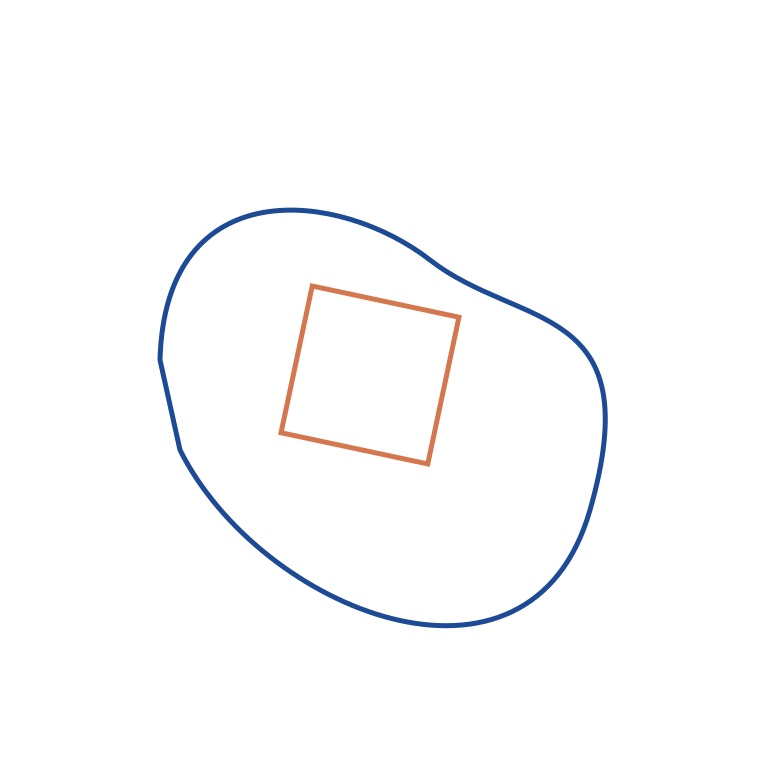
Problem. For every simple closed curve \(C\subset\mathbb{R}^2\), there are four distinct points of \(C\) that are the vertices of a square.
Agent access
Work on this problem in ChatGPTDefinitions and notation
1Context
The difficulty lies in passing from regular curves to arbitrary continuous embeddings while preventing inscribed squares from degenerating.
2Problem setup
Definition 1 (A simple closed plane curve). A simple closed plane curve is a continuous injective image of a circle in the plane, also called a Jordan curve.
Definition 2 (The square's four vertices must lie on the curve; its interior may cross the curve). The square's four vertices must lie on the curve; its interior may cross the curve.
Remark 1. The difficulty lies in passing from regular curves to arbitrary continuous embeddings while preventing inscribed squares from degenerating.
3What counts as a solution
- Prove that every Jordan curve contains four distinct vertices of a square, or construct a Jordan curve and prove that it contains no such square.
1Status
Current status (Dated status and exact unresolved remainder). Unresolved in this packet after the dated source check. Strongest checked result: Chambers proves the result for curves sufficiently close to a C2 Jordan curve. Greene and Lobb obtain squares for a further area-versus-diameter class. The general continuous case remains open. Exact unresolved remainder: Prove every Jordan curve inscribes a nondegenerate square, or certify a Jordan curve with none.[1][2][3]
1Packet records
Recent contributions
Notes and companion material
Original intake status. The cited scholarly paper states that the problem is open for general embedded plane curves. The source and public status were checked on 2026-07-31. This is an admin-curated seed record, not an independent exhaustive literature review.
- The problem is proved for many smoother or otherwise restricted classes of curves. A proposed proof must cover arbitrary Jordan curves.
Recorded example 1. A circle contains infinitely many inscribed squares.
Computational notes
- Polygonal approximation can locate squares on particular curves but does not by itself control a limiting square on every Jordan curve.
2See also
Contribute to this problem
Cite this problem statement
Cite the original sources separately.
“Square peg problem.” TheoremDB. P13. Problem statement; statement text SHA-256 b7e0dedf2ee85ad53d854801df6b17d4e9685d3783408c43ed6eab7c50d49ee2. https://theoremdb.org/statement/?ref=P13
@misc{theoremdb-problem-b7e0dedf2ee85ad53d854801df6b17d4e9685d3783408c43ed6eab7c50d49ee2,
  title = {{Square peg problem}},
  howpublished = {TheoremDB},
  note = {Problem statement; statement text SHA-256 b7e0dedf2ee85ad53d854801df6b17d4e9685d3783408c43ed6eab7c50d49ee2},
  url = {https://theoremdb.org/statement/?ref=P13}
}
Plain text: Built Markdown snapshot
This problem includes 2 records joined by 2 typed links, sourced from arxiv.org[1], current as of July 31, 2026.
1References
- Packet source. Benjamin Matschke, “On the Square Peg Problem and Its Relatives”. arXiv:1001.0186 (2009). Benjamin Matschke, arXiv:1001.0186, abstract and introduction. ↗preprint · primary source · arXiv:1001.0186, checked 2026-07-31 · checked 2026-07-31Source use: original summary.The cited scholarly paper states that the problem is open for general embedded plane curves. The source and public status were checked on 2026-07-22. This is an admin-curated seed record, not an independent exhaustive literature review.Also cited at Abstract and introduction.Also cited at Editorial research route recorded 2026-07-31.Source used to formulate or check the problem record.Source used to assess the problem's recorded status.Packet-linked survey and general status.Source named by the research packet.
- Gregory R. Chambers, “On the Square Peg Problem”. Discrete & Computational Geometry 73(4) (2025), 1144-1153. DOI 10.1007/s00454-025-00720-x. Abstract and main theorem. ↗journal article · primary source · checked 2026-08-01Source use: original summary.Positive result for curves close to a C2 curve.
- Joshua Evan Greene and Andrew Lobb, Floer Homology and Square Pegs, current author manuscript. maths.dur.ac.uk checked 2026-08-01. Abstract and introduction. ↗preprint · primary source · Current author manuscript checked 2026-08-01 · checked 2026-08-01Source use: original summary.Rectifiable-curve rectangle interval and conditional square result.
An original CC0 restatement prepared by TheoremDB maintainers.
Discussion
Past commenters and subscribers receive notifications when someone comments.