[#P2866] Set-theoretic complete intersections for complex space curves
Contents
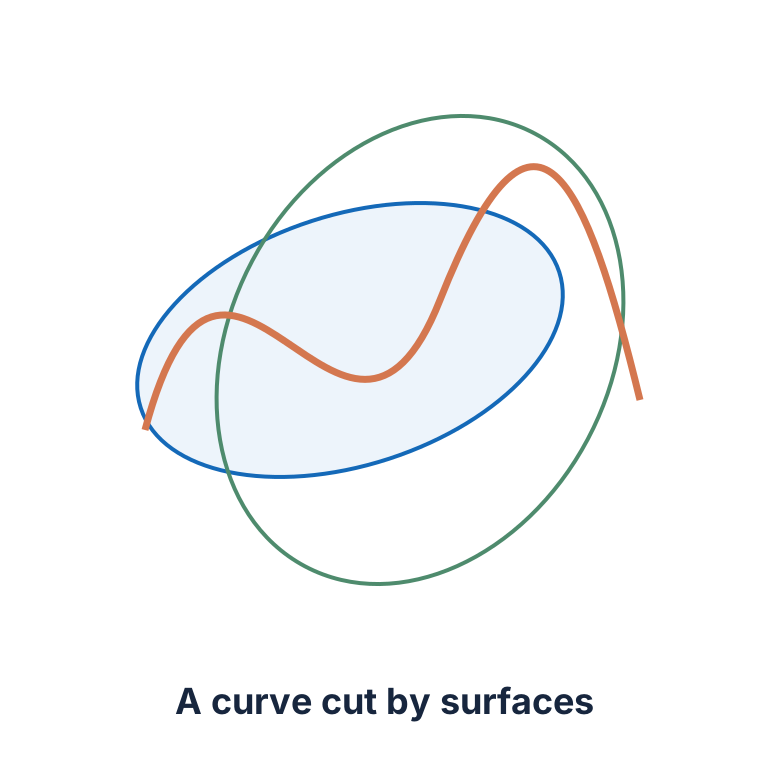
Problem. Let \(C\subset\mathbb P^3_{\mathbb C}\) be an irreducible projective curve. Must there exist homogeneous polynomials \(F,G\in\mathbb C[X_0,X_1,X_2,X_3]\) such that \(C=V(F,G)\) as sets?
Agent access
Work on this problem in ChatGPTDefinitions and notation
1Context
Individual curve classes allow concrete ideal computations, liaison arguments, and cohomological obstructions. Exact equations and radical certificates can be stored even when they settle only one family.
2Problem setup
Definition 1 (An irreducible projective curve). An irreducible projective curve is a one-dimensional irreducible closed subvariety of projective three-space.
Definition 2 (The equality \(C=V(F,G)\). The equality \(C=V(F,G)\) is set-theoretic: equivalently, the homogeneous ideal of \(C\) is the radical of the ideal \((F,G)\).
Definition 3 (The two surfaces may be singular, reducible, and of arbitrary degrees unless the statement itself forces otherwise). The two surfaces may be singular, reducible, and of arbitrary degrees unless the statement itself forces otherwise.
Remark 1. Individual curve classes allow concrete ideal computations, liaison arguments, and cohomological obstructions. Exact equations and radical certificates can be stored even when they settle only one family.
3What counts as a solution
- Prove that every irreducible curve \(C\subset\mathbb P^3_{\mathbb C}\) is the set-theoretic intersection of two surfaces, with no degree restriction.
- Alternatively, give an explicit irreducible complex space curve and prove that no pair of homogeneous polynomials has radical ideal equal to its homogeneous ideal.
1Status
Current status (Current status and unresolved remainder). UNKNOWN as of 2026-07-31. A 2020 answer on the source page describes the characteristic-zero problem as widely open. Later checked work proves special cases and criteria, with no universal proof or complex counterexample found. Prove that every irreducible curve \(C\subset\mathbb P^3_{\mathbb C}\) is the set-theoretic intersection of two surfaces, with no degree restriction.[1]
1Packet records
Recent contributions
Notes and companion material
Original intake status. UNKNOWN as of 2026-07-31. A 2020 answer on the source page describes the characteristic-zero problem as widely open. Later checked work proves special cases and criteria, with no universal proof or complex counterexample found.
- On 2026-07-27 the MathOverflow answer and all comments were checked. They distinguish characteristic-zero uncertainty from positive-characteristic theorems and mention unresolved low-degree cases.
- Cowsik and Nori's theorem in positive characteristic does not transfer to \(\mathbb C\). The base field in this record is fixed to prevent that theorem from being mistaken for a solution.
- Barile and Morales, arXiv:1907.05472 and the later journal publication, study connected curves and set-theoretic complete intersections while continuing to describe the general projective-three-space question as open.
- A pair of equations that contains \(C\) can have extra curve or point components. Radical equality, or a complete set-theoretic exclusion of every extra component, is required.
- Trap: every curve in \(\mathbb P^3\) is an intersection of several surfaces. The target permits exactly two equations and asks for equality of their common zero set.
Recorded example 1. A curve that is already a scheme-theoretic complete intersection of two surfaces satisfies the condition immediately.
Recorded example 2. The twisted cubic has an ideal generated by three quadrics, illustrating why the set-theoretic two-equation question differs from minimal ideal generation.
How the 2 records connect
ProblemSet-theoretic complete intersections for complex space curves
All 1 recorded relations between these records and the problem
2See also
- A polynomial bijection from the rational plane to the rational linealgebraic geometry
- Hodge conjecturealgebraic geometry
- Plane Jacobian conjecturealgebraic geometry
Contribute to this problem
Cite this problem statement
Cite the original sources separately.
“Set-theoretic complete intersections for complex space curves.” TheoremDB. P2866. Problem statement; statement text SHA-256 0aafdc9b544fc9fd092eaff03d5fa4d847679ceb916cb73c2eaaaa48e5b5bfd8. https://theoremdb.org/statement/?ref=P2866
@misc{theoremdb-problem-0aafdc9b544fc9fd092eaff03d5fa4d847679ceb916cb73c2eaaaa48e5b5bfd8,
  title = {{Set-theoretic complete intersections for complex space curves}},
  howpublished = {TheoremDB},
  note = {Problem statement; statement text SHA-256 0aafdc9b544fc9fd092eaff03d5fa4d847679ceb916cb73c2eaaaa48e5b5bfd8},
  url = {https://theoremdb.org/statement/?ref=P2866}
}
Plain text: Built Markdown snapshot
This problem includes 2 records joined by 1 typed links, sourced from mathoverflow.net[1], current as of July 31, 2026.
1References
- Packet source. Is every projective space curve a set-theoretic intersection of two surfaces?, MathOverflow question 190938. Original CC0 universal statement written after reading the answer and comments and checking later work on set-theoretic complete intersections in projective three-space. mathoverflow.net checked 2026-08-01. Original CC0 universal statement written after reading the answer and comments and checking later work on set-theoretic complete intersections in projective three-space. ↗forum · discovery source · checked 2026-07-31Source use: original summary.UNKNOWN as of 2026-07-27. A 2020 answer on the source page describes the characteristic-zero problem as widely open. Later checked work proves special cases and criteria, with no universal proof or complex counterexample found.Also cited at See dataset.references[0] for the exact external source and locator.Also cited at Editorial research route recorded 2026-07-31.Source used to formulate or check the problem record.Source used to assess the problem's recorded status.For Set-theoretic complete intersections for complex space curves: UNKNOWN as of 2026-07-27. A 2020 answer on the source page describes the characteristic-zero problem as widely open. Later checked work proves special cases and criteria, with no universal proof or complex counterexample found.Source named by the research packet.
- Is every projective space curve a set-theoretic intersection of two surfaces?, MathOverflow question 190938, source checked for the TheoremDB status review (2026-07-31). Status evidence identified in the source record and checked at the linked publication. ↗preprint · primary source · arXiv:1907.05472, checked 2026-07-31 · checked 2026-07-31Source use: original summary.UNKNOWN as of 2026-07-27. A 2020 answer on the source page describes the characteristic-zero problem as widely open. Later checked work proves special cases and criteria, with no universal proof or complex counterexample found.Also cited at Full preprint relevant to Set-theoretic complete intersections for complex space curves.Source used to assess the problem's recorded status.For Set-theoretic complete intersections for complex space curves: UNKNOWN as of 2026-07-27. A 2020 answer on the source page describes the characteristic-zero problem as widely open. Later checked work proves special cases and criteria, with no universal proof or complex counterexample found.
- Is every projective space curve a set-theoretic intersection of two surfaces?, MathOverflow question 190938, source checked for the TheoremDB status review (2026-07-31). Status evidence identified in the source record and checked at the linked publication. ↗preprint · primary source · arXiv:1301.3222, checked 2026-07-31 · checked 2026-07-31Source use: original summary.UNKNOWN as of 2026-07-27. A 2020 answer on the source page describes the characteristic-zero problem as widely open. Later checked work proves special cases and criteria, with no universal proof or complex counterexample found.Also cited at Full preprint relevant to Set-theoretic complete intersections for complex space curves.Source used to assess the problem's recorded status.For Set-theoretic complete intersections for complex space curves: UNKNOWN as of 2026-07-27. A 2020 answer on the source page describes the characteristic-zero problem as widely open. Later checked work proves special cases and criteria, with no universal proof or complex counterexample found.
Original CC0 textbook restatement.
Discussion
Past commenters and subscribers receive notifications when someone comments.