[#P2936] Complete coverage by random disks at the harmonic scale
Contents
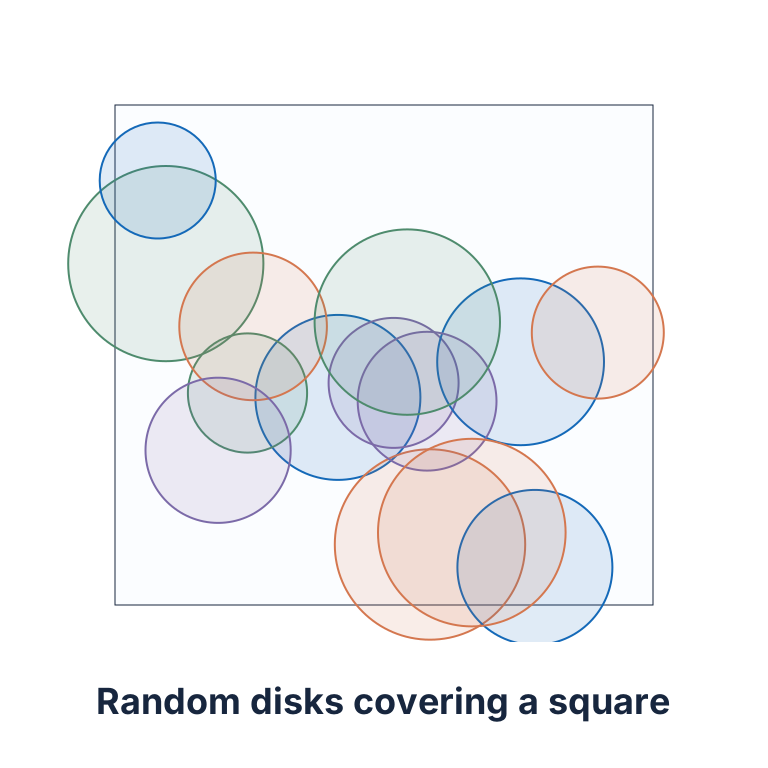
Problem. Let \(D=\{x\in\mathbb R^2:\|x\|\le1\}\), let \(X_1,X_2,\ldots\) be independent uniform points of \(D\), and let \(D_n\) be the closed disk centered at \(X_n\) with radius \(n^{-1/2}\). Is \(\Pr(D\subseteq\bigcup_{n\ge1}D_n)=1\)?
Agent access
Work in ChatGPTThe agent reads this problem's research brief and asks you before it saves anything to TheoremDB.
Definitions and notation
1Context
Multiscale nets, empty-cell bounds, and boundary-strip estimates can be reused at later scales. The harmonic sum makes fixed-point coverage easy while leaving the geometry of exceptional holes unresolved.
2Problem setup
Definition 1. Uniform on D means normalized planar Lebesgue measure, and the centers X_n are mutually independent.
Remark 1. Complete coverage requires every point of the uncountable closed disk D to lie in at least one random disk D_n.
3What counts as a solution
- Prove that the union covers D almost surely, or prove that the event of an uncovered point has positive probability.
- A computer-assisted argument must supply certified finite-net bounds and a rigorous passage that controls holes between net points and the boundary for the infinite tail.
1Status
Saved packet · August 1, 2026
Saved packet status (Dated status and exact unresolved remainder). Unresolved in this packet after the dated source check. Strongest checked result: The comments establish almost-sure coverage of each fixed point and zero area of the uncovered set. They do not establish complete coverage of the uncountable disk, and the exact critical sequence was not settled in the checked random-covering literature. Exact unresolved remainder: Prove that the union covers D almost surely, or prove that the event of an uncovered point has positive probability. A computer-assisted argument must supply certified finite-net bounds and a rigorous passage that controls holes between net points and the boundary for the infinite tail.[2][3][1]
1Packet records
Recent contributions
Saved work that is not yet in the reviewed packet, one entry per attempt.
Notes and companion material
Original intake status. UNKNOWN as of 2026-07-27. The comments establish almost-sure coverage of each fixed point and zero area of the uncovered set. They do not establish complete coverage of the uncountable disk, and the exact critical sequence was not settled in the checked random-covering literature.
- Penrose's arXiv:2101.06306 and related finite random geometric coverage results were checked. They use finite samples and threshold radii with boundary corrections, which do not directly decide this infinite nonidentical-radius process.
- Dvoretzky covering references were checked for the one-dimensional analogue. The planar boundary and two-dimensional holes require different capacity or net estimates.
- A local corpus search for harmonic random disks, n^{-1/2} covering, and complete random coverage found no duplicate.
- Independent source, duplicate, exact-title, and equivalent-formulation review completed on 2026-08-01.
Recorded example 1. For any fixed x in the interior of D, the sum of Pr(x in D_n) diverges at harmonic order, so x is covered almost surely. This pointwise statement permits a random exceptional point.
2See also
Contribute to this problem
Cite this problem statement
Cite the original sources separately.
“Complete coverage by random disks at the harmonic scale.” TheoremDB. P2936. Problem statement; statement text SHA-256 3c2cc7c59da20e71fe7fa3ccfcf89e2c99822a47ddf897ce3ff7b9e40ae14bfc. https://theoremdb.org/statement/?ref=P2936
@misc{theoremdb-problem-3c2cc7c59da20e71fe7fa3ccfcf89e2c99822a47ddf897ce3ff7b9e40ae14bfc,
  title = {{Complete coverage by random disks at the harmonic scale}},
  howpublished = {TheoremDB},
  note = {Problem statement; statement text SHA-256 3c2cc7c59da20e71fe7fa3ccfcf89e2c99822a47ddf897ce3ff7b9e40ae14bfc},
  url = {https://theoremdb.org/statement/?ref=P2936}
}
Plain text: Built Markdown snapshot
This problem includes 2 records joined by 2 typed links, sourced from mathoverflow.net[1], current as of August 1, 2026.
1References
- Packet source. MathOverflow question 458793, “Complete coverage by random disks at the harmonic scale,” checked 2026-08-01. Question statement, visible answers and comments, or the linked article sections described in the source record. ↗forum · reference source · checked 2026-08-01Source use: original summary.Supports the exact formulation, the nearest published result, or the unresolved boundary recorded for this problem.Also cited at Question 458793 and every visible answer and comment were checked on 2026-07-27.Also cited at Full question, answers, and visible comments concerning Complete coverage by random disks at the harmonic scale; checked 2026-08-01.Also cited at Editorial research route recorded 2026-08-01.Source used to formulate or check the problem record.Source used to assess the problem's recorded status.For Complete coverage by random disks at the harmonic scale, the reviewed source scope is Full question, answers, and visible comments concerning Complete coverage by random disks at the harmonic scale; checked 2026-08-01.. The packet makes no inference beyond that cited scope.Source named by the research packet.
- arXiv preprint 2101.06306, linked primary source for “Complete coverage by random disks at the harmonic scale,” checked 2026-08-01. Question statement, visible answers and comments, or the linked article sections described in the source record. ↗preprint · primary source · arXiv:2101.06306, checked 2026-08-01 · checked 2026-08-01Source use: original summary.Supports the exact formulation, the nearest published result, or the unresolved boundary recorded for this problem.Also cited at abstract and limit theorems for the coverage threshold R_n of n uniform centers with common radius.Source used to assess the problem's recorded status.For Complete coverage by random disks at the harmonic scale, this source gives finite-sample Euclidean coverage asymptotics and boundary effects; it does not settle complete coverage by radii 1/sqrt(n).
- J.-P. Kahane, “Dvoretzky problem,” Encyclopedia of Mathematics, revision 51207, last edited January 3, 2021. Question statement, visible answers and comments, or the linked article sections described in the source record. ↗website · reference source · checked 2026-08-01Source use: original summary.Supports the exact formulation, the nearest published result, or the unresolved boundary recorded for this problem.Also cited at definition and criterion for Dvoretzky's random covering problem on the circle.Source used to assess the problem's recorded status.For Complete coverage by random disks at the harmonic scale, this source supplies general random-covering context in a different geometry and with different covering sets.
An original CC0 reformulation motivated by the cited MathOverflow random-covering question; the radius and coverage event are stated directly.
Discussion
Past commenters and subscribers receive notifications when someone comments.