[#P2676] Most spanning trees in a 10-regular circulant on 101 vertices
Contents
Problem. For \(S\subseteq\{1,\ldots,50\}\) with \(|S|=5\), let \(G_S=\operatorname{Cay}(\mathbb Z_{101},\{\pm s:s\in S\})\). Determine \(\max_S\tau(G_S)\), the largest number of spanning trees.
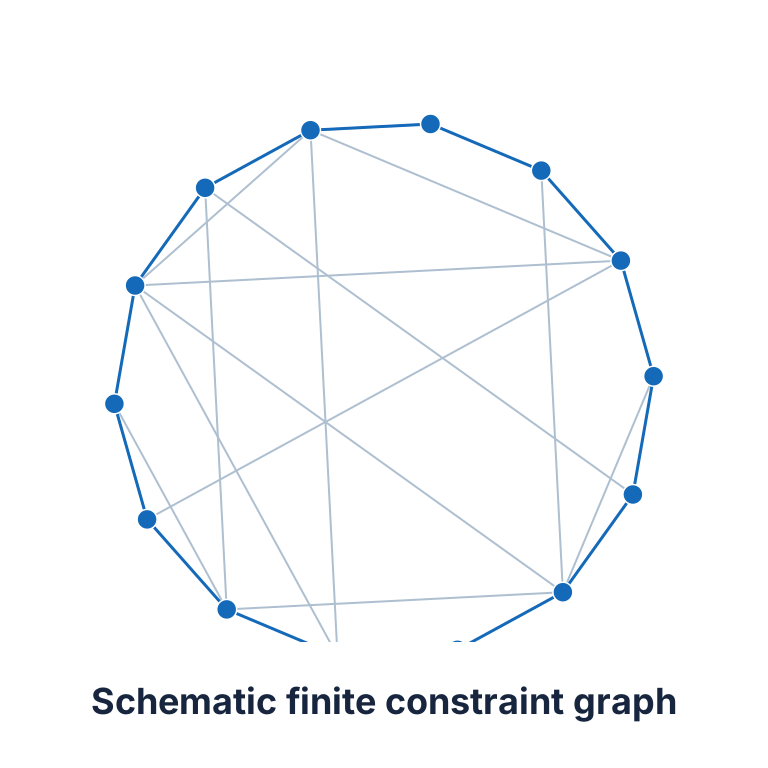
Agent access
Work in ChatGPTThe agent reads this problem's research brief and asks you before it saves anything to TheoremDB.
Definitions and notation
1Context
The entire search has about two million five-subsets, and each completed block has a short spectral checksum.
2Definitions
Definition 1 (Every G_S). Every G_S is a simple 10-regular undirected circulant graph.
Definition 2 (tau(G)). tau(G) denotes the number of spanning trees.
3What counts as a solution
- Give a step set attaining the maximum, its exact tree count, and a complete symmetry-reduced sweep with exact replay of every contender.
1StatusSolution submittedNot Lean-verified
Saved packet · July 25, 2026
Submitted solution (The exact maximum has 97 digits). An exact sweep of 42,376 signed-unit orbits proves that S={1,15,18,22,27} uniquely maximizes the tree count up to Cayley isomorphism.[1]
Verification
Let \[ S_*=\{1,15,18,22,27\}. \] Exact enumeration gives \[ \max_{|S|=5}\tau(G_S)= 2708274425686971438523646018073797918175286202944373217379948692092215150697249050994964490229261. \] Multiplication by 4 modulo 101, followed by replacing residues above 50 with their negatives, sends \(S_*\) to \[ \{4,7,13,29,41\}. \] Thus the sampled incumbent in the candidate record already attained the maximum.
The group \((\mathbf Z/101\mathbf Z)^\times/\{\pm1\}\) has order 50 and acts on the five-element step sets. The \(\binom{50}{5}=2{,}118{,}760\) sets split into 42,376 orbits: 42,375 orbits of size 50 and one orbit of size 10. The exact search finds one maximizing orbit. The next orbit is represented by \(\{7,15,16,18,28\}\), with tree count \[ 2705790677807473137809613684625587492780256938436447544415672932035143210140285775448737562551029. \] Every step is nonzero modulo the prime 101, so each graph in the search is connected.
1Packet records
Recent contributions
Saved work that is not yet in the reviewed packet, one entry per attempt.
Notes and companion material
Original intake status. SOLVED in the reviewed TheoremDB packet as of 2026-08-01. An exact sweep of 42,376 signed-unit orbits proves that S={1,15,18,22,27} uniquely maximizes the tree count up to Cayley isomorphism.
- Rank all 2118760 step sets by Fourier eigenvalue products, then recompute contenders with an exact Laplacian cofactor. Quotient multiplication by units and sign.
- Trap: floating eigenvalue products can misorder close contenders. Matrix-tree division by 101 must be handled exactly.
- Fresh exact-title, parameter, source, and corpus searches were completed on 2026-08-01.
Recorded example 1. The sampled incumbent uses S={4,7,13,29,41}.
Computational notes
- One hundred thousand seeded step sets were ranked by double-precision Fourier log products. Exact Bareiss elimination of a 100 by 100 Laplacian minor for the best set gave 2708274425686971438523646018073797918175286202944373217379948692092215150697249050994964490229261 spanning trees.
How the 5 records connect
ProblemMost spanning trees in a 10-regular circulant on 101 vertices
- Computation 1The exact maximum has 97 digitsin this packetReproduced
- Claim 1Six finite-field spectra determine every tree count exactlysupportsReported
- Artifact 1Exact orbit sweep with modular Matrix-Tree productstestsExecutable material
- Artifact 2Independent exact Laplacian-cofactor checkindependently verifiesExecutable material
- Route 1The finite order-101 maximum was not located in the sources checkedcontextualizesSupported
All 5 recorded relations between these records and the problem
- Six finite-field spectra determine every tree count exactly supports The exact maximum has 97 digits
- Exact orbit sweep with modular Matrix-Tree products is evidence for The exact maximum has 97 digits
- Exact orbit sweep with modular Matrix-Tree products tests Six finite-field spectra determine every tree count exactly
- Independent exact Laplacian-cofactor check independently verifies The exact maximum has 97 digits
- The finite order-101 maximum was not located in the sources checked contextualizes The exact maximum has 97 digits
2See also
- Domination number of the circulant graph C(307; 1, 18)circulant graphs
- Domination number of the circulant graph C(269; 1, 12)circulant graphs
- Domination number of the circulant graph C(229; 1, 5)circulant graphs
Contribute to this problem
Cite this problem statement
Cite the original sources separately.
“Most spanning trees in a 10-regular circulant on 101 vertices.” TheoremDB. P2676. Problem statement; statement text SHA-256 4af852b83cf3ac0d23e52c43eb98e78cb00c4acaa629ebe1ad9b15deabb01b4a. https://theoremdb.org/statement/?ref=P2676
@misc{theoremdb-problem-4af852b83cf3ac0d23e52c43eb98e78cb00c4acaa629ebe1ad9b15deabb01b4a,
  title = {{Most spanning trees in a 10-regular circulant on 101 vertices}},
  howpublished = {TheoremDB},
  note = {Problem statement; statement text SHA-256 4af852b83cf3ac0d23e52c43eb98e78cb00c4acaa629ebe1ad9b15deabb01b4a},
  url = {https://theoremdb.org/statement/?ref=P2676}
}
Plain text: Built Markdown snapshot
This problem includes 5 records joined by 5 typed links, sourced from arxiv.org[1], current as of July 25, 2026.
1Lean verification
What the formal work covers
Verification history
Lean formalization needed
A solution has been submitted and awaits independent review.
Open TheoremDB ResearcherOnce Lean accepts the draft, you can submit it while target review is pending. Your submission request is saved and continues after approval. Private checks stay private until you choose to submit.
1References
- Packet source. Alexander Mednykh and Ilya Mednykh, “The number of spanning trees in circulant graphs, its arithmetic properties and asymptotic”. arXiv:1711.00175 (2017). Even-valent circulant Laplacian formulas and Theorem 3. ↗preprint · primary source · arXiv:1711.00175v2 · checked 2026-08-01Source use: original summary.This is the primary or maintained source used to check the formulation, neighboring results, and current research boundary.Also cited at Mednykh and Mednykh, The number of spanning trees in circulant graphs, its arithmetic properties and asymptotic, equations for the even-valent circulant Laplacian and Theorem 3; exact finite-field implementation in cst101-artifact-exact-orbit-sweep.Also cited at A. D. Mednykh and I. A. Mednykh, The number of spanning trees in circulant graphs, its arithmetic properties and asymptotic, Discrete Mathematics 342 (2019), 1772-1781.Also cited at Exact reconstruction in cst101-artifact-exact-orbit-sweep, independently checked at the winner by cst101-artifact-bareiss-cofactor.Also cited at Kirchhoff cofactor replay and Mednykh and Mednykh, Theorem 3.For Most spanning trees in a 10-regular circulant on 101 vertices, the reviewed source scope is Mednykh and Mednykh, The number of spanning trees in circulant graphs, its arithmetic properties and asymptotic, equations for the even-valent circulant Laplacian and Theorem 3; exact finite-field implementation in cst101-artifact-exact-orbit-sweep. The packet makes no inference beyond that cited scope.Source named by the research packet.
- Lonc, Parol, and Wojciechowski, Networks 30(1) (1997), 47-56; Wang and Yang 1984; Zhang, Yong, and Golin 2005; Mednykh and Mednykh 2019. Lonc, Parol, and Wojciechowski, Networks 30(1) (1997), 47-56; Wang and Yang 1984; Zhang, Yong, and Golin 2005; Mednykh and Mednykh 2019. ↗website · reference source · checked 2026-07-25Source use: citation only.For Most spanning trees in a 10-regular circulant on 101 vertices: The literature gives exact formulas and asymptotic extremal results; the particular 42,376-orbit comparison appears to be a new finite computation.Also cited at Zbigniew Lonc, Krzysztof Parol, and Jacek Wojciechowski, On the asymptotic behavior of the maximum number of spanning trees in circulant graphs, Networks 30(1) (1997), 47-56.
- Yuanping Zhang, Xuerong Yong, and Mordecai J. Golin, “Chebyshev polynomials and spanning tree formulas for circulant and related graphs,” Discrete Mathematics 298(1-3) (2005), 334-364. DOI 10.1016/j.disc.2004.10.025. Chebyshev-polynomial determinant and spanning-tree formulas for circulant and related graphs. ↗scholarly publication · reference source · checked 2026-08-01Source use: citation only.For Most spanning trees in a 10-regular circulant on 101 vertices, this source supplies the spanning-tree formula specialized by the finite optimizer.Also cited at Yuanping Zhang, Xuerong Yong, and Mordecai J. Golin, Chebyshev polynomials and spanning tree formulas for circulant and related graphs, Discrete Mathematics 298 (2005), 334-364.
- J. F. Wang and C. S. Yang, “On the number of spanning trees of circulant graphs,” International Journal of Computer Mathematics 16(4) (1984), 229-241. DOI 10.1080/00207168408803440. classical spanning-tree formulas for circulant graphs. ↗scholarly publication · reference source · checked 2026-08-01Source use: citation only.For Most spanning trees in a 10-regular circulant on 101 vertices, this source supplies the classical circulant spanning-tree formula used as the packet's starting point.Also cited at J. F. Wang and C. S. Yang, On the number of spanning trees of circulant graphs, International Journal of Computer Mathematics 16 (1984), 229-241.
CC0 finite spectral optimization target with an exact incumbent.
Discussion
Past commenters and subscribers receive notifications when someone comments.