[#P2814] Torsion-freeness for king-grid independence complexes
Contents
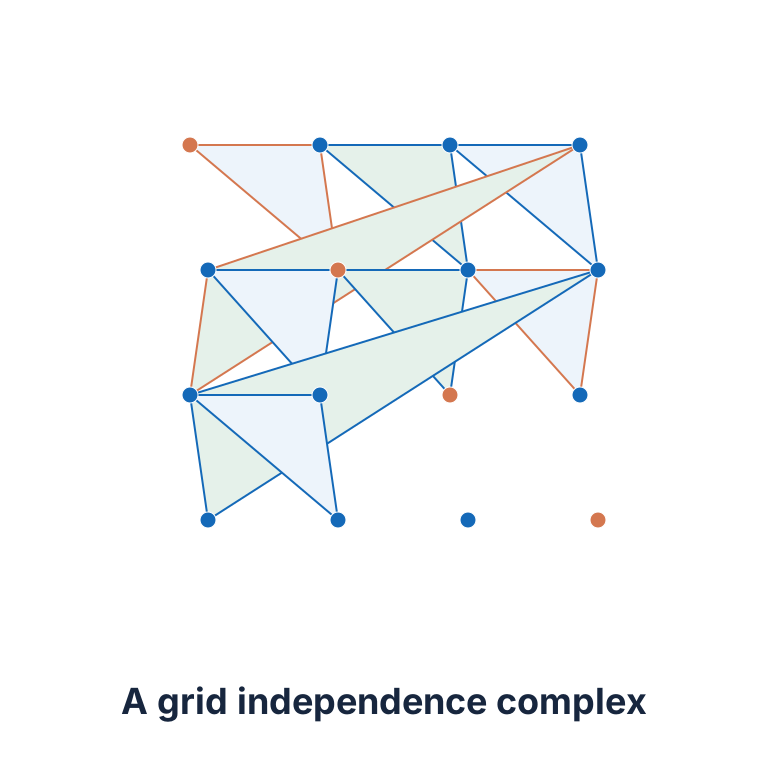
Problem. For \(n\ge1\), let \(K_n\) have vertex set \([n]\times[n]\), with two distinct vertices adjacent when their coordinate differences are both at most one. Let \(I(K_n)\) be the simplicial complex whose faces are the independent vertex sets of \(K_n\). Is every integral homology group \(H_j(I(K_n);\mathbb Z)\) torsion-free for every \(n\) and every \(j\ge0\)?
Agent access
Work on this problem in ChatGPTDefinitions and notation
1Context
The hard-square constraint gives transfer recurrences for face counts, while integral homology retains information those recurrences miss. Chain reductions, Morse matchings, and minimal torsion witnesses would remain reusable across nearby lattice complexes.
2Definitions
Definition 1 (Adjacency). Adjacency is a legal king move on an \(n\times n\) chessboard, including horizontal, vertical, and diagonal moves.
Definition 2 (An independent set contains no adjacent pair, and all independent sets form a simplicial complex under inclusion). An independent set contains no adjacent pair, and all independent sets form a simplicial complex under inclusion.
Definition 3 (An abelian group). An abelian group is torsion-free when no nonzero element has finite order.
3What counts as a solution
- Prove integral torsion-freeness for all \(n,j\), or give specific \(n,j\) together with a cycle and Smith-normal-form or equivalent certificate establishing nonzero torsion.
1Status
Current status (Current status and unresolved remainder). UNKNOWN as of 2026-08-01. The checked grid-independence-complex literature does not give an integral torsion classification for the king graphs \(K_n\).[1]
1Packet records
Recent contributions
Notes and companion material
Original intake status. OPEN as of 2026-08-01. UNKNOWN as of 2026-08-01. The checked grid-independence-complex literature does not give an integral torsion classification for the king graphs \(K_n\).
- 2026-07-27 prior-art search checked independence complexes of rectangular grids, king graphs, hard-square complexes, matching complexes, and homology torsion; no theorem covering this family was found.
- Euler characteristics and Betti numbers over one field cannot certify torsion-freeness. Smith normal forms or integral discrete Morse matchings are needed.
- A counterexample consists of one \(n,j\) and an integral boundary-matrix certificate with a nonunit Smith invariant; a positive proof could build a wedge decomposition or a torsion-free Morse complex uniformly in \(n\).
- Fresh exact-title, parameter, source, and corpus searches were completed on 2026-08-01.
Recorded example 1. For \(n=1\), the complex is a point. For \(n=2\), \(K_2\) is complete on four vertices, so \(I(K_2)\) is four isolated points and \(\widetilde H_0\cong\mathbb Z^3\).
How the 2 records connect
ProblemTorsion-freeness for king-grid independence complexes
All 1 recorded relations between these records and the problem
2See also
- Integral torsion in scale-four hypercube Rips complexestopology
- Hodge conjecturetopology
- Square peg problemtopology
Contribute to this problem
Cite this problem statement
Cite the original sources separately.
“Torsion-freeness for king-grid independence complexes.” TheoremDB. P2814. Problem statement; statement text SHA-256 4090153bc6adc626d83eba5f1186cba6b26cc124235408c443d7053e3120489e. https://theoremdb.org/statement/?ref=P2814
@misc{theoremdb-problem-4090153bc6adc626d83eba5f1186cba6b26cc124235408c443d7053e3120489e,
  title = {{Torsion-freeness for king-grid independence complexes}},
  howpublished = {TheoremDB},
  note = {Problem statement; statement text SHA-256 4090153bc6adc626d83eba5f1186cba6b26cc124235408c443d7053e3120489e},
  url = {https://theoremdb.org/statement/?ref=P2814}
}
Plain text: Built Markdown snapshot
This problem includes 2 records joined by 1 typed links, sourced from arxiv.org[1], current as of August 1, 2026.
1References
- Packet source. Mireille Bousquet-Mélou, Svante Linusson, and Eran Nevo, On the independence complex of square grids, Journal of Algebraic Combinatorics 27 (2008), 423-450. Integral homotopy methods for independence complexes of nearby square-grid families. ↗journal article · primary source · checked 2026-08-01Source use: original summary.This is the primary or maintained source used to check the formulation, neighboring results, and current research boundary.Also cited at Editorial research route recorded 2026-08-01.Source named by the research packet.
- Anurag Singh, The topology of independence complexes of square grids, 2022, arXiv:2204.05629v2. Wedge-of-spheres result for nearby square-grid graph families. ↗preprint · secondary source · arXiv:2204.05629v2 · checked 2026-08-01Source use: original summary.This later or complementary source was checked for equivalent formulations, methods, and possible prior answers.For Torsion-freeness for king-grid independence complexes: This later or complementary source was checked for equivalent formulations, methods, and possible prior answers.
- Himanshu Chandrakar and Anurag Singh, “Independence Complexes of Hexagonal Grid Graphs,” arXiv:2512.21318v1 (2025). Source identified in the candidate’s dated status assessment; exact page or record linked above. ↗preprint · reference source · arXiv:2512.21318, checked 2026-08-01 · checked 2026-08-01Source use: citation only.Supports the dated status review or a neighboring result for “Torsion-freeness for king-grid independence complexes.”Also cited at Full preprint relevant to Torsion-freeness for king-grid independence complexes.Source used to assess the problem's recorded status.For Torsion-freeness for king-grid independence complexes: Supports the dated status review or a neighboring result for “Torsion-freeness for king-grid independence complexes.”
Original CC0 family-level torsion question with exact chain-complex acceptance tests.
Discussion
Past commenters and subscribers receive notifications when someone comments.