[#P31] Riemann hypothesis
Contents
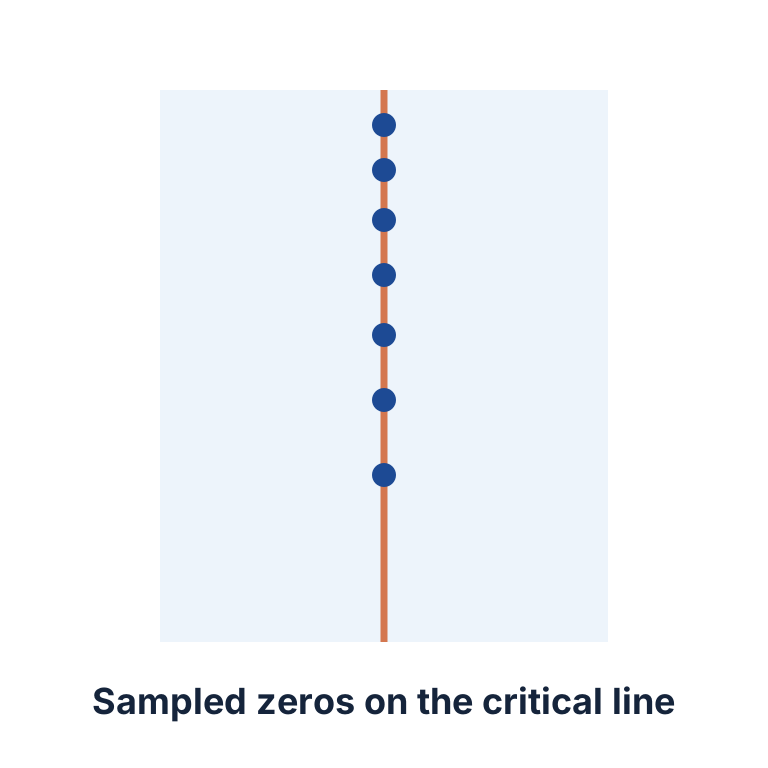
Problem. Every nontrivial zero \(\rho\) of the analytically continued Riemann zeta function satisfies \(\operatorname{Re}(\rho)=\tfrac{1}{2}\).
Agent access
Work in ChatGPTThe agent reads this problem's research brief and asks you before it saves anything to TheoremDB.
Definitions and notation
1Context
The hypothesis connects the zeros of the zeta function with the distribution of prime numbers.
2Definitions
Definition 1 (For real part of s greater than 1, the Riemann zeta function). For real part of s greater than 1, the Riemann zeta function is defined by zeta(s) = sum over positive integers n of n^(-s), and it has a meromorphic continuation to the complex plane.
Definition 2 (The nontrivial zeros). The nontrivial zeros are the zeros other than those at the negative even integers.
3What counts as a solution
- Give a proof that every nontrivial zero has real part 1/2, or exhibit and rigorously verify a nontrivial zero whose real part differs from 1/2.
1Status
Saved packet · July 31, 2026
Saved packet status (Dated status and exact unresolved remainder). Unresolved in this packet after the dated source check. Strongest checked result: Platt and Trudgian rigorously verified every zero with 0<gamma<=3*10^12 lies on the critical line and is simple. Exact unresolved remainder: Prove every nontrivial zero has real part 1/2, or rigorously exhibit one off the line.[1][2]
1Packet records
Recent contributions
Saved work that is not yet in the reviewed packet, one entry per attempt.
Notes and companion material
Original intake status. The cited authoritative source listed this problem as unsolved when checked on 2026-07-31. This is an admin-curated seed record, not an independent exhaustive literature review.
- Consult the cited official problem description for the full technical background and prize conditions.
Recorded example 1. The zeros at -2, -4, -6, and the remaining negative even integers are trivial zeros and are outside the claim.
Computational notes
- Numerical verification of finitely many zeros is evidence about a bounded range and does not settle the universal statement.
2See also
- Improve the upper exponent for the longest Pierce remainder chainanalytic number theory
- Cramér's prime-gap conjectureanalytic number theory
- Optimal Gaussian Rank-One Loewner Threshold for the Riemann Theta Kernelanalytic number theory
Contribute to this problem
Cite this problem statement
Cite the original sources separately.
“Riemann hypothesis.” TheoremDB. P31. Problem statement; statement text SHA-256 c6b88a26d3f4f601b16bc8b17dd78849efc0a89857275f4c8f8e207b9f55b530. https://theoremdb.org/statement/?ref=P31
@misc{theoremdb-problem-c6b88a26d3f4f601b16bc8b17dd78849efc0a89857275f4c8f8e207b9f55b530,
  title = {{Riemann hypothesis}},
  howpublished = {TheoremDB},
  note = {Problem statement; statement text SHA-256 c6b88a26d3f4f601b16bc8b17dd78849efc0a89857275f4c8f8e207b9f55b530},
  url = {https://theoremdb.org/statement/?ref=P31}
}
Plain text: Built Markdown snapshot
This problem includes 2 records joined by 2 typed links, sourced from claymath.org[1], current as of July 31, 2026.
1References
- Packet source. Clay Mathematics Institute, Riemann Hypothesis, official Millennium Prize Problem page, checked 2026-08-01. Official Problem Description by E. Bombieri; listed under Unsolved Millennium Prize Problems. ↗website · primary source · checked 2026-07-31Source use: original summary.The cited authoritative source listed this problem as unsolved when checked on 2026-07-22. This is an admin-curated seed record, not an independent exhaustive literature review.Also cited at Unsolved label and official problem description.Also cited at Editorial research route recorded 2026-07-31.Source used to formulate or check the problem record.Source used to assess the problem's recorded status.Provides the authoritative current status and exact target.Source named by the research packet.
- Dave Platt and Tim Trudgian, “The Riemann hypothesis is true up to 3·1012”. Bulletin of the London Mathematical Society 53(3) (2021), 792-797. DOI 10.1112/blms.12460. Abstract and main theorem. ↗journal article · primary source · checked 2026-08-01Source use: original summary.Rigorous finite-height verification and simplicity result.
An original CC0 restatement prepared by TheoremDB maintainers.
Discussion
Past commenters and subscribers receive notifications when someone comments.