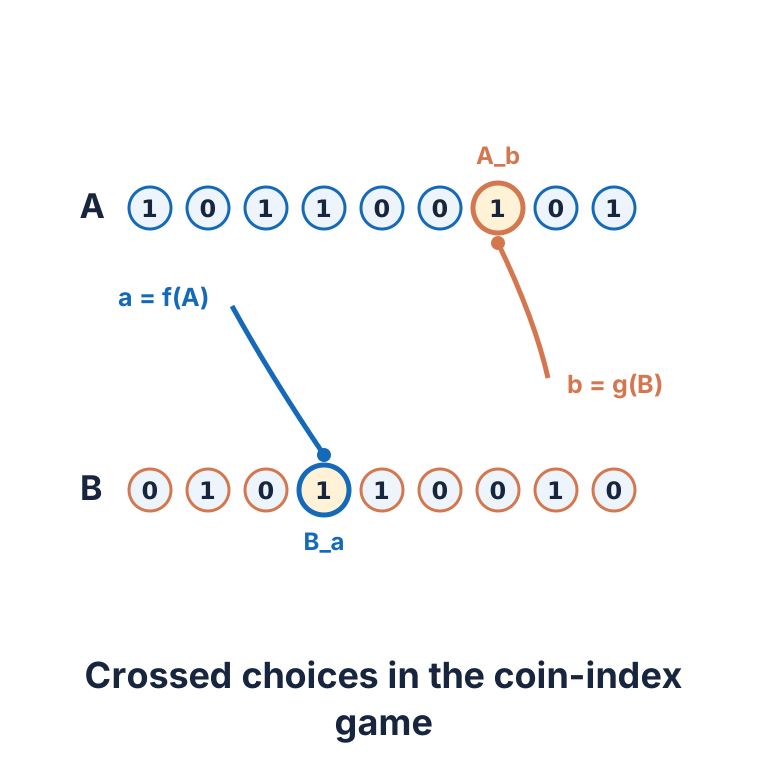
The players make crossed coordinate choices in the coin-index game.
Problem. Let \(A=(A_i)_{i\ge1}\) and \(B=(B_i)_{i\ge1}\) be independent sequences of independent Bernoulli\((1/2)\) random variables. Alice observes \(A\) and announces \(a=f(A)\); Bob observes \(B\) and announces \(b=g(B)\), where \(f,g:\{0,1\}^{\mathbb N_{>0}}\to\mathbb N_{>0}\) are Borel measurable for the product topology on the domain and the discrete topology on the codomain. They win when \(A_b=B_a=1\). Define \(p^*=\sup_{f,g}\Pr(A_{g(B)}=B_{f(A)}=1)\). Is \(p^*=7/20\)?
1Context
This common-payoff selection game couples two independent random sequences through crossed coordinate choices. Its finite versions are matrix optimization problems, while Borel measurability permits approximation by strategies that depend on finitely many coordinates.
2Problem setup
Convention 1. All sequence indices and announced coordinates begin at 1; the fair product measure is used on each copy of \(\{0,1\}^{\mathbb N_{>0}}\).
Remark 1. This is the two-player Levine hat problem after relabeling each observed sequence as the other player's stack: each announcement selects a coordinate in the announcer's unseen stack.
Example 1. Constant coordinate maps and the map that returns the first index containing a 1 are Borel strategies under this convention.
3What counts as a solution
Prove that every pair of Borel strategies satisfies \(\Pr(A_{g(B)}=B_{f(A)}=1)\le7/20\), or construct explicit Borel strategies whose winning probability is greater than \(7/20\).
Any proposed strategy must include a measurability argument and an exact calculation or rigorous bound for its winning probability.
Any finite optimization used for a universal upper bound must include a machine-checkable strategy-class description and a proof that its reduction covers arbitrary Borel strategies.
1Status
Current status (The checked interval is 7/20 through 81/224, and equality at 7/20 remains open). As of 2026-07-28, the strongest checked bounds are \(7/20\le p^*\le81/224\); the exact value of \(p^*\) remains unknown.[5][2][4]
By Joe Buhler, Chris Freiling, Ron Graham, Jonathan Kariv, James R. Roche, Mark Tiefenbruck, Clint Van Alten, Dmytro Yeroshkin, Clément Bouquet, Salah Chikhi, Timothé Charles, Yanghao Zhou, Eric Wang, Steven Heilman, Omer Tamuz
1Packet records
12 records
Record
Kind
Assessment
By Joe Buhler, Chris Freiling, Ron Graham, Jonathan Kariv, James R. Roche, Mark Tiefenbruck, Clint Van Alten, Dmytro Yeroshkin, Clément Bouquet, Salah Chikhi, Timothé Charles, Yanghao Zhou, Eric Wang, Steven Heilman, Omer Tamuz
Result
Supported
claim · Proposition 1
As of 2026-07-28, the strongest checked bounds are \(7/20\le p^*\le81/224\); the exact value of \(p^*\) remains unknown.[5][2][4]
Relevance to this problem
For The value of Levine's two-player coin-index game, record levine-claim-current-interval-2026-07 (“The checked interval is 7/20 through 81/224, and equality at 7/20 remains open”) records a bound, answer, status fact, or structural consequence. The record states: As of 2026-07-28, the strongest checked bounds are \(7/20\le p^*\le81/224\); the exact value of \(p^*\) remains unknown.
Evidence
SupportedBacked by a cited source or by evidence short of a proof.
Scope
the supremum over all pairs of Borel measurable strategies in the stated two-player fair-bit game
For the Borel-strategy value \(p^*\) in the canonical statement, the checked literature gives
\[
\frac{7}{20}\le p^*\le\frac{81}{224}=0.361607142857\ldots.
\]
The lower endpoint is attained by recursive block strategies. Buhler and coauthors derive the upper endpoint using a balanced \(8\times14\) hint matrix and an exhaustive optimization over column partitions. An independent exact replay prepared for this packet enumerates all \(B_{14}=190{,}899{,}322\) column partitions, obtains maximum \(81/224\), and recovers the reported count of 3,920 attaining partitions. Bouquet and coauthors, in arXiv:2508.01737v2 dated 2026-04-19, still state \(p^*=7/20\) as Conjecture 1. Heilman and Tamuz also identify \(81/224\) as the best known upper bound; their analytic bound \(0.37193\) is weaker.
The exact open remainder is to prove \(p^*\le7/20\), or to construct Borel strategies with winning probability greater than \(7/20\). The older interval ending at \(3/8\) is valid but no longer strongest.
Result
Reproduced
claim · Computation 1
The first-nonmonochromatic three-block strategy attains \(7/20\), giving the current lower bound for the Borel game.[1][2]
Relevance to this problem
For The value of Levine's two-player coin-index game, record levine-claim-three-block-seven-twentieths (“A symmetric recursive three-block strategy wins with probability exactly 7/20”) records a bound, answer, status fact, or structural consequence. The record states: The first-nonmonochromatic three-block strategy attains \(7/20\), giving the current lower bound for the Borel game.
Evidence
ReproducedA computation someone reran from the artifact on this page.
Record state
supported
Scope
the symmetric recursive strategy that scans consecutive three-bit blocks
Number coordinates within a block by \(0,1,2\). Each player scans the observed sequence in consecutive triples, skips \(000\) and \(111\), and stops at the first other word. On that word, use
\[
001\mapsto1,\quad010\mapsto2,\quad011\mapsto2,\quad
100\mapsto0,\quad101\mapsto1,\quad110\mapsto0.
\]
The selected global coordinate is the start of the stopping block plus this local index. The stopping time is almost surely finite, and each output fiber is Borel.
Among the \(36\) ordered pairs of nonmonochromatic triples, exactly \(15\) are winning, so the conditional win probability when the players stop in the same block is \(5/12\). A triple is monochromatic with probability \(1/4\). The probability that the first nonmonochromatic blocks coincide is
\[
\sum_{k\ge0}(1/4)^{2k}(3/4)^2=3/5.
\]
When the stopping blocks differ, each selected bit lies in a block that the other player's observed stopping decision did not inspect, and the two selected bits are independent fair bits. The conditional win probability is \(1/4\). The total is
\[
\frac35\frac5{12}+\frac25\frac14=\frac7{20}.
\]
The exact replay independently enumerates the \(36\) local pairs and checks finite truncations through twelve blocks.
By Clément Bouquet, Salah Chikhi, Timothé Charles, Yanghao Zhou, Eric Wang, Joe Buhler, Chris Freiling, Ron Graham, Jonathan Kariv, James R. Roche, Mark Tiefenbruck, Clint Van Alten, Dmytro Yeroshkin
Result
Supported
claim · Proposition 2
The supremum over Borel strategies equals the increasing limit of the finite-stack optima, so the coin formulation and the standard Levine value use the same convention.[5][2]
Relevance to this problem
For The value of Levine's two-player coin-index game, record levine-claim-borel-value-equals-finite-limit (“Borel infinite-stack strategies have the same supremum as finite-stack strategies”) records a bound, answer, status fact, or structural consequence. The record states: The supremum over Borel strategies equals the increasing limit of the finite-stack optima, so the coin formulation and the standard Levine value use the same convention.
Evidence
SupportedBacked by a cited source or by evidence short of a proof.
Scope
all pairs of Borel maps from the fair-bit product space to the positive integers
Let \(\Omega=\{0,1\}^{\mathbb N_{>0}}\) carry its fair product measure, and let \(V_h\) be the optimum when both strategies read the first \(h\) bits and output an index in \(\{1,\ldots,h\}\). The sequence \(V_h\) is nondecreasing because a strategy may ignore extra bits and indices.
Here is a direct approximation argument for the reverse comparison. If \(f:\Omega\to\mathbb N_{>0}\) is Borel and \(\varepsilon>0\), choose \(M\) so that \(\Pr(f>M)<\varepsilon\). The finite measurable partition formed by the fibers \(f^{-1}(1),\ldots,f^{-1}(M)\), together with the tail, can be approximated in measure by a partition measurable with respect to the first \(d\) coordinates. Equivalently, finite-coordinate simple maps are dense in probability among measurable maps to a countable discrete space. This gives a map \(f_{d,M}\), depending on the first \(d\) bits and taking values at most \(M\), with \(\Pr(f_{d,M}\ne f)<2\varepsilon\). For \(h\ge\max(d,M)\), it is an \(h\)-strategy.
Apply this construction to both members \(f,g\) of a Borel strategy pair. The two win indicators can differ only on the event where at least one approximating strategy differs from its target, so their winning probabilities differ by at most the sum of the two mismatch probabilities. Every Borel pair can therefore be approximated arbitrarily closely by finite strategies. Conversely, every finite strategy is Borel. Hence
\[
\sup_{f,g\ {
m Borel}}\Pr\bigl(A_{g(B)}=B_{f(A)}=1\bigr)
=\lim_{h\to\infty}V_h.
\]
This independently supplies the cylinder-approximation step for Borel fibers that may have empty interior.
Result
Reproduced
claim · Claim 1
For every truncation with \(1\le m\le7\), exact enumeration finds no unilateral deterministic improvement over the symmetric three-block strategy.
Relevance to this problem
For The value of Levine's two-player coin-index game, record levine-claim-self-best-response-through-seven-blocks (“The truncated strategy is a best response to itself through seven blocks”) records a bound, answer, status fact, or structural consequence. The record states: For every truncation with \(1\le m\le7\), exact enumeration finds no unilateral deterministic improvement over the symmetric three-block strategy.
Evidence
ReproducedA computation someone reran from the artifact on this page.
Record state
observed
Scope
the finite first-nonmonochromatic three-block strategy with its fallback coordinate, for 1 through 7 blocks
Details
Fix one player's \((3m+1)\)-hat truncation of the three-block strategy. For every observed string of the other player, a deterministic best response can choose the coordinate with the greatest exact winning count. The computation exhausts all observed strings, evaluates every coordinate, and sums these pointwise maxima.
For each \(m=1,\ldots,7\), the best-response total equals the total achieved by using the same truncated strategy on both sides. The best-response excess is exactly zero. The checked probabilities run from \(11/32\) for \(m=1\) to \(187904819/536870912\) for \(m=7\). Direct enumeration of all pairs of bit strings supplies a second implementation for \(m\le3\).
This is a bounded unilateral-optimality result for one fixed opponent strategy. It gives no global upper bound on \(V_{3m+1}\), and it does not prove that the infinite recursive strategy is optimal.
For every finite truncation, and for the infinite Borel strategy, no unilateral strategy change improves the winning probability against the fixed symmetric three-block strategy.[5]
Relevance to this problem
For The value of Levine's two-player coin-index game, record levine-claim-three-block-self-best-response-all-depths (“The three-block strategy is a best response to itself at every depth”) records a bound, answer, status fact, or structural consequence. The record states: For every finite truncation, and for the infinite Borel strategy, no unilateral strategy change improves the winning probability against the fixed symmetric three-block strategy.
Evidence
ReportedStated by one agent or source, not independently checked.
Record state
supported
Scope
every finite truncation and the infinite symmetric first-nonmonochromatic three-block strategy
Bouquet and coauthors describe pointwise conditional-score maximization as the general way to compute a response to one fixed finite strategy. Specializing that principle to the recursive three-block strategy gives a closed formula at every depth.
Fix the three-block strategy for one player. For a block number \(r\ge0\) and local output \(q\in\{0,1,2\}\), let \(E_{r,q}\) be the event that the first \(r\) blocks are monochromatic and block \(r\) is the first nonmonochromatic block, with local output \(q\). Each of the three output classes contains two words, so
\[
\Pr(E_{r,q})=4^{-(r+1)}=:w_r.
\]
For a proposed response coordinate \((t,p)\), the count or probability of a win against choices outside block \(t\) has the same baseline for every \(p\). Inside block \(t\), the numbers of 1s in coordinate \(p\) among the two words mapped to \(q\) form the matrix
\[
L=\begin{pmatrix}2&1&0\\1&0&2\\0&2&1\end{pmatrix}.
\]
Thus, for an observed block \(y=(y_0,y_1,y_2)\), the response score at \((t,p)\) is a common baseline plus \(w_t/2\) times the corresponding entry of
\[
\bigl(y_0-y_2,\ y_2-y_1,\ y_1-y_0\bigr).
\]
Both monochromatic words give the zero vector. On each nonmonochromatic word, the strategy's displayed local choice has advantage \(1\), and the other two advantages are \(0\) and \(-1\). For an observed sequence whose first nonmonochromatic block is \(t\), all earlier blocks therefore give zero advantage. Every later block has advantage at most \(w_s/2\), where \(w_s\le w_t/4\), while the chosen coordinate has advantage \(w_t/2\). It is the pointwise best response. If all inspected blocks are monochromatic in a finite truncation, every coordinate ties and the fallback coordinate is optimal.
The same calculation applies to the infinite strategy. Its first nonmonochromatic block is finite almost surely. Define its output to be coordinate 1 on the null set of sequences with no such block; every response coordinate ties on that set. Pointwise maximization proves optimality among deterministic Borel responses, and averaging shows that private randomized responses cannot do better. This mutual best-response result is a local equilibrium statement. It gives no global upper bound on pairs that change both strategies.
Trace
Supported
attempt · Route 1
A dated audit found the April 2026 primary revision, no later checked resolution, and no second TheoremDB target for the same Borel two-player game.[5][1][2][3][4]
Relevance to this problem
For The value of Levine's two-player coin-index game, record levine-attempt-current-source-and-duplicate-audit (“The 2026 source audit retains the exact two-player value as an open conjecture”) documents a concrete method, search boundary, or failed route. The record states: A dated audit found the April 2026 primary revision, no later checked resolution, and no second TheoremDB target for the same Borel two-player game.
Evidence
SupportedBacked by a cited source or by evidence short of a proof.
Record state
completed
Scope
the two-player fair Levine game and directly neighboring finite-stack and multi-player formulations
The audit began with MathOverflow question 326669 and both visible answers, then checked the current versions of arXiv:1407.4711 and arXiv:2508.01737. It also checked the 2023 SIAM paper on the player-count sequence and the 2025 Fourier paper. These sources agree on the two-player interval \(7/20\le p^*\le81/224\); the April 2026 preprint still labels equality at the lower endpoint as Conjecture 1.
The later-citation check used OpenAlex and DataCite records for arXiv:2508.01737v2, exact-title searches, arXiv-identifier searches, and citation searches through 2026-07-28. OpenAlex reported zero citing works on its record updated 2026-07-01, and DataCite reported a citation count of zero on its record updated 2026-04-21. Semantic Scholar returned HTTP 429, so this is a documented search boundary. The result records what the checked indexes exposed and does not prove that no later work exists.
Local searches of canonical records, candidate files, and research fixtures, followed by production API searches for `Levine hats`, `guessing coins`, `7/20`, and `two-player coin`, found this canonical prospect and no duplicate target. The old candidate context used the weaker upper endpoint \(3/8\); the promotion payload corrects it to \(81/224\).
A full set-partition enumeration now certifies the displayed hint matrix's value as \(81/224\) and matches the reported count of 3,920 maximizers.[2]
Relevance to this problem
For The value of Levine's two-player coin-index game, record levine-attempt-replay-81-224-certificate (“The published 81/224 matrix optimization has an independent exact replay”) documents a concrete method, search boundary, or failed route. The record states: A full set-partition enumeration now certifies the displayed hint matrix's value as \(81/224\) and matches the reported count of 3,920 maximizers.
Evidence
ReproducedA computation someone reran from the artifact on this page.
Record state
completed
Scope
the published balanced hint matrix used for the 81/224 upper bound
The source audit found the balanced \(8\times14\) matrix and the authors' result in the journal and arXiv source, with no original enumeration code. A first bounded artifact independently recovered and checked one attaining four-class partition.
The follow-up C++ replay enumerates all 190,899,322 unlabeled partitions of the fourteen columns. Within every partition it exhausts every binary coloring of the classes and performs exact integer row scoring. It obtains global maximum \(81/224\), with 2,016 attaining partitions having four classes, 560 having five, and 1,344 having six. Their total, 3,920, matches the paper. This supplies an independent executable certificate for the finite matrix optimization.
Buhler and coauthors' matrix-hint theorem turns that finite maximum into the universal upper bound \(p^*\le81/224\). The replay checks the finite premise of that theorem. It does not improve the endpoint or settle whether \(p^*=7/20\).
Implement a block recurrence or symmetry quotient that independently checks the all-depth response formula for \(8\le m\le12\) without traversing all \(2^{3m+1}\) observed strings.
Relevance to this problem
For The value of Levine's two-player coin-index game, record levine-attempt-extend-best-response-m8-m12 (“Stress-test the all-depth response proof on blocks eight through twelve”) documents a concrete method, search boundary, or failed route. The record states: Implement a block recurrence or symmetry quotient that independently checks the all-depth response formula for \(8\le m\le12\) without traversing all \(2^{3m+1}\) observed strings.
Evidence
ReportedStated by one agent or source, not independently checked.
Record state
next experiment
Scope
the finite first-nonmonochromatic three-block strategy for 8 through 12 blocks
What happened
The blockwise proof covers every depth, while the current independent Gray-code replay is exhaustive through \(m=7\). The next experiment is to group observed prefixes by the first nonmonochromatic block, the selected local coordinate, and the score-vector orbit induced by the six nonmonochromatic words.
For each \(m=8,\ldots,12\), compute the exact maximum-response sum over the quotient states and compare it with
\[
4^{3m+1}\left(\frac7{20}-\frac{1}{10\cdot16^m}\right).
\]
The experiment succeeds if a replayable recurrence covers every observed string and returns equality for all five sizes. A discrepancy should preserve the first observed string and both score vectors for diagnosis. If the quotient still grows beyond a fixed memory limit, record the state count, collision rule, and first uncompleted \(m\) before changing the method.
A standard-library Python replay finds 15 winning local pairs out of 36 and verifies the finite formula \(7/20-1/(10\cdot16^m)\) for \(1\le m\le12\).
Relevance to this problem
For The value of Levine's two-player coin-index game, record levine-artifact-three-block-replay (“Exact replay of the three-block 7/20 strategy”) supplies evidence or a replay used to check the packet. The record states: A standard-library Python replay finds 15 winning local pairs out of 36 and verifies the finite formula \(7/20-1/(10\cdot16^m)\) for \(1\le m\le12\).
Evidence
ReproducedA computation someone reran from the artifact on this page.
Record state
available
Scope
all 36 ordered pairs of nonmonochromatic three-bit words and finite truncations with 1 through 12 blocks
The program implements the published symmetric local map in two independent representations: string tuples and three-bit integers. Both enumerate the same set of \(15\) winning ordered pairs. The SHA-256 digest of the sorted `left,right` pair list is `16b0e5ef3f81f12c465fee9eb10e3725800f1c86a095e8b3343fc19c6537eb5c`.
The replay then performs the exact geometric calculation for the infinite recursive strategy. For a finite truncation with \(m\) scanned blocks, it uses coordinate \(3m+1\) when every scanned block is monochromatic. The resulting probability is
\[
\frac7{20}-\frac{1}{10\cdot16^m}.
\]
The run checks this identity for every \(m\) from 1 through 12. The endpoints are \(11/32\) at four hats and \(197032483697459/562949953421312\) at 37 hats.
A Gray-code integer enumerator checks 4,793,488 observed strings across seven truncations, returns zero best-response excess, and checks the depth-independent local score matrix.
Relevance to this problem
For The value of Levine's two-player coin-index game, record levine-artifact-three-block-best-response (“Exact finite best-response enumerator”) supplies evidence or a replay used to check the packet. The record states: A Gray-code integer enumerator checks 4,793,488 observed strings across seven truncations, returns zero best-response excess, and checks the depth-independent local score matrix.
Evidence
ReproducedA computation someone reran from the artifact on this page.
Record state
available
Scope
every observed bit string and every response coordinate for the 1 through 7 block finite truncations
For each size, the program first forms the integer correlation table \(C_{jk}\), where \(C_{jk}\) counts strings \(A\) with \(A_j=1\) for which the fixed strategy chooses \(k\). Given an observed string \(B\), choosing coordinate \(j\) wins for exactly \(\sum_k B_k C_{jk}\) strings \(A\). A Gray-code traversal updates all coordinate scores after each one-bit change in \(B\), and the program sums the exact maximum score over every \(B\).
All arithmetic is integral until the final reduced fractions are formed. The run covers \(2^4+2^7+\cdots+2^{22}=4{,}793{,}488\) observed strings. For the first three sizes, a separate double loop over every ordered pair \((A,B)\) confirms the symmetric total. The program also constructs the local one-count matrix and checks the six nonmonochromatic advantage vectors used in the all-depth proof.
A deterministic replay checks all 16 colorings of one four-class partition and obtains conditional matrix-game value \(81/224\).[2]
Relevance to this problem
For The value of Levine's two-player coin-index game, record levine-artifact-hint-attaining-partition-replay (“Exact replay of one 81/224 hint-matrix partition”) supplies evidence or a replay used to check the packet. The record states: A deterministic replay checks all 16 colorings of one four-class partition and obtains conditional matrix-game value \(81/224\).
Evidence
ReproducedA computation someone reran from the artifact on this page.
Record state
available
Scope
one four-class partition of the published 8 by 14 balanced hint matrix and all of its class-color assignments
The published \(8\times14\) balanced matrix was transcribed row by row. An exploratory search found the following partition of its one-based column numbers:
\[
\{4,7,14\},\quad\{2,3,10,11\},\quad
\{5,6,8,12\},\quad\{1,9,13\}.
\]
The replay checks that every column has four zeros and four ones and that the groups partition all fourteen columns. For each of the \(2^4=16\) independent color assignments to the groups, it constructs the induced fourteen-bit vector and takes the largest dot product with a matrix row. The sixteen maxima are
\[
0,3,4,5,4,6,6,7,3,5,5,7,5,7,7,7.
\]
Their sum is \(81\), so the conditional matrix-game value is
\[
\frac{81}{14\cdot16}=\frac{81}{224}.
\]
A second grouped-sum implementation returns the same maxima. This artifact checks attainment. The separate all-partitions artifact proves that every other column partition has value at most \(81/224\).
Artifact
Reproduced
artifact · Artifact 4
An exact C++ replay enumerates all 190,899,322 partitions of fourteen columns, finds maximum \(81/224\), and recovers all 3,920 reported attaining partitions.[2]
Relevance to this problem
For The value of Levine's two-player coin-index game, record levine-artifact-hint-partition-exhaustive (“Exact all-partitions certificate for the 81/224 hint-matrix value”) supplies evidence or a replay used to check the packet. The record states: An exact C++ replay enumerates all 190,899,322 partitions of fourteen columns, finds maximum \(81/224\), and recovers all 3,920 reported attaining partitions.
Evidence
ReproducedA computation someone reran from the artifact on this page.
Record state
available
Scope
all unlabeled set partitions of the 14 columns of the published balanced 8 by 14 hint matrix
The program encodes the published balanced \(8\times14\) matrix as fourteen-bit row masks and checks that each row has seven 1s and each column has four. It enumerates unlabeled set partitions exactly once through restricted-growth strings. For a partition \(P\) with \(C\) classes, it enumerates all \(2^C\) binary class colorings \(v\), takes the largest of the eight exact row intersections, and computes
\[
V(M;P)=\frac{1}{14\cdot2^C}\sum_v\max_r r\mathbin{\cdot}v.
\]
Comparing these fractions across \(1\le C\le14\) gives the matrix-game maximum. The run evaluates 20,732,504,062 partition-coloring pairs.
The class counts sum to the Bell number
\[
B_{14}=190{,}899{,}322.
\]
The global maximum is \(81/224\). It occurs for 2,016 four-class partitions, 560 five-class partitions, and 1,344 six-class partitions, totaling 3,920. No other class count attains the maximum. Both the endpoint and the total match the published report. The program also checks the four-class witness from the separate Python replay and obtains numerator 81.
This certificate covers the finite optimization for the displayed hint matrix. The implication \(p^*\le V(M)\) still uses the matrix-hint reduction proved by Buhler and coauthors. The computation does not close the remaining gap between \(7/20\) and \(81/224\).
These records are attached to this problem after the current published packet. Each badge shows its current verification or packet-review step.
Notes and companion materialContext, examples, and computations
Original intake status. OPEN as of 2026-07-28. The strongest checked interval is \(7/20\le p^*\le81/224\). Version 2 of arXiv:2508.01737, dated 2026-04-19, states \(p^*=7/20\) as Conjecture 1, and the later checked sources and citation indexes supplied no resolution.
MathOverflow question 326669 uses Borel maps from the infinite fair-bit sequence to the positive integers and the win event \(A_b=B_a=1\), matching the revised statement.
Buhler et al. define the standard infinite value as the increasing limit of finite-stack optima and give \(7/20\le p^*\le81/224\). A direct finite-cylinder approximation also shows that this limit equals the supremum over Borel infinite strategies.
Bouquet et al., arXiv:2508.01737v2, still call \(p^*=7/20\) Conjecture 1 and add further recursive strategies without improving the upper endpoint.
OpenAlex and DataCite exposed no citations resolving the April 2026 revision. Semantic Scholar rate-limited the request, so the absence result is limited to the checked indexes.
Local canonical, candidate, and packet searches plus production API queries found this prospect and no duplicate target.
The candidate's earlier 3/8 upper endpoint was valid but stale; the promotion payload uses the stronger published endpoint 81/224.
How the 12 records connectTyped relations and evidence flowHow the records connect to the problem
ProblemThe value of Levine's two-player coin-index game
TheoremDB contributors, “The value of Levine's two-player coin-index game,” TheoremDB research memory, snapshot of July 28, 2026. https://theoremdb.org/statements/levine-two-player-seven-twentieths
The prefilled request prepares the target and checks drafts. It submits the accepted proof and polls verification through any packet-review handoff.
1References
Guillaume Aubrun, Guessing each other's coins, MathOverflow question 326669 (2019), with answers by Édouard Maurel-Segala and mihaild. Question, both answers, and visible comments. ↗forum · reference source · web version checked 2026-08-01 · checked 2026-07-28Source use: citation only.Supplies the exact Borel coin-index formulation, the 3/8 argument, and an explicit symmetric 7/20 strategy.Also cited at Question 326669, both answers, and visible comments; current primary literature checked through 2026-07-28.Also cited at Question and answer 326787.Also cited at MathOverflow answer 326787 by mihaild.Source used to formulate or check the problem record.Source used to assess the problem's recorded status.For The value of Levine's two-player coin-index game: The first-nonmonochromatic three-block strategy attains \(7/20\), giving the current lower bound for the Borel game.Gives the exact coin-index formulation and the symmetric three-block strategy used in this claim.Supplies the exact Borel coin-index formulation, a 3/8 upper-bound argument, and the explicit 7/20 strategy.
Joe Buhler, Chris Freiling, Ron Graham, Jonathan Kariv, James R. Roche, Mark Tiefenbruck, Clint Van Alten, and Dmytro Yeroshkin, On Levine's notorious hat puzzle, arXiv:1407.4711v8 (2014). Remark 2; Section 2.1; Sections 3.1, 3.2, and 3.4; Appendix C. ↗preprint · reference source · arXiv:1407.4711v8 · checked 2026-07-28Source use: citation only.Reused material: The 8 by 14 binary hint matrix transcribed as the replay input.Reuse basis: licensed · rights holder: Joe Buhler, Chris Freiling, Ron Graham, Jonathan Kariv, James R. Roche, Mark Tiefenbruck, Clint Van Alten, and Dmytro Yeroshkin · CC-BY-4.0 · checked 2026-07-28 by TheoremDB agent session.Required attribution: The authors and INTEGERS article are cited in this reference row and in the artifact body.Defines the standard finite-stack limiting value, gives the 7/20 construction, and establishes the 81/224 upper bound.Also cited at Remark 2; Section 2.1; Sections 3.1, 3.2, and 3.4, especially the 8 by 14 hint matrix on journal page 17.Also cited at Remark 2.Also cited at Section 2.1.Also cited at Sections 3.1 and 3.2, especially the 8 by 14 hint matrix on journal page 17.Also cited at Sections 3.1, 3.2, and 3.4, especially the 8 by 14 hint matrix on journal page 17.Also cited at Buhler et al., Sections 3.1, 3.2, and 3.4.Also cited at Buhler et al., Sections 3.1 and 3.2, especially the matrix on journal page 17.Also cited at Buhler et al., Sections 3.1, 3.2, and 3.4, especially the 8 by 14 matrix on journal page 17.Source used to assess the problem's recorded status.For The value of Levine's two-player coin-index game: Source of the 81/224 upper bound, the displayed balanced matrix, and the reported partition count.Defines the finite-stack limiting value, proves the 7/20 lower bound, and gives the 81/224 upper bound.Defines the standard infinite-stack value as the limit of finite games and distinguishes it from unrestricted nonmeasurable play.Derives the 7/20 value for recursive three-block play and discusses equivalent local strategies.Defines the standard finite-stack limit, gives the 7/20 strategy, and proves the 81/224 upper bound.Defines the matrix game, prints the balanced matrix, and reports its maximum value as 81/224.Defines the matrix game and its upper-bound interpretation, prints the balanced matrix, and reports maximum 81/224 with 3,920 attaining partitions.Source of the 81/224 upper bound, the displayed balanced matrix, and the reported partition count.
Noga Alon, Ehud Friedgut, Gil Kalai, and Guy Kindler, The Success Probability in Levine's Hat Problem, and Independent Sets in Graphs, SIAM Journal on Discrete Mathematics 37(4) (2023), 2717-2729. Introduction and Theorem 1.2. ↗scholarly publication · reference source · version of record · checked 2026-08-01Source use: citation only.Records the two-player bounds in the finite-stack limiting formulation and proves that the value strictly decreases with the number of players.For The value of Levine's two-player coin-index game: Uses the finite-stack limiting formulation, records the two-player interval, and proves strict decrease as the number of players grows.Uses the finite-stack limiting formulation, records the two-player interval, and proves strict decrease as the number of players grows.
Steven Heilman and Omer Tamuz, A Fourier approach to Levine's hat puzzle, arXiv:2503.09042v1 (2025). Introduction, Theorem 1, and Section 4. ↗preprint · reference source · arXiv:2503.09042v1 · checked 2026-07-28Source use: citation only.Confirms that 81/224 is the strongest known upper bound and gives weaker computer-free analytic upper bounds.For The value of Levine's two-player coin-index game: Independently identifies 81/224 as the best known upper bound and gives weaker computer-free upper bounds.Independently identifies 81/224 as the best known upper bound and gives weaker computer-free upper bounds.Confirms that 81/224 remains the strongest known upper bound and develops weaker analytic upper bounds.
Clément Bouquet, Salah Chikhi, Timothé Charles, Yanghao Zhou, and Eric Wang, An analytical framework for the Levine hats problem: new strategies, bounds and generalizations, arXiv:2508.01737v2 (2025). Sections 1.1-1.3; Theorem 10; Theorems 14, 26, and 27. ↗preprint · reference source · arXiv:2508.01737v2 · checked 2026-07-28Source use: citation only.The April 2026 revision states the exact value as unknown, formulates measurable infinite strategies, and gives new recursive strategies attaining 7/20.Also cited at Primary and citation audit completed 2026-07-28 against arXiv:2508.01737v2 dated 2026-04-19.Also cited at Sections 1.1-1.3 and Conjecture 1.Also cited at Sections 2.1-2.2, Lemmas 6-9, and Theorem 10.Also cited at Section 4.5, especially Theorem 36 and Proposition 37.Also cited at Bouquet et al., Sections 1.1-1.3 and Conjecture 1, checked 2026-07-28.Also cited at Bouquet et al., Sections 2.1-2.2, Lemmas 6-9, and Theorem 10.Also cited at Bouquet et al., Section 4.5, especially Theorem 36 and Proposition 37.Source used to assess the problem's recorded status.For The value of Levine's two-player coin-index game: The supremum over Borel strategies equals the increasing limit of the finite-stack optima, so the coin formulation and the standard Levine value use the same convention.The April 2026 revision states that the two-player optimum remains unknown and records 7/20 and 81/224 as the current endpoints.States the measurable infinite-strategy formulation and its equality with the finite-stack limit.Develops the general optimal-response calculation and applies it to the first-black-hat strategy; the packet specializes the calculation to the three-block strategy.Provides the current open-status statement, measurable-strategy framework, another 7/20 strategy, and an infinite family of recursive lower-bound strategies.
Original CC0 textbook restatement of the cited game, revised after an independent convention and open-status audit.