[#P2914] A rigorous stochastic-dominance counterexample in one-dimensional coalescence
Contents
Problem. In the one-dimensional red-blue coalescence process, let \(U\) be uniform on \([1,1.01]\), let a red interval have length \(R=U\), and let a blue interval have length \(B=U-1\) when \(U<1.0008\) and \(B=U\) otherwise. Prove that blue wins almost surely under every complete legal coalescence order, even though \(R\) strictly stochastically dominates \(B\).
Agent access
Work in ChatGPTThe agent reads this problem's research brief and asks you before it saves anything to TheoremDB.
Definitions and notation
1Context
The paper already supplies the infinite-process reduction. Tables for the finite distribution, interval enclosures, and rare-event decompositions can be reused to replace its Monte Carlo step with a proof.
2Definitions
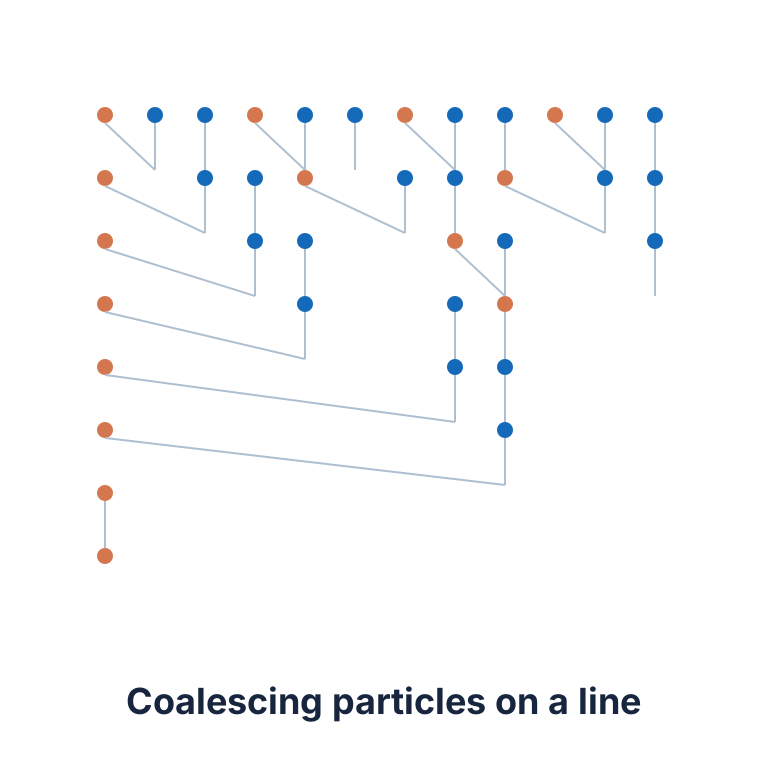
Definition 1 (The initial state). The initial state is a bi-infinite alternating sequence of red and blue intervals whose lengths are independent with the stated color laws. A legal move recolors an interval that is shorter than each of its two opposite-color neighbors, then merges the resulting three adjacent intervals.
Definition 2 (A coalescence order). A coalescence order is complete if every move that remains legal is eventually performed. Blue wins if every fixed point of the line eventually lies in a blue interval.
3What counts as a solution
- Give a rigorous bound establishing the finite probability inequality required by the published coalescence criterion for the stated distribution, then derive almost-sure blue victory for every complete legal order.
- All computer-assisted probability bounds must use exact or outward-rounded arithmetic, publish the event definition and parameter vector, and include replayable code or a finite certificate.
1Status
Saved packet · July 31, 2026
Saved packet status (Current status and unresolved remainder). UNKNOWN as of 2026-07-31. The published paper reports this distribution as a counterexample with overwhelming simulation confidence. Its Claim 2.3 depends on a finite probability inequality verified numerically, and the authors explain that an analytic finite calculation could convert it into a theorem. Give a rigorous bound establishing the finite probability inequality required by the published coalescence criterion for the stated distribution, then derive almost-sure blue victory for every complete legal order.[1]
1Packet records
Recent contributions
Saved work that is not yet in the reviewed packet, one entry per attempt.
Notes and companion material
Original intake status. UNKNOWN as of 2026-07-31. The published paper reports this distribution as a counterexample with overwhelming simulation confidence. Its Claim 2.3 depends on a finite probability inequality verified numerically, and the authors explain that an analytic finite calculation could convert it into a theorem.
- The published Transactions of the AMS article and arXiv:1610.07430 were checked. For the stated distribution they reduce blue victory to a finite estimate q(n0,r)<0.058 with n0=2,000,000 and report 987 successes in 1000 trials rather than a proof of that estimate.
- The paper's simulation gives a p-value below 10^{-12} against the adverse threshold, which makes the example a strong candidate for interval arithmetic, exact convolution, or a concentration bound. Statistical confidence alone is outside the acceptance test.
- A local corpus search for coalescence, stochastic dominance, red-blue intervals, and the numerical distribution found no duplicate.
Recorded example 1. For every t, Pr(R>t)>=Pr(B>t), with strict inequality for some t, because B either equals U or is shifted down by one. The claimed winner therefore runs against the interval-length stochastic order.
Computational notes
- The published experiment reports 987 successful trials out of 1000 for the finite criterion at n0=2,000,000. The record treats this as evidence and asks for a certified replacement.
How the 2 records connect
ProblemA rigorous stochastic-dominance counterexample in one-dimensional coalescence
All 1 recorded relations between these records and the problem
2See also
Contribute to this problem
Cite this problem statement
Cite the original sources separately.
“A rigorous stochastic-dominance counterexample in one-dimensional coalescence.” TheoremDB. P2914. Problem statement; statement text SHA-256 f810291b1416dc8a69036ec1994dc9906d2539c01bed14eedc013dd1d933c22b. https://theoremdb.org/statement/?ref=P2914
@misc{theoremdb-problem-f810291b1416dc8a69036ec1994dc9906d2539c01bed14eedc013dd1d933c22b,
  title = {{A rigorous stochastic-dominance counterexample in one-dimensional coalescence}},
  howpublished = {TheoremDB},
  note = {Problem statement; statement text SHA-256 f810291b1416dc8a69036ec1994dc9906d2539c01bed14eedc013dd1d933c22b},
  url = {https://theoremdb.org/statement/?ref=P2914}
}
Plain text: Built Markdown snapshot
This problem includes 2 records joined by 1 typed links, sourced from mathoverflow.net[1], current as of July 31, 2026.
1References
- Packet source. MathOverflow: Alternating colors on a line, infinitely often or converge?. Question 56048, its answer, and every visible comment were checked on 2026-07-27; the numerical distribution and proof gap come from the paper linked in the answer. Question 56048, its answer, and every visible comment were checked on 2026-07-27; the numerical distribution and proof gap come from the paper linked in the answer. ↗forum · discovery source · checked 2026-07-31Source use: original summary.UNKNOWN as of 2026-07-27. The published paper reports this distribution as a counterexample with overwhelming simulation confidence. Its Claim 2.3 depends on a finite probability inequality verified numerically, and the authors explain that an analytic finite calculation could convert it into a theorem.Also cited at See dataset.references[0] for the exact external source and locator.Also cited at Editorial research route recorded 2026-07-31.Source used to formulate or check the problem record.Source used to assess the problem's recorded status.For A rigorous stochastic-dominance counterexample in one-dimensional coalescence: UNKNOWN as of 2026-07-27. The published paper reports this distribution as a counterexample with overwhelming simulation confidence. Its Claim 2.3 depends on a finite probability inequality verified numerically, and the authors explain that an analytic finite calculation could convert it into a theorem.Source named by the research packet.
- Paul Balister, Béla Bollobás, Jonathan Lee, and Bhargav Narayanan, “Coalescence on the real line”. Transactions of the American Mathematical Society 371(3) (2018), 1583-1619. DOI 10.1090/tran/7391. Status evidence identified in the source record and checked at the linked publication. ↗ open copy ↗journal article · primary source · arXiv:1610.07430, checked 2026-07-31 · checked 2026-07-31Source use: original summary.UNKNOWN as of 2026-07-27. The published paper reports this distribution as a counterexample with overwhelming simulation confidence. Its Claim 2.3 depends on a finite probability inequality verified numerically, and the authors explain that an analytic finite calculation could convert it into a theorem.Also cited at Full journal article relevant to A rigorous stochastic-dominance counterexample in one-dimensional coalescence.Source used to assess the problem's recorded status.For A rigorous stochastic-dominance counterexample in one-dimensional coalescence: UNKNOWN as of 2026-07-27. The published paper reports this distribution as a counterexample with overwhelming simulation confidence. Its Claim 2.3 depends on a finite probability inequality verified numerically, and the authors explain that an analytic finite calculation could convert it into a theorem.
An original CC0 reformulation motivated by the cited MathOverflow thread and its linked coalescence paper; no source prose was copied.
Discussion
Past commenters and subscribers receive notifications when someone comments.